Published Date: December 10, 2025
Written By:Chirag Patel
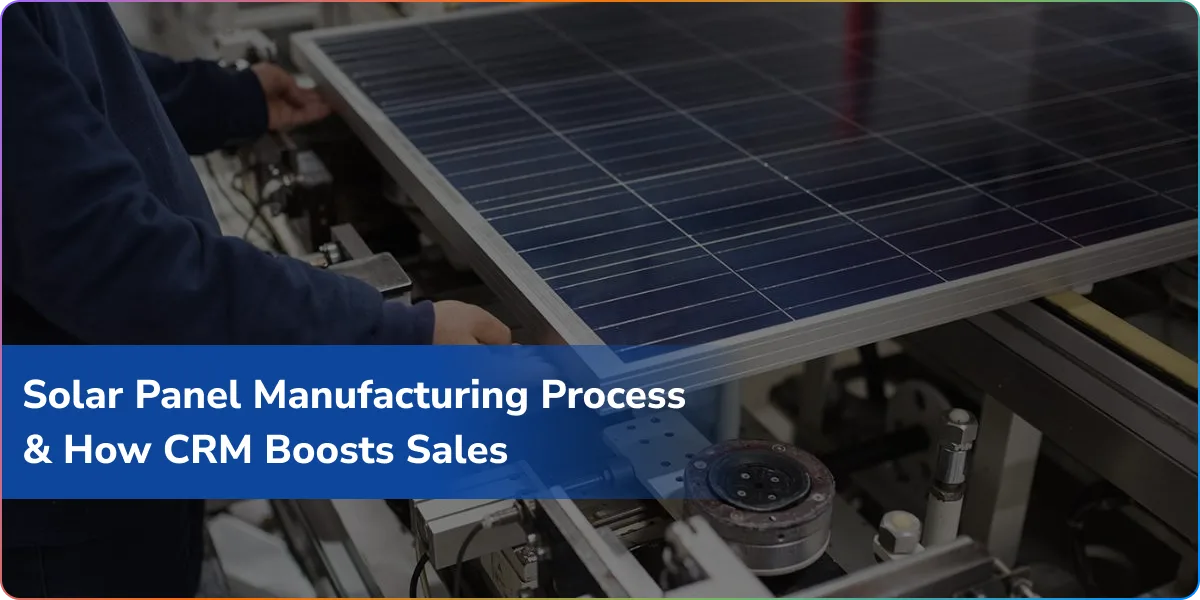
The solar industry is growing fast, and manufacturers are under pressure to manufacture quality panels quickly while managing sales, orders, inventory, and after-sales service. Understanding how to manufacture solar panel from pv cell manufacturing to final module assembly is crucial, so is having a robust CRM in an automobile-style system for the solar business.
In this blog, we will go through how to manufacture solar panel, photovoltaic cell manufacturing, solar panel production machine, and explain how Logixbuilt Solutions’ CRM helps solar companies manage that entire workflow efficiently.
1. Why Manufacturing and CRM Must Work Hand-in-Hand
Solar manufacturing covers not just the melting of silicon and assembly into modules via solar panel production machine, but is also a business challenge. Manufacturers must handle:
- Dealers and EPC partners
- Customer inquiries and leads
- Order placement and tracking
- Warranty claims and maintenance
- Inventory of raw materials, cells, and finished panels
Without a centralized system, these tasks are often scattered in spreadsheets, emails, or siloed ERP development solutions. That’s where a solar CRM built specifically for the industry becomes indispensable.
CRM development solutions for solar companies. A CRM for solar companies-like that from Logixbuilt Solutions-can bridge production and sales by:
- Following up leads from interested buyers, distributors, or installers
- Automate follow-ups and sales workflows
- Monitor production status of every solar module batch.
- Coordinating service, warranty, and installation teams
- Providing real-time visibility to inventory, sales, and quality
Thus, the CRM doesn’t just help sell — it integrates deeply into solar module manufacturing process.
2. Key Steps of the Solar Panel Manufacturing Process: Brief Overview
To appreciate how a CRM supports manufacturing, it helps to quickly recap how to manufacture solar panel at a high level. Here are the core phases:
- Purification of silicon: The raw silicon is refined to semiconductor-grade purity.
- Ingot creation – purified silicon is formed into ingots (mono- or polycrystalline).
- Wafer cutting: the ingots are sliced into thin wafers.
- Solar cell manufacturing / Photovoltaic cell manufacturing: Wafers are processed into cells with doped layers, contacts, and anti-reflective coating.
- Cell testing and sorting: cells are tested for efficiency and defects.
- Module Assembly solar module manufacturing process: Stringing, lamination, framing, junction box installation.
- Final quality testing includes electrical testing, thermal cycling, and reliability checks.
- Packing & shipping – the panels are packed and shipped out to customers or dealers
At every step, production data is generated, and this is where a powerful CRM for solar manufacturers makes all the difference.
3. How Logixbuilt Solutions’ CRM integrates with manufacturing
Here’s a detailed look at how a CRM specifically built for solar companies can support and optimize each step of the solar panel manufacturing process.
3.1 Lead to Order — Managing Demand Predictively
- When a distributor, installer, or corporate buyer shows interest, that inquiry enters the solar CRM.
The CRM captures lead information, which includes the following: requested capacity, panel type, monocrystalline / poly, and expected date of delivery.
- AI-enabled lead scoring, inside the CRM, can predict how serious the buyer is to help the sales force prioritize.
- Upon qualification, the CRM helps convert a lead into a sales order, thereby linking demand directly to production planning.
This ensures that the photovoltaic cell production line does not go blind because each and every inquiry, together with the confirmed orders, is immediately available.
3.2 Production Tracking & Transparency
The biggest challenge is knowing where each solar cell manufacturing batch currently sits in its lifecycle. Logixbuilt’s CRM offers:
- Batch-level tracking: Each lot of wafers or cells can be assigned a batch code. The CRM tracks its progress from ingot → wafer → cell → module.
- With custom software development: Managers will view in real time how many batches are in “cutting,” “doping,” “testing,” “laminating,” and “framing” stages.
- Quality hold alerts: When one lot fails some test, say micro-crack inspection or flash testing, the CRM flags it for production teams to isolate and rework.
- Inventory link: CRM automatically updates the inventory as batches progress: how many cells are ready, how many modules are laminated, how many are framed.
The integration enables seamless visibility into the solar module manufacturing process.
3.3 Order Fulfillment & Dispatch
After the quality checks of modules, orders have to be fulfilled and dispatched. The CRM helps in:
- Creating pick-lists based on confirmed orders
- Scheduling packaging and dispatch dates
- Coordinating with logistics partners
- sending shipping notifications to customers or dealers
Because it’s aware of what is in production, the CRM does not promise panels to buyers until the modules are actually ready — minimizing disappointments and delays.
3.4 After-Sales: Warranty, Maintenance & Service
Solar panels typically come with long warranties-10 to 25 years. Handling that demands a far better system:
- CRMs store warranty start dates, batch numbers, and serial.
- Service teams receive automated reminders from the solar CRM regarding the running of preventive checks for customers.
- If a customer raises a claim (say for micro-cracks or output drop), the CRM logs it, assigns a technician, and tracks the resolution.
- Service feedback is recorded that may be used for manufacturing improvement, such as if some batches have more problems.
This closes the loop from production to sales to service.
3.5 Analytics and Continuous Improvement
A modern CRM is more than just collecting data in one place; it’s actually an engine for powerful analytics. Logixbuilt’s CRM provides:
Yield analysis: How many wafers get converted into cells? What’s the efficiency of each batch?
- Sales vs. production forecasting: Based on the sales pipeline, predict how many modules need to be manufactured in the following quarter.
- Quality trends: Are certain batches failing more quality tests? How does that correlate with raw material or machine settings?
- Customer behavior: Which customers raise claims more often? What service problems recur?
These kinds of insights are crucial for the fine-tuning of solar cell manufacturing and enhanced output quality.
4. Why Solar Companies Should Invest in a Specialized CRM
A generic CRM might be useful at facilitating simple sales, but the solar business is different. Here’s why solar manufacturers need an auto-CRM-style system tailored for solar:
- Complex Production Workflow
Solar manufacturing involves several stages: ingot → wafer → cell → module. A regular CRM would not track the batches or test failures, much less quality metrics. Logixbuilt’s Solar CRM logs each stage and records necessary parameters.
- Long Warranty & Service Life-cycle
Solar panels aren’t just sold, but maintained over decades. While an industry-agnostic CRM may do poorly with regard to warranty tracking, a specialized solar CRM handles claims, preventive service, and follow-ups easily.
- Dealer and Installer Network
Many solar companies do not sell directly; rather, they go through installers, EPC firms, or distributors. The CRM centralizes lead routing, order tracking, and commissions.
- Regulatory and Manufacturing Compliance
Solar manufacturing often requires strict test records, such as thermal cycling and EL testing. A solar-specific CRM supports the storage and maintenance of compliance documents and test results.
- Scalable Forecasting
As solar businesses scale, you need predictive planning for production versus demand. With the proper CRM, you can forecast how many PV cells to produce, how many modules to assemble, and how much raw silicon to buy.
5. How Logixbuilt Solutions’ CRM Stands Out
Logixbuilt Solutions, known for building scalable and customized CRMs, brings special value to solar manufacturing with the following key features:
- Production Lifecycle Module: Provides tracking and storage of every step in the solar panel manufacturing process, from wafer to module.
- Batch & Quality Management: Allows detailed batch codes, test result logs, and automatic alerts for quality issues.
- Lead-to-Order Workflow: Captures leads (EPCs, installers, and corporate buyers) and ties directly to production planning.
- Service Management: Manages warranty, preventive maintenance, technician dispatch, and service history.
Inventory & Dispatch Control: keeping track of the stock of silicon wafers, PV cells, and finished modules; undertaking dispatch coordination.
- Customizable Dashboards: Offers PV cell manufacturing KPIs, production throughput, yield, sales performance, and service metrics.
- Analytics & Reporting – Uses AI or BI modules to predict demand, maximize quality, and monitor production bottlenecks.
Logixbuilt Solutions provides solar companies with a CRM designed for them, eliminating manual silos, fostering end-to-end efficiency, and empowering solar manufacturers to scale.
6. Addressing Challenges in Solar Panel Manufacturing Process with CRM
Here are common pain points in solar production — and how a CRM for solar manufacturing solves them:
| Challenge | How Solar CRM Helps |
| Fragmented data across sales, production, and service teams | Centralizes everything in one platform |
| Quality issues in manufacturing without traceability | Tracks test results per batch and flags defects |
| Inaccurate order fulfillment due to lack of production visibility | Makes real-time production status visible to sales & dispatch |
| Manual warranty claim tracking | Automates warranty logs, technician assignment, and tracking |
| Under- or over-stocking raw materials | Forecasting module helps align procurement with production needs |
7. Future of Solar Manufacturing + CRM
The solar panel manufacturing industry will be digitized even more in the future. Key trends wherein CRM will play a key role:
- AI-driven quality control: Automated image analysis of micro-cracks, EL (electroluminescence) testing integrated into CRM.
IoT Integration: Connect the production machines-wafer saws, and laminators to CRM for real-time data capture and predictive maintenance.
- Blockchain for Traceability: Apply blockchain through CRM to track every panel’s journey from silicon to shipping, which will enhance compliance and trust.
- Customer Portal: The CRM-powered portal will help customers track their order status, batch numbers, and even service requests.
- Sustainability Analytics: CRM tracks carbon footprint per batch, energy consumption per ingot, and helps manufacturers align with green goals.
Are you a solar manufacturer aiming to scale smarter?
Logixbuilt Solutions provides an integrated Solar CRM for solar companies to bridge the gap in solar panel manufacturing with sales, production, and service on one platform.
FAQ
How does CRM help track the solar panel manufacturing process?
A Solar CRM allows manufacturers to keep track of every batch produced in real time. Stages that include silicon cutting, cell manufacture, module assembly, lamination, and dispatch can be tracked. Miscommunication between departments is reduced, and timely delivery to dealers and EPC clients is assured.
Can CRM help manage dealer and distributor networks?
Yes, Logixbuilt's Solar CRM has dedicated modules for onboarding dealers, routing leads, tracking incentives, pricing tiers, and managing orders. The manufacturer can view dealer performance, pending orders, and real-time stock availability on a single dashboard.
Does CRM improve the after-sales service of a solar company?
Absolutely, any solar installation needs long-term support in terms of warranty and AMC tracking. A CRM automates service reminders, complaint logging, technician allocation, on-site updates, and customer communication to ensure a superior post-installation experience.
Is Logixbuilt Solutions' CRM customizable for different solar workflows?
Yes, each solar company has its own workflow. Logixbuilt Solutions customizes modules for production, sales, warehousing, AMC, service, and installation. Custom dashboards, automation rules, and integrations make sure the CRM fits your exact operations, the other way around.

Chirag Patel is the Chief Technology Officer at Logix Built Solutions Limited with 11+ years of experience in engineering scalable digital platforms. He specializes in CRM development, eCommerce solutions, and customer experience technologies designed to improve engagement, retention, and conversion. Chirag leads end-to-end product engineering with a strong focus on performance, automation, and architecture design, enabling businesses to deliver seamless digital experiences and achieve sustainable growth in competitive markets.