Published Date: November 20, 2026
Written By:Siddharth Pandya
Investment management has never suffered from a lack of data. If anything, investment teams often have more information than they can efficiently process. Financial statements, earnings calls, market signals, economic indicators, and alternative datasets all contribute to investment research. However, traditional research methods and analytical systems can struggle to keep pace when information is scattered across multiple platforms and decisions need to be made quickly.
The growing interest in AI in investment management reflects this challenge. According to a 2025 global survey by Grant Thornton and ThoughtLab, 73% of asset management executives consider AI critical to their organisation’s future. Yet, turning that ambition into measurable business value remains a challenge.
AI can support several stages of the investment lifecycle, including investment research, portfolio optimization, risk assessment, and client reporting. But adopting AI involves more than plugging a model into an existing system and expecting immediate improvements in investment performance. It requires the right technology, implementation strategy, and performance metrics.
This guide explores practical AI use cases, the technologies behind them, an implementation framework, and how investment firms can measure the actual ROI of AI adoption.
What is AI in Investment Management?
AI in investment management refers to the use of artificial intelligence to analyse financial data, identify patterns, generate insights, and support investment decisions. It works with structured data, such as stock prices, financial statements, and portfolio holdings, as well as unstructured information from earnings calls, market news, and regulatory filings.
Unlike traditional systems that rely heavily on predefined rules and manual inputs, AI can identify relationships across large datasets and generate updated insights as new information becomes available. For instance, it can evaluate company performance, flag unusual market movements, assess portfolio risks, and generate investment research summaries.
Traditional Investment Analytics vs. AI-Driven Investment Intelligence
Traditional investment analytics relies on historical data, spreadsheets, financial models, and predefined assumptions. Analysts typically gather information from multiple sources, review financial reports, and compare performance indicators before evaluating investment opportunities.
AI-driven investment intelligence helps streamline these activities by analysing large datasets, extracting information from financial documents, identifying patterns, and highlighting potential risks or opportunities. For example, an AI-powered system can summarize financial changes across multiple company reports, helping analysts compare performance without manually reviewing every document.
While traditional analytics depends heavily on manual analysis and predefined rules, AI helps investment teams process information faster and make more informed decisions.
Machine Learning, Generative AI, and AI Agents in Investment Management
- Machine Learning: Identifies market patterns, forecasts potential trends, and supports portfolio risk assessment.
- Generative AI: Summarizes financial reports, extracts insights, and assists with investment research.
- AI Agents: Coordinate multi-step workflows, from collecting market data to preparing portfolio reports.
Together, these technologies support different stages of the investment lifecycle. Machine learning identifies patterns, generative AI helps interpret financial information, and AI agents coordinate connected workflows. Their combined capabilities help investment professionals make better-informed decisions while retaining control over investment strategies and execution.
8 Practical AI Use Cases in Investment Management
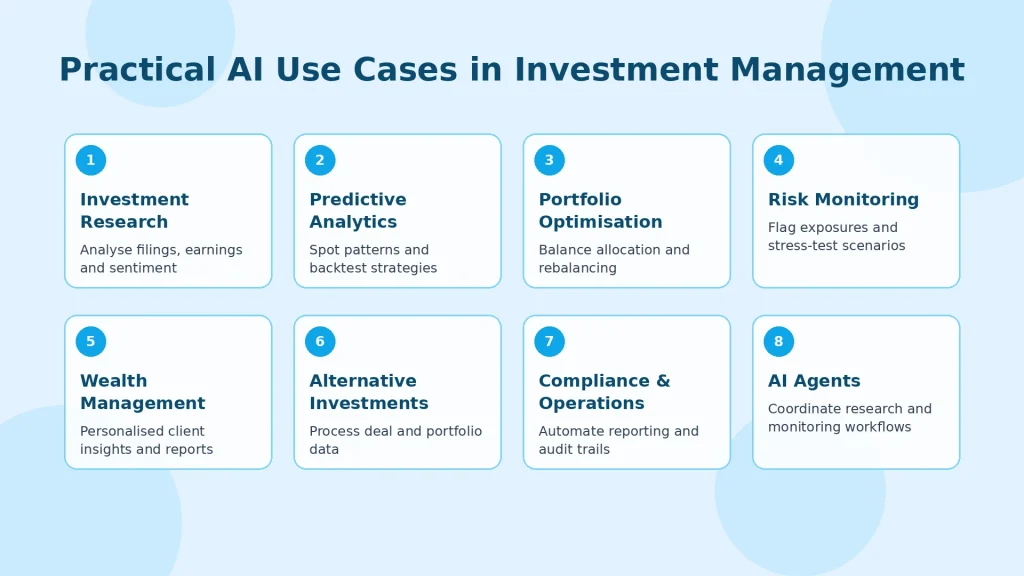
The value of AI becomes clearer when examining the activities behind investment decisions. From analysing financial documents to monitoring portfolio risks and evaluating private companies, AI can support several stages of the investment lifecycle. The following eight AI use cases in asset management cover investment research, portfolio management, wealth management, and investment operations.
1. AI-Powered Investment Research and Market Intelligence
Investment research involves reviewing earnings calls, annual reports, regulatory filings, analyst opinions, and financial news. AI can analyse information from these sources, extract relevant financial metrics, and compare company performance across reporting periods. Natural Language Processing (NLP) can also evaluate sentiment in earnings transcripts and news coverage to identify changes in management outlook, market perception, and business performance. This gives analysts a consolidated view of relevant information and reduces the time spent reviewing individual documents.
2. Predictive Analytics and Investment Strategy Development
Historical market data, economic indicators, trading volumes, and asset performance can help investment teams identify patterns that may influence future decisions. Predictive analytics models analyse these inputs to estimate potential price movements, assess volatility, and evaluate changing market conditions. Investment teams can also backtest an AI investment strategy against historical datasets to understand its performance under different market scenarios. These forecasts provide analytical signals rather than guarantees of future investment returns.
3. AI in Portfolio Management and Optimization
AI in portfolio management helps investment managers evaluate asset allocation, portfolio performance, and risk exposure. Models can analyse asset correlations, historical returns, investment objectives, and risk tolerance to suggest allocation adjustments and identify when portfolio rebalancing may be necessary. They can also highlight portfolio concentration and show how investments are distributed across different asset classes.
4. Risk Assessment and Portfolio Monitoring
AI in asset management can strengthen risk assessment by analysing portfolio exposures, market movements, credit indicators, liquidity conditions, and counterparty information. Machine learning models can identify unusual patterns and flag potential risks for further investigation. Alternative data, including news reports and company disclosures, can provide additional warning signals.
AI-powered simulations can also test portfolio resilience against scenarios such as sudden interest rate increases or sector-wide market corrections. This helps risk teams identify potential vulnerabilities and investigate them before they escalate.
5. AI for Wealth Management and Personalized Advisory
AI wealth management systems analyse client profiles, financial goals, investment preferences, and risk tolerance to support personalized portfolio recommendations. An AI wealth management platform can also streamline portfolio summaries, support automated financial reporting, and identify changes in clients’ investment requirements. Relationship managers can use these insights to prepare relevant recommendations and respond to client queries more efficiently.
Rather than replacing financial advisors, AI helps them understand client portfolios better and dedicate more time to strategic discussions.
6. AI in Alternative Investment Analytics
Private equity, venture capital, and other alternative investment firms often manage information scattered across pitch decks, financial statements, due diligence reports, and portfolio company updates. AI in alternative investment analytics helps process these documents, extract financial indicators, compare investment opportunities, and monitor portfolio performance.
Firms can also use predictive models to evaluate valuation trends, identify potential underperformers, and assess possible exit opportunities. This makes AI useful for analysing complex information across private investment portfolios.
7. AI-Powered Compliance and Investment Operations
Investment firms handle extensive documentation, reporting requirements, and transaction records. AI can assist with reviewing regulatory disclosures, flagging inconsistencies in investment documents, and identifying unusual transaction patterns for further investigation. It can also automate routine workflows such as portfolio reporting, automated bank reconciliation, and document classification.
Maintaining audit trails of AI-generated insights, human reviews, and approvals is equally important for regulatory oversight and accountability.
8. AI Agents for Investment Research and Portfolio Workflows
Unlike AI tools that perform individual tasks, AI agents can coordinate multiple steps across connected investment systems. For example, a research agent can collect company financials, an analysis agent can evaluate performance indicators, and a monitoring agent can track subsequent developments.
These agents can work together to prepare research briefs, flag portfolio changes, and generate investment summaries. Such workflows, a form of enterprise workflow automation, can reduce repetitive coordination between investment systems and teams. However, investment recommendations, transactions, and other sensitive actions should remain subject to defined permissions and human approval.
AI Technologies Used in Modern Investment Management Systems
AI-powered investment systems combine machine learning models, language technologies, data infrastructure, and software integrations. Each technology serves a different purpose, from analysing market patterns to processing financial documents and automating research workflows.
Machine Learning and Predictive Modeling
Machine learning models analyse historical and real-time financial data to identify patterns and estimate potential outcomes.
- Regression Models: Forecast asset performance, estimate returns, and examine relationships between financial variables.
- Classification Algorithms: Categorize investments based on risk levels, creditworthiness, or performance indicators.
- Time-Series Forecasting: Analyse historical market movements, trading volumes, and economic indicators to estimate potential trends.
- Predictive Risk Scoring: Identify assets with elevated risk and support portfolio exposure assessments.
Natural Language Processing and Large Language Models
Financial information extends beyond numbers. Earnings transcripts, annual reports, analyst research, and regulatory filings contain valuable insights that Natural Language Processing (NLP) and Large Language Models (LLMs) can help extract, interpret, and organize.
- Document Extraction: Retrieve financial metrics, management commentary, and relevant information from lengthy reports.
- Sentiment Analysis: Evaluate earnings calls, financial news, and analyst opinions to identify changes in market sentiment.
- Automated Summarization: Generate concise research briefs from multiple financial documents.
- Retrieval-Augmented Generation (RAG): Connect LLMs to internal investment research databases, allowing analysts to ask questions and retrieve context-based answers with supporting references.
AI Agents and Multi-Agent Systems
AI agents can execute and coordinate connected tasks across investment workflows rather than responding only to individual prompts.
- Automated Research: Collect company financials, market updates, and relevant investment information.
- Workflow Coordination: Connect financial data sources, analytics tools, and internal investment platforms.
- Multi-Agent Collaboration: Assign research, risk analysis, and portfolio monitoring to specialized agents that share relevant outputs.
- Controlled Execution: Apply defined permissions, activity logs, and human approval checkpoints before sensitive actions.
Data Engineering, APIs, and Cloud Infrastructure
AI models require reliable data pipelines and infrastructure to function effectively within investment management systems.
- Data Integration: Connect market data providers, financial databases, portfolio management platforms, and internal records.
- Secure Data Pipelines: Validate, clean, and organize incoming financial information before it reaches AI models.
- API Integration: Allow different investment applications, analytics tools, and AI models to exchange information.
- Cloud Infrastructure: Support scalable data processing, model deployment, and real-time or near-real-time analytics.
- Security and Governance: Implement encryption, access controls, data monitoring, and audit mechanisms.
Together, these technologies create an integrated investment management technology stack. Data pipelines collect and organize financial information, machine learning models identify patterns, language models extract insights from financial documents, and AI agents coordinate tasks across connected applications. This combination provides the technical foundation for modern AI-driven investment management systems.
How to Implement AI in Investment Management: A Practical Framework
Adopting AI in investment management involves more than selecting a model and connecting it to financial data. Firms need to identify suitable workflows, prepare their infrastructure, choose the right technologies, and establish controls before deployment.
For asset management firms, a structured AI implementation approach helps turn isolated experiments into practical solutions that support everyday investment operations.
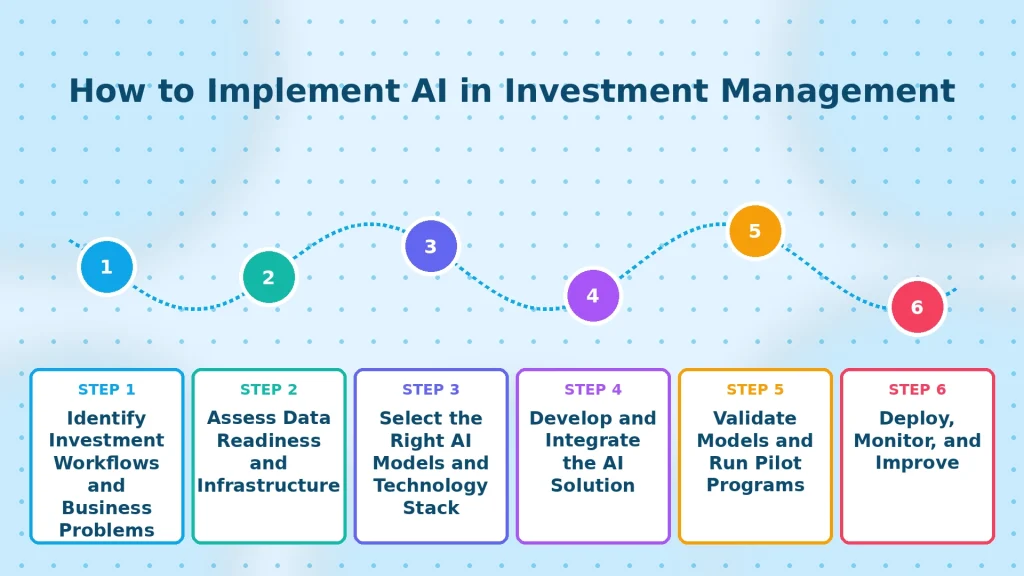
Step 1: Identify Investment Workflows and Business Problems
Start by identifying processes where AI can solve actual business problems. Examine investment research, portfolio monitoring, risk assessment, and reporting workflows. Identify repetitive tasks, manual data processing requirements, and delays caused by fragmented information across existing systems.
Prioritize use cases based on business impact, implementation complexity, data availability, and expected ROI. For example, automating financial document extraction may be a better starting point than building a fully autonomous portfolio management system.
Step 2: Assess Data Readiness and Infrastructure
AI models need reliable financial data to generate meaningful outputs. Evaluate existing datasets for missing records, outdated information, inconsistent formats, and duplication.
Identify data sources across financial databases, market information platforms, and portfolio management systems. Establish data governance policies covering ownership, access permissions, encryption, and security.
Step 3: Select the Right AI Models and Technology Stack
Choose technologies based on the investment workflow and its requirements.
- Machine Learning: Predictive analytics, risk scoring, and pattern identification.
- Large Language Models: Financial document processing and investment research.
- AI Agents: Multi-step research, portfolio monitoring, and reporting workflows.
Also evaluate build-versus-buy options based on business requirements. Existing AI asset management software may be suitable for standard investment workflows and faster deployment. In contrast, custom software development for AI portfolio management can provide greater flexibility for proprietary datasets, specialized models, and complex system integrations.
Step 4: Develop and Integrate the AI Solution
Connect AI models with financial databases, portfolio management systems, and internal research platforms. Custom API development and integration and automated data pipelines allow these applications to exchange information efficiently.
Implement encryption, role-based access, audit logs, and human approval mechanisms for sensitive investment recommendations and portfolio changes. Explainability features should also help investment professionals understand AI-generated outputs.
Step 5: Validate Models and Run Pilot Programs
Test the solution before introducing it across the organization. Backtest predictive models against historical market data and compare AI-generated insights with expert-reviewed outputs.
During pilot testing, measure prediction accuracy, false-positive rates, processing time, and output consistency. Begin with a limited workflow, address identified issues, and refine the system before wider deployment. Where applicable, use out-of-sample testing and paper trading to evaluate model performance under conditions that were not used during training. This helps identify overfitting and assess how the system performs before live deployment.
Step 6: Deploy, Monitor, and Improve
AI systems require continuous monitoring as market conditions and data patterns change. Track model performance, data drift, infrastructure costs, and system reliability. Periodically review outputs, update models, and improve data pipelines to maintain accuracy and operational efficiency.
These six steps provide a structured approach to AI adoption, helping investment firms move from initial experimentation to scalable implementation while establishing clear performance metrics for evaluating business value.
How to Measure AI Transformation Value in Investment Management
Implementing AI is often easier than demonstrating its business value. For investment firms, ROI should not be measured only through investment returns or prediction accuracy. It should also account for operational savings, research productivity, risk management improvements, and client servicing efficiency.
To understand the actual value of AI in investment management, firms should track measurable outcomes across five key areas.
1. Operational Efficiency and Cost Reduction
One of the easiest ways to measure the impact of AI-powered automation is to compare how much time and money investment teams spend on routine tasks before and after implementation.
Track metrics such as:
- Research hours saved per investment analyst
- Percentage reduction in manual document processing time
- Cost per investment research report
- Time required for portfolio reporting and reconciliation
2. Investment Research and Decision-Making Performance
AI can help analysts process information faster, but speed alone does not indicate better research. Firms should also evaluate the quality, accuracy, and consistency of investment insights.
Measure the time required to evaluate investment opportunities, the completeness of research data, forecast errors against established benchmarks, and the time between identifying a market signal and reviewing it.
3. Portfolio and Risk Management Outcomes
For portfolio managers, AI’s value can be measured through improvements in monitoring coverage, risk identification, and exposure management. Relevant metrics include the time taken to identify exposure changes, risk detection accuracy, false-positive rates, and model performance against established risk benchmarks.
4. Client Experience and Wealth Management Value
AI-powered wealth management workflows can improve client servicing while reducing administrative work for advisors. Firms can track client onboarding time, report generation time, advisor productivity, client engagement, and retention rates to determine whether AI is improving service delivery.
5. Calculate the Overall AI ROI
Once these metrics are established, firms can calculate the financial return from AI implementation using:
ROI = [ ( Total Benefits – Total AI Costs ) / Total AI Costs ] * 100
Total benefits may include:
- Labor hours saved through workflow automation
- Reduced research and operational expenses
- Lower reporting and reconciliation costs
- Increased analyst capacity
- Measurable improvements in client servicing
Total AI costs may include:
- AI software and cloud infrastructure
- Financial data licensing and system integration
- Model development and maintenance (see our guide to AI development cost)
- Security, compliance, and governance
- Employee training and change management
Consider an asset management firm that implements an AI-powered research and reporting system.
| Metric | Annual Value |
| Research and reporting hours saved | $90,000 |
| Reduced operational expenses | $40,000 |
| Additional productivity value | $30,000 |
| Total Annual Benefits | $160,000 |
| AI development and infrastructure | $60,000 |
| Data integration and licensing | $20,000 |
| Maintenance and training | $20,000 |
| Total Annual Costs | $100,000 |
Using the ROI formula:
ROI = [ ( 160,000 – 100,000 ) / 100,000 ] * 100 = 60%
This example shows how firms can evaluate AI’s financial contribution without relying on assumptions about higher investment returns. The most reliable approach is to establish baseline metrics before implementation, compare them after deployment, and account for ongoing costs and measurable benefits.
Ultimately, measuring AI transformation value in investment management requires comparing measurable business outcomes against the total cost of implementation. Firms should evaluate both financial returns and operational improvements to determine whether AI adoption delivers sustainable business value.
Choose the Right AI Software for Investment Management
The right AI software depends on the type of investments a firm manages, its existing technology infrastructure, and the workflows it wants to improve. Before selecting AI software for investment management, businesses should evaluate the following criteria to ensure the solution meets their operational, technical, and security requirements:
AI Portfolio Management Software
AI portfolio management software helps investment teams monitor portfolio performance, assess risks, and make allocation decisions. Key capabilities include portfolio analytics, risk monitoring, asset allocation recommendations, and performance tracking against benchmarks.
AI Asset Management Software
AI asset management software supports broader investment operations, including financial research, asset monitoring, and reporting. It can extract insights from financial documents, integrate market data, automate recurring reports, and connect information across investment platforms.
AI Software for Alternative Investments
AI software for alternative investments helps firms manage the complexity of private markets. Common capabilities include automated due diligence, private company valuation analysis, fund performance monitoring, and portfolio company tracking.
AI Tools for VC Portfolio Management
AI tools for VC portfolio management help investors monitor startup performance across their portfolios. They can track revenue growth, burn rate, cash runway, and other financial indicators while supporting investor reporting and portfolio company benchmarking.
The choice ultimately comes down to how well the software fits existing investment workflows. Firms with specialized requirements may also consider AI integration services to build tailored analytics, integrations, and monitoring tools rather than relying entirely on off-the-shelf platforms.
Building AI-Powered Investment Management Solutions with Logix Built
Investment teams don’t need another dashboard that simply displays financial data. They need software that can interpret it, connect insights across systems, and reduce the manual work behind investment decisions. Logix Built develops custom AI solutions for financial workflows, from extracting insights from financial reports and automating investment research to building portfolio monitoring and reporting systems.
Our DFM Adviser case study demonstrates our experience in developing financial management solutions with centralized data, automated reporting, interactive dashboards, and intelligent financial insights.
We can integrate these capabilities with existing databases, analytics platforms, and portfolio systems, with security controls and human review built into the workflow. If you need help applying AI to investment management, Logix Built is ready to help you turn your operational challenges into secure, scalable software solutions.
Frequently Asked Questions
How is AI used for portfolio management?
AI for portfolio management helps monitor asset performance, assess portfolio risks, identify allocation imbalances, and recommend rebalancing strategies based on investment goals and risk tolerance.
How do AI agents support investment management?
AI agents in investment management can automate multi-step tasks such as collecting financial data, analysing market updates, preparing research summaries, and generating portfolio reports.
What technology do investment managers need to adopt AI?
The technology for investment managers typically includes machine learning models, generative AI, data analytics platforms, APIs, cloud infrastructure, and secure data pipelines. The right combination depends on the firm’s workflows and existing systems.
Can artificial intelligence make investment decisions?
Artificial intelligence in investment management can evaluate financial data, identify potential opportunities, forecast trends, and generate recommendations. However, AI predictions are not guaranteed outcomes. Investment professionals must validate insights and consider market conditions before making decisions.
What are the benefits of using AI in investment management?
AI can reduce manual research, automate reporting, improve risk monitoring, and help investment teams analyse larger datasets. It also supports more consistent workflows and gives professionals more time to focus on strategic decisions.

Siddharth Pandya is the Founder, CEO, and Managing Director of Logix Built Solutions Limited, an AI-powered development company specializing in custom software, web, mobile app, and AI-driven solutions for enterprises and startups. With 15+ years of experience in digital innovation and enterprise technology, he leads the company's vision of building intelligent, scalable software solutions across web, mobile, AI/ML, and data science applications. Under his leadership, Logix Built has helped businesses in healthcare, fintech, logistics, e-commerce, real estate, and other sectors improve operational efficiency, adopt AI-powered automation, and gain a competitive edge in their markets.