Published Date: November 16, 2026
Written By:Siddharth Pandya
A chatbot for banking has a rather demanding job. It needs to know why a transaction failed, where a customer’s money went, how much their next EMI is, and why their debit card suddenly stopped working. And it needs to answer all of this without putting anyone on hold for 20 minutes.
That’s a tall order for a piece of software, but AI is making it increasingly achievable. Banking chatbots have evolved from scripted FAQ machines into intelligent assistants powered by Natural Language Processing (NLP), Large Language Models (LLMs), and conversational AI. They can now interpret complex queries, retrieve financial information, and interact with banking systems to complete authorized tasks.
However, building one involves considerably more than plugging an LLM into a chat window, which is where AI integration services come in. Banks need secure integrations, reliable data retrieval, transaction controls, and strict access permissions. This blog explores how AI chatbots work in banking, their real-world applications, and the technical requirements for developing secure solutions that support financial workflows.
What Is a Banking Chatbot and How Has It Evolved?
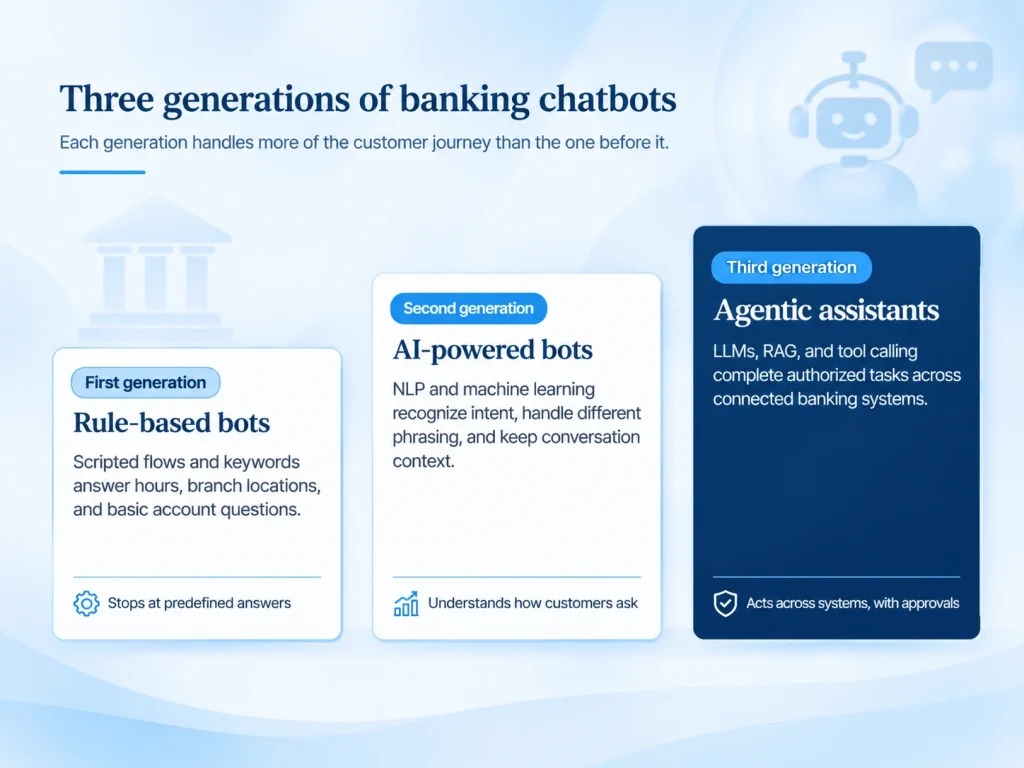
A banking chatbot is a conversational interface that helps customers and bank employees access financial information and services through text or voice. But not every banking chatbot is built to handle the same level of complexity. The technology has evolved through three distinct generations:
Rule-Based Banking Bots
The earliest banking bots relied on predefined conversation flows, keywords, and decision trees. They could answer predictable questions about banking hours, branch locations, and basic account services. Ask something outside their programmed responses, however, and the conversation would quickly hit a dead end.
AI-Powered Banking Chatbots
With Natural Language Processing (NLP) and machine learning, financial chatbots became better at identifying customer intent, extracting relevant information, and maintaining conversational context. This made conversational AI in banking more flexible, allowing chatbots to understand different ways of asking the same question.
Generative AI and Agentic Banking Assistants
Today’s chatbots in financial services go a step further. LLMs generate contextual responses, while Retrieval-Augmented Generation (RAG) connects them to verified banking information. With tool calling and AI agents, a banking bot can also coordinate tasks across connected systems, provided the necessary authentication and authorization controls are in place.
How Does an AI Chatbot for Banks Work?
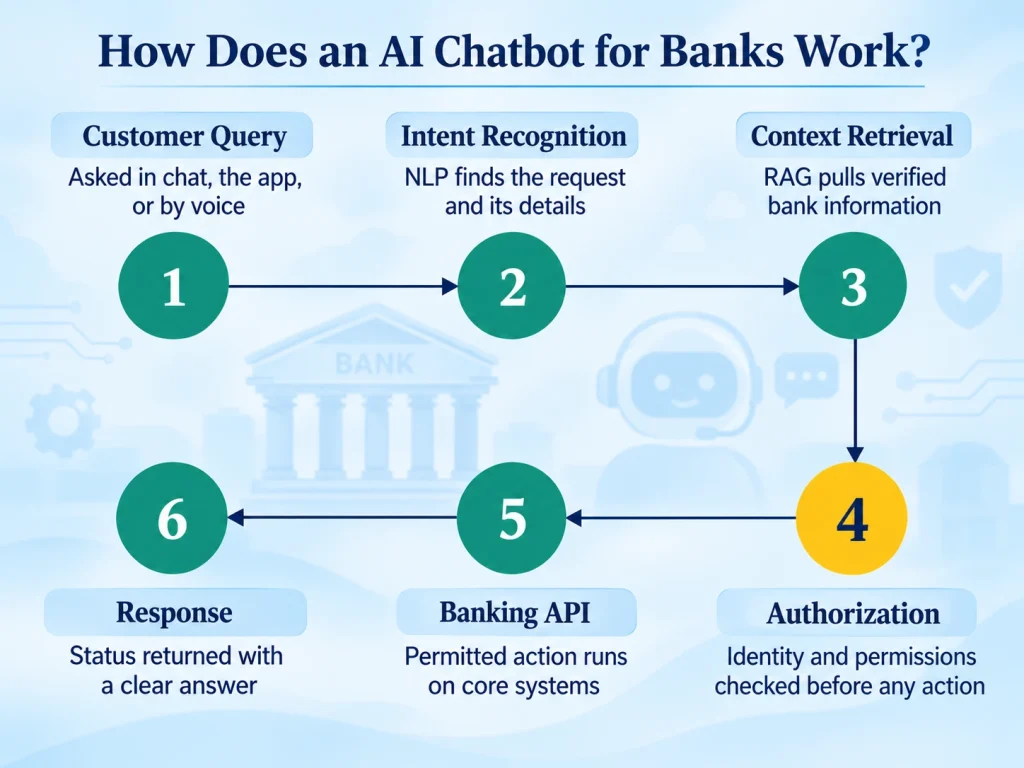
An AI chatbot for banks does more than match questions with stored answers. It processes customer requests, retrieves relevant information, communicates with banking systems, and determines which actions it can safely perform. A typical workflow follows this sequence:
Customer Query → Intent Recognition → Context Retrieval → Authentication and Authorization → Banking API Execution → Response Generation
Natural Language Understanding and Intent Classification
Using Natural Language Processing (NLP), the chatbot identifies what a customer wants, extracts relevant details, and selects the appropriate workflow. For example, when a customer asks, “Why was I charged $25 yesterday?”, the system identifies a transaction-related query, extracts the amount and date, and retrieves the corresponding transaction record after verifying the customer’s identity and access permissions.
LLMs and Retrieval-Augmented Generation (RAG)
Large Language Models (LLMs) interpret complex queries and generate conversational responses. RAG complements them by retrieving information from approved banking documents, product details, interest rate schedules, FAQs, and internal knowledge bases. This grounds responses in verified information, reducing the risk of hallucinated or outdated answers.
Banking API Integration and Tool Calling
Custom API development and integration connects the banking AI chatbot to core banking systems, CRMs, payment gateways, and loan management platforms. Tool calling allows it to retrieve account balances or transaction history. However, executing a fund transfer requires additional authentication, authorization, transaction validation, and customer confirmation.
Context Management and Human Handoff
Session management and conversation history help the AI banking assistant retain context across interactions. When a request falls outside the chatbot’s permissions, involves a complex issue, or requires human judgment, escalation logic transfers the conversation to a support agent along with relevant interaction details. This makes conversational AI for banks more useful across complex customer service workflows.
Want a Banking Chatbot That Fits Your Systems?
Every bank has different systems, rules, and customer needs. Tell us what you use today and we will help you plan a chatbot that works with it.
Key Applications of Conversational AI in Banking
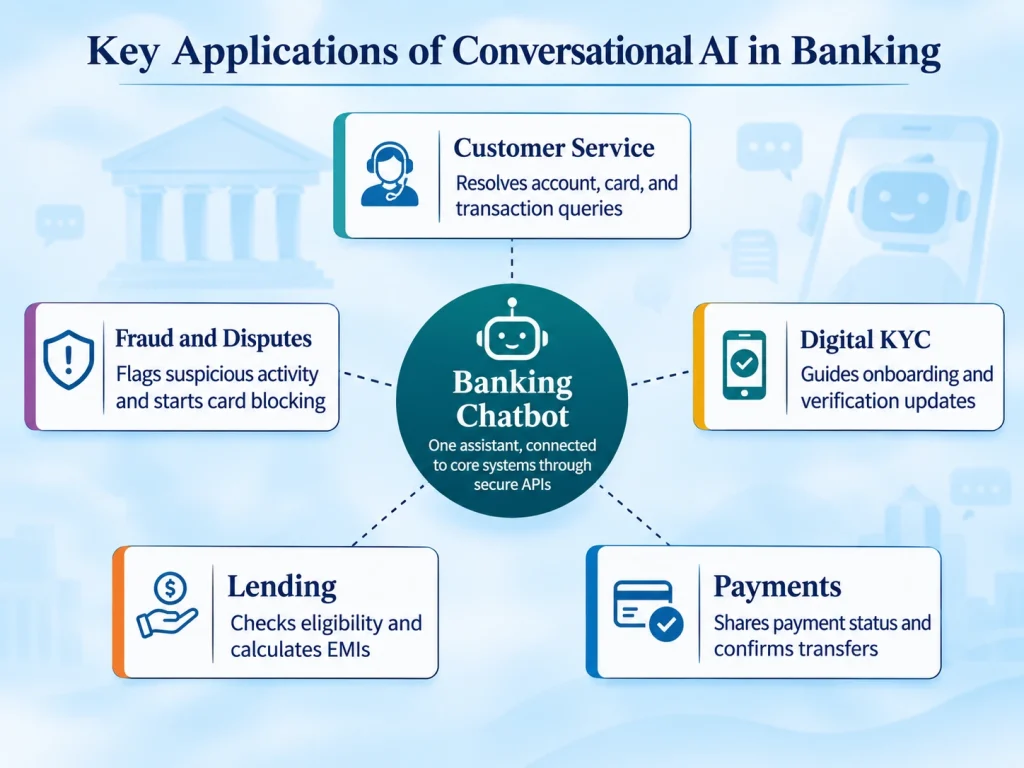
The real value of conversational AI in banking becomes apparent when it moves beyond answering FAQs and starts supporting actual banking operations. From onboarding new customers to handling payment disputes, banking chatbots can assist across several stages of the customer journey.
Customer Service and Query Resolution
AI in banking customer service helps resolve account-related queries, transaction discrepancies, card issues, and service requests. By retrieving information from customer records and internal knowledge bases, banking chatbots can provide relevant answers without requiring customers to navigate multiple support channels. Complex cases can be escalated to human agents.
Digital Account Opening and KYC
A chatbot for banks can guide applicants through account registration, explain documentation requirements, collect application details, and connect with identity verification systems. Customers can also receive updates on KYC verification and account activation.
Payments and Transaction Management
AI chatbots for banking can retrieve payment statuses, share transaction confirmations, and assist with bill payments or fund transfers through a secure payment gateway. Sensitive operations can trigger additional identity checks and transaction authorization before execution.
Lending and Credit Operations
Chatbots can answer loan eligibility questions, explain documentation requirements, retrieve application updates, and calculate EMIs. They can also assist existing borrowers with repayment schedules and loan servicing queries.
Fraud Monitoring and Dispute Management
By integrating with fraud monitoring systems, an AI banking bot can notify customers about suspicious activity, guide them through card blocking, and initiate predefined dispute reporting workflows. These applications make chatbots in the banking industry useful beyond routing customer support.
Advanced Use Cases of AI Chatbots Across Banking Operations
AI chatbots in banking can support workflows that go well beyond customer service. They can help customers understand financial information, give corporate clients faster access to banking data, and make internal operations more efficient.
| Application | How AI Chatbots Are Used | Primary Value |
| Wealth Management | Retrieve portfolio details, summarize spending patterns, track investment performance, and explain financial products. | Gives customers and relationship managers easier access to financial insights. |
| Corporate Banking | Answer queries about cash positions, pending payments, liquidity, and transaction reports. | Helps business clients and treasury teams access financial data without navigating multiple dashboards. |
| Employee Knowledge Assistance | Search internal policies, compliance documentation, product guidelines, and operational procedures. | Reduces manual searches across disconnected knowledge repositories. |
| Voice-Based Banking | Use speech recognition, intent detection, and multilingual processing to handle spoken customer requests. | Supports faster self-service and smoother contact centre interactions. |
Beyond these applications, banking chatbots can help financial institutions streamline internal workflows and improve service coordination. They can assist relationship managers with customer queries, help employees access internal banking policies, and provide faster access to operational information. This allows banking teams to spend less time on routine tasks and focus more on complex customer requirements.
Benefits of AI Chatbots for Banks and Financial Institutions
The business case for chatbots for banking goes beyond faster responses. When deployed across high-volume workflows, AI chatbots can improve service economics, employee productivity, and operational visibility.
- Lower Cost Per Customer Interaction: AI-powered automation of repetitive queries reduces the number of routine requests handled by human agents, lowering support costs as interaction volumes grow.
- Improved Contact Center Productivity: AI-assisted agents can retrieve customer context, surface relevant information, and generate response suggestions, reducing handling time and manual effort.
- Consistent Service Across Banking Channels: An AI customer service platform for banks can provide consistent information across websites, mobile apps, and contact centers through shared knowledge sources.
- Better Customer Data and Operational Insights: Conversation analytics can identify recurring complaints, service bottlenecks, product-related questions, and points where customers struggle to complete banking tasks.
Technical Architecture of an Enterprise Banking Chatbot
An enterprise banking chatbot is not simply an LLM connected to a chat window. It is a coordinated system of conversational interfaces, AI orchestration, banking integrations, security controls, and monitoring components. Each layer has a specific responsibility, and the system must coordinate them without compromising customer data or transaction integrity.
A typical architecture follows this flow:
Customer Interface → AI Orchestration → Banking APIs and Middleware → Core Banking Systems
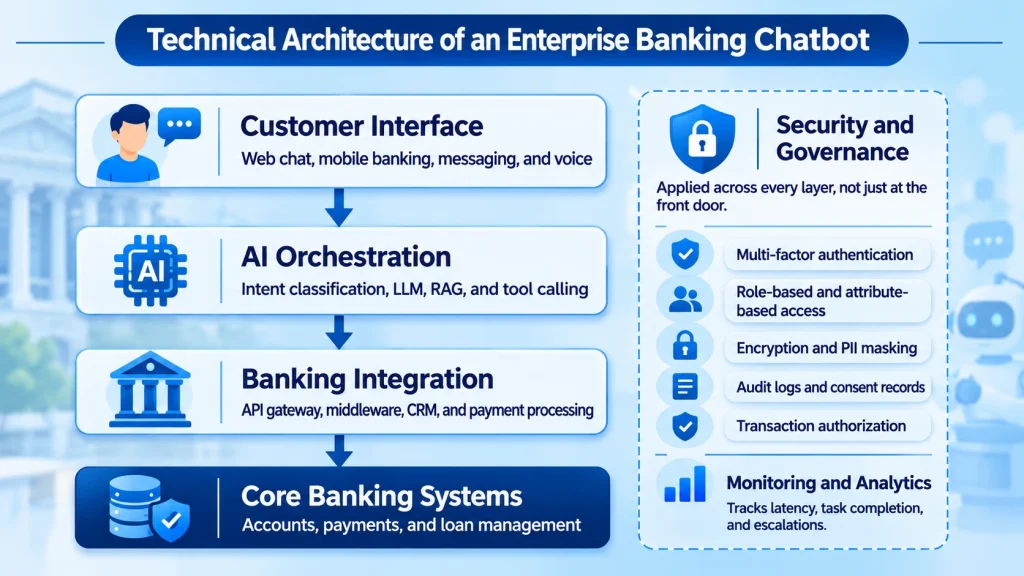
Security and governance controls operate across every layer, while monitoring services track performance and system reliability.
| Architecture Layer | Core Components | Technical Responsibility |
| Conversational Interface | Web chat, mobile banking apps, messaging platforms, voice interfaces | Accepts customer queries, manages sessions, and presents responses across digital channels |
| AI Orchestration | Intent classification, LLM integration, prompt management, conversation state, RAG pipelines, tool calling | Interprets requests, retrieves relevant information, maintains context, and routes approved actions to the appropriate tools |
| Banking Integration | API gateways, middleware, core banking APIs, CRM, payment processing, loan management systems | Connects the chatbot to banking infrastructure to retrieve account information and execute permitted workflows |
| Security and Governance | MFA, identity verification, RBAC, ABAC, encryption, PII masking, audit logs, transaction authorization, consent management, secrets management | Controls who can access information and perform actions. Guardrails restrict prompt injection, unauthorized tool execution, and unverified financial responses. |
| Monitoring and Analytics | Accuracy tracking, API monitoring, latency metrics, task completion rates, escalation tracking, model usage, cost monitoring | Measures system reliability, identifies recurring failures, and highlights areas for improvement |
How the Layers Work Together: Consider a customer asking the chatbot to transfer money. The interface captures the request, and the orchestration layer identifies the intent and extracts the required details. The security layer verifies the customer’s identity and checks transaction permissions. The integration layer then communicates with the relevant banking APIs to validate and process the transfer, subject to required authorization and confirmation. Finally, the chatbot reports the transaction status, while monitoring systems record the interaction.
The layered approach is what distinguishes an enterprise-ready chatbot platform for banking from a basic conversational tool. When evaluating the best AI platform for banks or an AI-based chatbot service for the financial industry, architecture, integration flexibility, and security controls matter as much as model performance.
How to Develop a Banking Chatbot: Step-by-Step Process
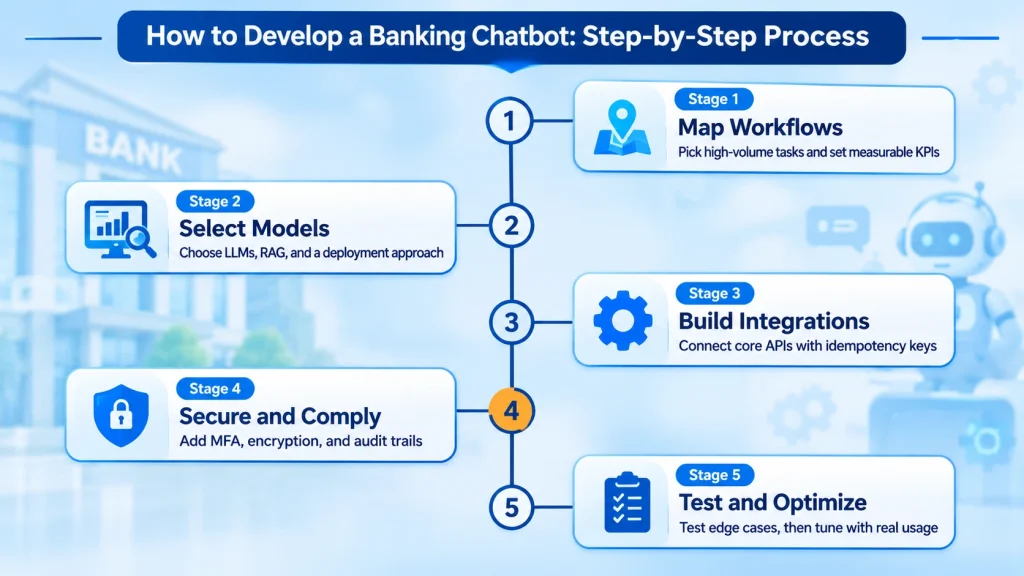
Banking chatbot development involves careful workflow planning, secure integrations, transaction controls, and rigorous testing. Here are the five key stages involved in building a custom solution.
1. Identify Banking Workflows and Automation Requirements
Start by understanding existing banking operations and identifying where conversational AI can reduce manual effort.
- Map Existing Workflows: Review customer service processes, account inquiries, payment tracking, and loan-related operations.
- Identify Automation Opportunities: Prioritize repetitive, high-volume tasks that do not require complex human judgment.
- Define Approval Boundaries: Separate routine queries from sensitive actions such as fund transfers or account changes that need additional authorization.
- Establish KPIs: Set measurable targets for containment rate, task completion, response latency, and escalation frequency.
2. Select the AI Models and Development Architecture
The technology stack should reflect the chatbot’s intended functions, data requirements, and deployment environment.
- Evaluate AI Models: Assess NLP models, LLMs, and conversational AI frameworks based on accuracy, scalability, and integration requirements.
- Choose a Deployment Approach: Compare hosted models, private deployments, and domain-specific models based on data control, cost, and infrastructure needs.
- Determine the Retrieval Strategy: Use RAG to retrieve verified banking information, fine-tuning for specialized language patterns, or a hybrid approach where appropriate.
- Plan for Model Failures: Implement fallback models, response validation, and confidence thresholds to handle uncertain or incomplete outputs.
3. Build Banking API Integrations
A chatbot for banking needs secure access to the systems that power financial services. This requires carefully designed integrations and transaction workflows.
- Connect Banking Systems: Integrate core banking APIs, customer databases, CRM platforms, payment gateways, and loan management systems.
- Implement API Controls: Configure authentication, rate limiting, timeout handling, and error management.
- Prevent Duplicate Transactions: Use idempotency keys to prevent repeated payment execution when requests are retried.
- Separate Access Permissions: Apply different permissions to read-only operations, such as balance inquiries, and financial transactions, such as fund transfers.
4. Implement Security and Regulatory Requirements
Security must be incorporated into the architecture from the beginning, particularly when the chatbot handles financial information or initiates transactions.
- Secure Customer Access: Implement identity verification, multi-factor authentication, and authorization checks.
- Protect sensitive information: Apply encryption in transit and at rest, PII masking, and appropriate data retention policies.
- Control System Access: Use role-based permissions, audit trails, and restricted access to banking APIs and internal resources.
- Address Compliance Requirements: Follow applicable banking, privacy, and data protection regulations across operating jurisdictions. Maintain audit-ready records of customer consent, system access, and sensitive financial operations.
- Add AI-Specific Safeguards: Protect against prompt injection, data leakage, unauthorized tool execution, and unverified financial responses.
5. Test, Deploy, and Optimize the Chatbot
Before production deployment, the chatbot must be tested against routine workflows, unusual requests, and potential system failures.
- Conduct Comprehensive Testing: Test prompt injection, unauthorized tool calls, sensitive data exposure, and attempts to bypass transaction controls.
- Test Edge Cases: Simulate ambiguous queries, failed transactions, expired sessions, duplicate payment attempts, and unauthorized requests.
- Evaluate Performance: Measure response accuracy, task completion rates, latency, and successful escalation to human agents.
- Monitor Production Behavior: Track API failures, customer feedback, escalation frequency, and system reliability.
- Optimize Continuously: Refine prompts, retrieval sources, integrations, and automation rules based on real usage data.
Working with an experienced AI banking software development company can help financial institutions navigate these engineering requirements and build conversational AI systems that fit their existing infrastructure.
Challenges in Banking Chatbot Development and How to Address Them
Deploying AI in the banking sector introduces challenges that conventional customer service bots rarely face. Financial chatbots interact with sensitive personal data, regulated processes, and systems where a single incorrect action can have financial consequences. Each risk therefore needs a corresponding engineering control.
| Challenge | Technical Consideration |
| Legacy System Integration | Use API gateways, middleware, and adapter layers to connect older banking infrastructure without disrupting existing systems. |
| AI Hallucinations | Implement RAG, verified data sources, response validation, and controlled output generation to reduce inaccurate financial responses. |
| Financial Data Security | Apply encryption, tokenization, access controls, and data masking to protect sensitive customer and transaction information. |
| Transaction Errors | Use idempotency keys, transaction validation, confirmation workflows, and audit logs to prevent duplicate or unauthorized operations. |
| Regulatory Compliance | Implement jurisdiction-specific controls, consent management, data governance, and appropriate retention policies. |
| Unreliable AI Actions | Restrict tool permissions, validate API requests, and require additional verification or human approval for sensitive operations. |
| Third-Party AI Dependency | Implement fallback mechanisms, provider monitoring, and contingency plans to maintain service availability during model or provider outages. |
Unlike conventional customer service bots, a chatbot in the banking industry cannot simply prioritize conversational accuracy or response speed. It must also maintain data confidentiality, transaction integrity, traceability, and regulatory compliance. This makes governance, access control, and human oversight essential parts of deploying reliable AI chatbots for banks.
Worried About Security and Compliance?
Legacy systems, wrong answers, and data risks are real concerns for any bank. Talk to us and we will help you plan a safe and reliable chatbot.
The Future of Chatbots in Banking: From Conversational AI to Autonomous Agents
The next evolution of AI chatbots in banking will involve systems that can do more than interpret questions and generate responses. Advances in AI agents, predictive analytics, and multimodal interfaces are moving banking toward more context-aware and action-oriented interactions.
1) AI Agents in Banking
AI agents in banking will increasingly coordinate multi-step workflows across connected systems. For example, an agent could retrieve account information, check a delayed payment, identify the issue, and initiate an authorized services request. Permission boundaries, transaction validation, and human approval will remain essential for sensitive actions.
2) Proactive and Predictive Banking Assistance
Rather than waiting for customers to ask questions, AI systems could identify relevant needs using transaction patterns, account activity, and contextual signals. This may include payment reminders, unusual spending alerts, or notifications about upcoming financial obligations, subject to customer consent and privacy controls.
3) Multimodal and Voice-First Banking
Voice AI in banking will continue to develop through interfaces that combine speech recognition, text, and contextual data. Customers could switch between speaking, typing, and sharing relevant information within a single interaction, making digital banking more accessible and flexible.
Build Custom Banking Chatbots with Logix Built
Banking chatbot development requires more than conversational AI. It calls for secure architecture, reliable integrations, and an understanding of financial workflows. As an AI banking software development company, Logix Built’s fintech software development team helps businesses develop custom banking chatbot solutions using LLM integration, conversational AI, secure API connectivity, and RAG-based information retrieval. Whether you need a customer-facing assistant or an AI-based chatbot service for the financial industry, we build around your infrastructure, workflows, and security requirements.
Our fintech development experience includes projects such as DFM Advisor, which involves financial calculations, automated PDF reporting, and investment insights, and Remotify, a platform built for international invoicing, multi-currency payments, and automated financial workflows. Planning a budget? See our breakdown of fintech app development cost for typical ranges across app types and integrations.
Discuss your banking chatbot requirements with Logix Built and explore how we can develop a solution around your business needs.
Frequently Asked Questions
How does an AI chatbot work in banking?
An AI chatbot for banking uses Natural Language Processing (NLP), machine learning, and Large Language Models (LLMs) to understand customer queries. It retrieves relevant information from connected banking systems and performs authorized tasks through secure API integrations.
What are the benefits of AI chatbots in banking?
AI chatbots banking solutions reduce repetitive support requests, provide faster responses, improve contact center productivity, and offer round-the-clock assistance. They also help banks identify recurring customer concerns through conversation analytics.
What is an AI-based chatbot service for the financial industry?
An AI-based chatbot service for the financial industry involves developing conversational AI solutions for banks, credit unions, lenders, and other financial institutions. These systems can support customer service, payment inquiries, loan assistance, account management, and internal operations.
Which banks use chatbots and virtual assistants?
Several banks with chatbots use AI-powered assistants to handle customer queries, provide account information, and guide users through digital services. The capabilities vary by institution, with some offering basic query resolution and others supporting more advanced banking workflows. Examples include Bank of America's Erica (account information and spending insights), Capital One's Eno (balance checks, bill payments and card management), Wells Fargo's Fargo (bill payments and money transfers), and U.S. Bank's Smart Assistant (voice and text-based banking support).
What is the difference between a banking chatbot and bank's AI virtual assistant?
A banking chatbot typically handles specific customer queries and predefined tasks. A bank's AI virtual assistant can support broader interactions, maintain conversational context, retrieve information from multiple systems, and coordinate more complex workflows within authorized permissions.

Siddharth Pandya is the Founder, CEO, and Managing Director of Logix Built Solutions Limited, an AI-powered development company specializing in custom software, web, mobile app, and AI-driven solutions for enterprises and startups. With 15+ years of experience in digital innovation and enterprise technology, he leads the company's vision of building intelligent, scalable software solutions across web, mobile, AI/ML, and data science applications. Under his leadership, Logix Built has helped businesses in healthcare, fintech, logistics, e-commerce, real estate, and other sectors improve operational efficiency, adopt AI-powered automation, and gain a competitive edge in their markets.