Published Date: August 18, 2026
Written By:Chirag Patel
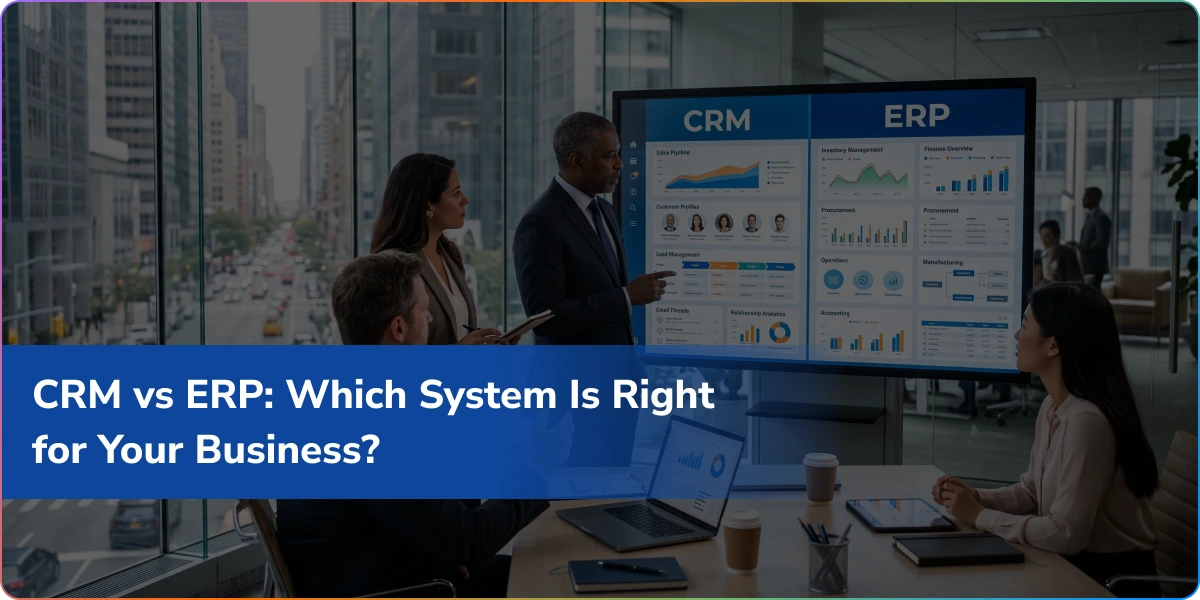
When deciding to scale your business, you are most likely to run into two major system choices: CRM vs ERP. Although both help in smooth business functioning, but they support completely different sides of the operation.
Lets see, what is ERP vs CRM?
- ERP (Enterprise Resource Planning) is for the back-end office teams. It takes care of stocks, core business operations, financials and shipping.
- CRM (Customer Relationship Management) is for the front-end office teams. It helps to handle marketing, customer relations and sales to drive growth.
The real magic, however, happens when these two work in coordination. While CRM grows revenue, ERP manages the resources. Both when clubbed together can remove repetitive data, break down communication silos and give a clear view of the customer journey.
Let’s discuss in detail to find the perfect fit for your business right now.
What is a CRM system?
A Customer Relationship Management (CRM) platform, built through CRM development, is created to streamline the complete buyer lifecycle throughout dealing with the company. It serves as the core foundation of any team handling customer interactions to upscale the front-office graph.
- Lead Monitoring: Track potential buyers as they go through your sales funnel.
- Customer Care: Unify service ticket enquiries and communication history for speedier resolution.
- Automated Marketing: Deliver customized email campaigns and track the customer engagements through it.
What is an ERP system?
An Enterprise Resource Planning (ERP) framework, delivered through ERP development, emphasizes the internal mechanism of the organization. The root ERP system vs CRM difference is that ERP links product, operational and financial data spread throughout the entire company to let the functions run smoothly.
- Inventory & Supply Chain: Supervise real-time inventory levels, vendor purchasing and warehousing.
- Order Accomplishment: Pace up the workflows by automating everything from manufacturing to distribution.
- Financial Management: Conveniently track payroll, company budgets, bookkeeping and invoicing.
The Core ERP vs CRM Differences
To better comprehend the CRM vs ERP difference, the below table enables us to look at them side-by-side at the same time. Although their final aim is enterprise optimization, their routine and regular functions are absolutely distinct.
| Business Area | ERP (Enterprise Resource Planning) | CRM (Customer Relationship Management) |
| Main Focus | Financials, business management and operations | Revenue activities and customer relationships |
| Core Data | Stock vendors, sales & purchase orders, invoices, margins, financials, shipments, costs. | Contacts, opportunities, service cases, leads, accounts, campaigns, customer communications |
| General Benefits | No manual work, faster close, better reporting, high stock accuracy, strong operational control | Stronger follow-up, accurate sales predicting, improved pipeline visibility, better customer experience |
| Integrated Value | Finance and operations team can learn about consumer demands | Service and sales team can analyze operational context |
| Core Users | Operations, procurement, supply chain, finance, inventory, warehouse | Marketing, account management, sales, customer service |
| Best Fit For | Inventory, Reporting, operations control, finance | Marketing, process consistency, better consumer visibility, sales |
Is there anything common between ERP vs CRM?
In spite of several distinctions, it is significant to mention the ERP vs CRM similarities. Both the frameworks depend upon a unified database to supply leadership with data-induced reporting platforms, eradicate clumsy document paperwork and focus on optimizing team workflows with automation.
Power connecting both CRM vs ERP system
The actual miracle occurs when software is integrated through custom API development and integration. By connecting a CRM vs ERP system, the back office and front office finally interact with each other, removing all sort of huge operational hurdle:
- Predictive Analytics: Finance teams can go through the active sales funnel in the CRM to create many more approximate revenue forecasting inside the ERP system.
- Prevent Duplicacy Of Data: The moment any deal gets closed on the CRM framework, the ERP automation software immediately produces an invoice and verifies warehouse inventory without any data repetition.
- Satisfied Consumers: Support teams can see billing and shipping statuses in real-time from the ERP program without going away from their consumer dashboard.
Which one is your current business requirement?
Businesses often get confused while choosing between both the systems. However, you must smartly evaluate your instant priority by scanning through the present business blockages.
Select ERP first, if:
- You are handling various spreadsheets at the same time spanning various departments just to infer basic financials.
- Before committing, it’s worth understanding ERP implementation cost so you can budget realistically for the switch.
- Your procedures are stuck by shipping delays, inventory mistakes, or by cluttered bookkeeping.
Select CRM first, if:
- You need crystal clear insights about sales funnel and marketing performance.
- The main objective is to attain more clients and highly increase the sales volume.
- The sales team is missing the count of leads and finding it difficult to handle customer interaction.
The bottom line is if your core concern is looking for consumers, then begin by fixing your front-office with a smart CRM. However, if your pain point is handling internal procedures and growth, you must mend your back-office with ERP.
Not Sure Which One Fits Your Business?
Get a free consultation with our team to map your exact CRM or ERP needs – no guesswork, just the right system for your growth stage.
How Logix Built Help To Decide For CRM vs ERP System?
We provide both operational efficiency and business growth. It is almost impossible to choose while mapping through CRM vs ERP landscape. We at Logix Built, remove the guesswork forever.
Not only we support you choosing the perfect system for your present hurdle- we hold equal expertise at clubbing them together. Build a seamless data highway for your organization by integrating back-end ERP and front-end CRM with each other.
Get real-time visibility for the sales team as well as seek early insights for the sales pipeline.
Never let data silos to downscale your momentum. Let us craft a centralized business software to save cost and drive revenue.
Frequently Asked Questions
Should a startup choose ERP or CRM?
It all goes around the peak business pain point. To boost sales and fix lead tracking, begin with a CRM software. However, if you are having a hard time with stock errors and disorganized finance books, go for ERP first. Eventually, both clubbed together would be required to grow business.
Any special benefits from CRM vs ERP system?
Both systems can remove data silos. By connecting both platforms, you can pace up order processing, automate manual tasks and provide sharp observations on internal operations as well as consumer demands.
What is ERP System vs CRM?
ERP manages resource planning with internal logistics. And CRM brings the company revenue by getting the consumers enrolled. Businesses should smartly use the combination of ERP and CRM for maximum benefits.
Is CRM taken as a sort of ERP?
Both are designed for distinctive purposes. CRM covers consumer relations, marketing and sales. While ERP focuses on the functions like accounting, engineering, finance, production and human resources.

Chirag Patel is the Chief Technology Officer at Logix Built Solutions Limited with 11+ years of experience in engineering scalable digital platforms. He specializes in CRM development, eCommerce solutions, and customer experience technologies designed to improve engagement, retention, and conversion. Chirag leads end-to-end product engineering with a strong focus on performance, automation, and architecture design, enabling businesses to deliver seamless digital experiences and achieve sustainable growth in competitive markets.