
Published Date: August 17, 2026
Written By:Siddharth Pandya
You build an AI app, ask it to follow your instructions, and expect consistent results. But instead, it gives generic answers, misses industry terms, or struggles to match your brand’s tone. This is a common challenge, so many businesses are fine-tuning LLMs to get more accurate and reliable outputs.
Fine-tuning improves a pre-trained model by teaching it with your own task-specific data instead of building a new model from scratch. In one NVIDIA test, fine-tuning Llama 3 8B delivered an 18% improvement in task accuracy over the untuned baseline model. This shows that a smaller model trained for a specific task can outperform a larger general-purpose model.
In this guide, you’ll learn what LLM fine-tuning is, how it works, different fine-tuning methods, the complete process, and best practices to achieve better results.
What is LLM Fine-Tuning?
LLM fine-tuning involves selecting a pre-trained large language model and training it further on a smaller, task-specific dataset. This improves its performance on a particular task or within a particular domain. In simple terms, fine-tuning helps a general-purpose model become more specialized without training a new model from scratch.
During fine-tuning, the model retains its general language abilities, including grammar, reasoning, and broad world knowledge. At the same time, it learns the vocabulary, writing style, and patterns specific to your industry or task.
For example, a hospital can fine-tune an LLM on anonymized patient records and clinical documentation. A general-purpose model might struggle with abbreviations such as “SOB” (shortness of breath) or “MI” (myocardial infarction), while a fine-tuned model can interpret them correctly, summarize patient histories, and generate documentation that follows the hospital’s standards.
Why Fine-Tune an LLM?
A general-purpose LLM works well for many tasks, but it may struggle with industry-specific terminology, consistent formatting, or your brand’s tone. That’s where fine-tuning adds value. It helps adapt the model to your business so it performs better in real-world applications.
- The model learns from task-specific examples, helping it produce more relevant and reliable outputs for your use case.
- Fine-tuning teaches the model your terminology, writing style, and preferred response format, making outputs more consistent.
- Training on high-quality, domain-specific data can reduce incorrect or fabricated responses for specialized tasks.
- Because the model learns your preferred behavior during training, you don’t need to repeat lengthy instructions in every prompt. This can lower token usage and improve response time.
- Organizations can fine-tune and deploy models within their own infrastructure, helping protect sensitive data and meet regulatory requirements in industries like healthcare and finance.
- In many cases, a high-quality labeled dataset with a few hundred or thousands of examples is enough to improve performance, especially when using parameter-efficient fine-tuning methods.
Fine-tuning helps transform a general-purpose LLM into a model that better understands your business, follows your preferred style, and delivers more reliable results. For organizations that need consistent, domain-specific AI applications, it offers a practical way to improve performance without building a model from scratch.
When Should You Fine-Tune an LLM?
Fine-tuning is not always the right first step. Prompt engineering and retrieval-augmented generation (RAG) solve most problems more cheaply, so spend extra effort only where it pays off.
Fine-tuning is a good choice when you need to:
- Maintain consistent behavior across thousands of requests.
- Improve outputs after prompt engineering and RAG stop delivering better results.
- Follow a consistent tone, style, or response format that prompting alone can’t achieve.
- Specialize the model for a domain using high-quality task-specific data.
Hold off on fine-tuning when your knowledge changes frequently, the task is a one-off, or you don’t have a reliable way to measure success. In these situations, training a model may require more time and resources than the problem justifies.
Retrieval-augmented generation (RAG) is often a better choice when your knowledge base changes frequently because it retrieves the latest information from external sources instead of relying only on what the model learned during training. Prompt engineering is also a good starting point for many use cases, especially when simple instructions are enough to produce the desired output.
Choosing the right approach depends on your use case. The table below can help you decide whether prompt engineering, RAG, or fine-tuning is the best fit for your requirements.
| Situation | Suitable Solution |
| You need a specific tone, writing style, or response format for every request. | Fine-tuning |
| Your model needs to understand industry-specific terminology or workflows. | Fine-tuning |
| Knowledge base changes weekly or monthly. | RAG |
| You need responses based on the latest documents or databases. | RAG |
| You want to test or improve outputs without retraining the model. | Prompt engineering |
| The task is simple and can be handled with clear instructions. | Prompt engineering |
| Long prompts are becoming difficult to manage or maintain. | Fine-tuning |
| Proprietary data should be kept within your infrastructure | Fine-tuning |
The right approach depends on factors such as your data, business goals, and how often your knowledge changes. Understanding the differences between RAG vs. fine-tuning vs. prompt engineering makes it easier to choose the most effective solution for your use case.
How Does LLM Fine-Tuning Work?
A large language model is made up of millions or billions of values called weights. These weights determine how the model processes information and generates responses. Weights are set during pre-training. Fine-tuning changes them by training the model on examples from your task-specific dataset.
For each training example, the model compares its output with the expected output and measures the difference. The model then adjusts its weights slightly to reduce that difference. This process is repeated many times during training.
Repeating this loop across many examples teaches the model your patterns without erasing what it already knows. There are different ways to update a model during fine-tuning. Full fine-tuning modifies all weights in the model, while parameter-efficient methods update only specific model components, based on your budget and needs.
What Are the Different Methods for LLM Fine-Tuning?
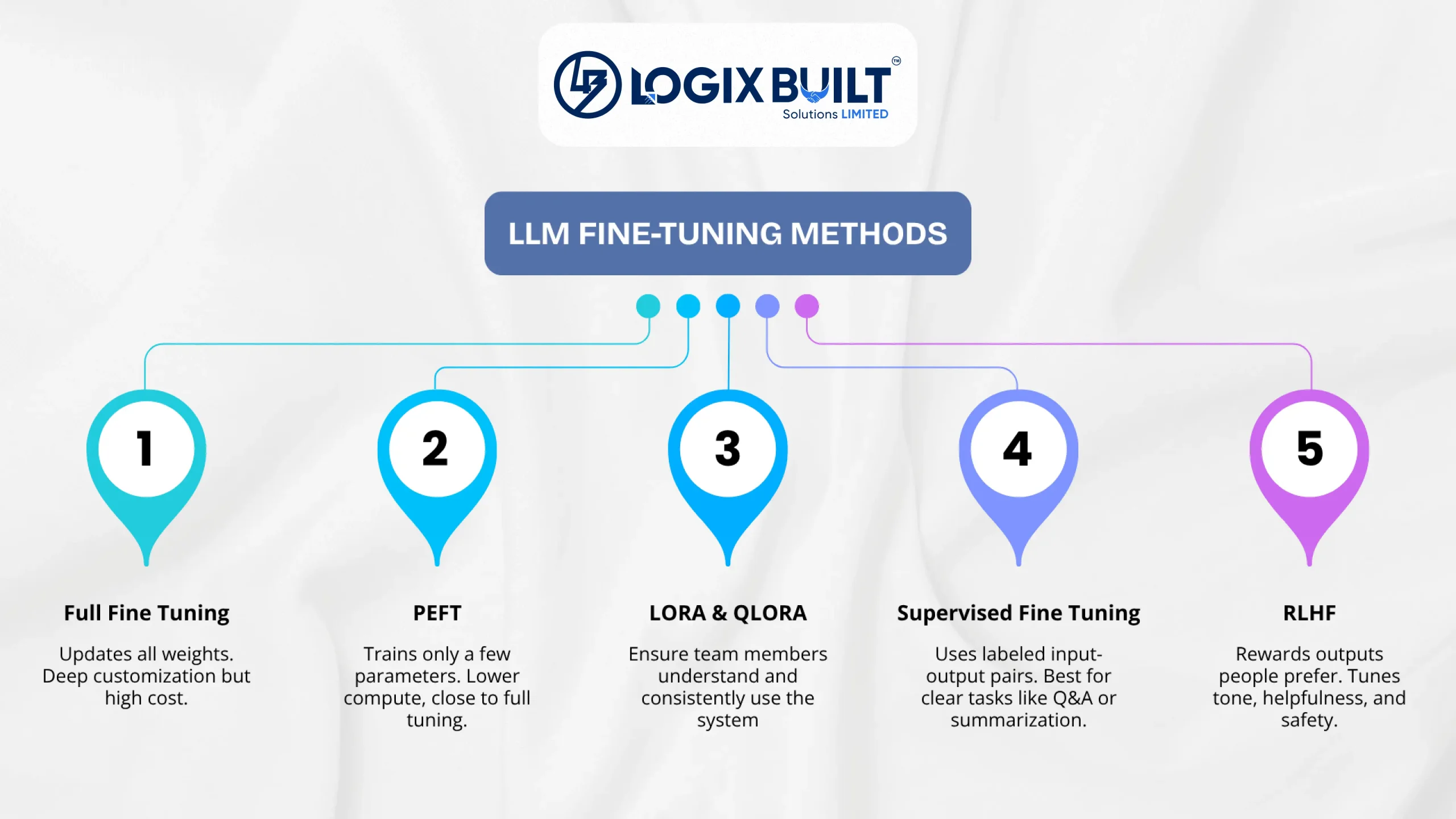
Different fine-tuning methods balance cost, performance, and hardware requirements in different ways. Choosing the right one depends on your use case, available resources, and the level of customization you need.
Full Fine-Tuning
Full fine-tuning updates every weight (parameters that shape how the model processes input and generates output) in the model using your task-specific data. It delivers the deepest customization, since nothing stays frozen, but it also demands the most compute, memory, and training time. This makes it best suited to large teams with big, high-quality datasets and the infrastructure to support it.
Parameter Efficient Fine-Tuning
Parameter-efficient fine-tuning, or PEFT, freezes most of the model’s original weights and trains only a small set of new parameters added on top. This cuts compute and memory costs sharply while keeping results close to full fine-tuning, which is why PEFT has become the default choice for most teams outside large AI labs.
LoRA and QLoRA
LoRA, or low-rank adaptation, adds small trainable matrices on top of the model’s frozen weights instead of touching the originals. QLoRA goes further, adding quantization to shrink memory use even more. Together, these LLM fine-tuning techniques let teams fine-tune large models on modest hardware, sometimes a single GPU.
Supervised Fine-Tuning
Supervised fine-tuning, or SFT, trains the model on labeled input-and-output pairs so it learns the correct response for each type of input. It’s the most common starting point for adapting LLMs to business tasks, fitting well-defined tasks like classification, summarization, and question answering, where correctness is easy to define.
Reinforcement Learning From Human Feedback (RLHF)
RLHF uses human preferences to guide the model toward producing more helpful, safe, and natural responses. It’s typically applied after supervised fine-tuning, and it’s the technique behind how many production chat models get tuned for tone, helpfulness, and safety.
Each fine-tuning method offers a different balance of customization, cost, and hardware requirements. This table will help you understand when each approach is most suitable:
| Method | Compute Cost | Data Needed | Best For |
| Full fine-tuning | High | Large, high quality | Large teams with dedicated infrastructure |
| PEFT | Low | Moderate | Most teams outside large AI labs |
| LoRA / QLoRA | Low | Moderate | Fine-tuning large models on limited hardware |
| Supervised fine-tuning | Moderate | Labeled input-output pairs | Well-defined tasks with clear correct answers |
| RLHF | High | Human preference rankings | Improving helpfulness, safety, and response quality using human feedback |
Once you’ve selected the right fine-tuning approach, the next step is preparing your data and training the model.
How to Fine-Tune an LLM Model: Step-by-Step Process
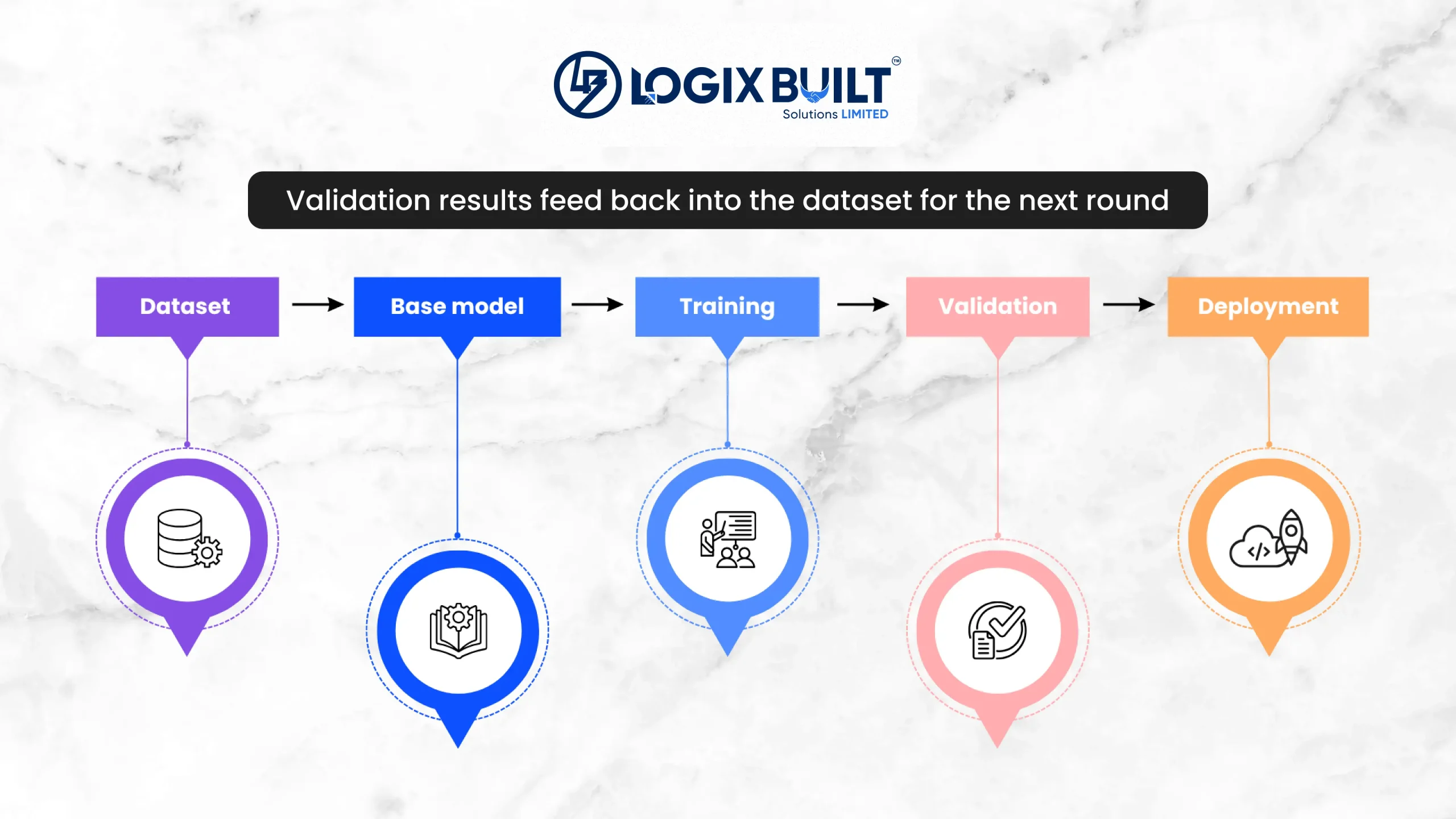
Knowing the methods is only half the picture. Here’s how to fine-tune an LLM model in practice, from raw data to a deployed system.
Prepare Your Dataset
Gather clean, relevant examples that represent the behavior you want, formatted as input-and-output pairs, usually in JSON or CSV. Remove errors, duplicates, and inconsistent examples, then split remaining data into training, validation, and test sets so you can measure progress honestly.
Choose a Pre-Trained Base Model
Pick a base model that fits your task, budget, and license terms, an open model like Llama or Mistral, or a commercial API. Model size, how closely its training matches your domain, and available compute should all shape this choice, not just raw benchmark scores.
Set the Training Parameters
Three settings matter most: learning rate, batch size, and number of epochs. Sensible defaults from your training platform work fine for a first run. A learning rate too high causes unstable training, while one too low wastes time, so adjust cautiously and one variable at a time.
Train the Model
Training loads the base model, feeds it your prepared dataset, and updates the weights over several passes through the data. How long this takes depends on data size, model size, and GPU power, and progress is tracked continuously against the validation set to catch problems early.
Validate Model Performance
Check the trained model against a separate validation and test set using metrics like accuracy or loss, data it never saw during training. This shows whether the model genuinely learned the task or just memorized examples, and it flags overfitting before the model reaches production.
Deploy the Fine-Tuned Model
Serve the finished, fine-tuned LLM model behind an API or application, either by merging the trained changes into the base model or loading a lightweight adapter on top at runtime. Once live, monitor cost, speed, and output quality closely, since production traffic often reveals edge cases training data missed.
Building and maintaining a fine-tuning pipeline requires expertise in data preparation, model training, evaluation, deployment, and ongoing monitoring. Businesses that don’t have an in-house AI team often work with experienced partners to manage this process efficiently. Logix Built’s LLM development services can help you fine-tune, deploy, and optimize custom LLMs tailored to your business needs.
Fine-Tuning Looks Complex – We Make It Simple
From dataset prep to deployment, our AI team handles the full fine-tuning pipeline so you get a production-ready model without building an in-house ML team.
What Are the Best Practices for LLM Fine-Tuning?
Getting fine-tuning right comes down to discipline more than scale. These LLM fine-tuning best practices work for most projects:
- Start with a high-quality dataset: Focus on clean, relevant, and well-labeled examples. For many business use cases, a few hundred high-quality examples can produce better results than thousands of inconsistent ones.
- Choose the right base model: Select a pre-trained model that already aligns closely with your task or domain. This reduces the amount of fine-tuning needed.
- Use conservative training settings: Avoid changing the model more than necessary, as overly aggressive training can reduce its general language capabilities.
- Prefer parameter-efficient methods when possible: Techniques like LoRA and QLoRA can deliver strong results while reducing compute, memory, and training costs.
- Evaluate throughout training: Test the model regularly using a separate validation dataset instead of waiting until training is complete. This helps identify overfitting early.
- Review your training data carefully: Remove duplicates, bias, incorrect labels, and conflicting examples to improve data quality.
- Test before deployment: Validate the model using real-world scenarios to ensure it performs reliably in production.
- Improve iteratively: Analyze failure cases and refine your dataset instead of adding random examples or retraining from scratch.
Following these best practices helps you build fine-tuned LLMs that are more accurate, reliable, and easier to maintain over time.
What Are the Most Common LLM Fine-Tuning Use Cases?
Fine-tuning helps businesses adapt LLMs for a wide range of real-world applications. Some of the most common LLM fine-tuning use cases are:
- Customer support chatbots: Train models on company policies, product information, and brand guidelines to deliver accurate and consistent responses.
- Sentiment analysis: Analyze customer reviews, surveys, and social media posts to understand customer opinions and trends.
- Document summarization: Generate concise summaries of lengthy reports, contracts, research papers, or meeting notes.
- Named entity recognition (NER): Identify and extract entities such as names, organizations, locations, dates, or product information from unstructured text.
- Domain-specific translation: Translate content using industry-specific terminology while maintaining accuracy and context.
- Structured output generation: Produce consistent outputs in formats such as JSON or XML for easier integration with business applications.
- Code assistance: Fine-tune models on internal codebases to generate code, explain functions, and suggest improvements that align with your development standards.
- Industry-specific AI assistants: Build assistants for healthcare, finance, legal, and other regulated industries using domain-specific knowledge and terminology.
The right use case depends on your business goals, available data, and the level of customization you need. Fine-tuning is most valuable when a general-purpose model cannot consistently deliver the quality or behavior your application requires.
What Are the Common Challenges in LLM Fine-Tuning?
LLM fine-tuning can deliver better results, but it comes with real risks that your team needs to plan around. Some of the most common challenges of LLM fine-tuning include:
- Overfitting: Training on a small or narrow dataset can cause the model to memorize examples instead of learning patterns that generalize to new inputs.
- Catastrophic forgetting: Excessive fine-tuning can reduce some of the model’s general language capabilities while it learns task-specific behavior.
- Bias in training data: If the dataset contains biased or unbalanced examples, the model may learn and reinforce those patterns.
- High compute and training costs: Full fine-tuning of large models requires significant GPU resources, memory, and training time.
- Data quality requirements: Fine-tuning depends on clean, accurate, and well-labeled datasets. Poor-quality data often leads to poor-quality results.
- Training parameter selection: Choosing the right learning rate, batch size, and number of epochs can significantly affect model performance.
- Model drift: As business data, user behavior, or industry knowledge changes over time, model performance can decline, making periodic retraining necessary.
Understanding these challenges early helps you choose the right fine-tuning approach, prepare better datasets, and build LLM applications that remain accurate and reliable over time.
Build Your Fine-Tuned LLM With Logix Built
Every business has different goals, data, and infrastructure, which means there’s no one-size-fits-all approach to LLM fine-tuning. Choosing the right model, deciding on a fine-tuning method, preparing training data, and validating performance all require careful planning to achieve the best results.
That’s where Logix Built can help. We offer LLM development services for businesses that lack in-house AI/ML expertise or want high-quality results. We work closely with clients to identify the right fine-tuning strategy, prepare production-ready datasets, train custom models, and deploy scalable LLM solutions. Get in touch to discuss your project today.
Let’s Build Your Custom LLM
Choosing the right model, method, and data strategy is where most fine-tuning projects go wrong. Partner with Logix Built to get it right the first time.
FAQs on Fine-Tuning LLMs
Which open source models are best for fine-tuning?
Llama and Mistral are among the most popular open-source families for fine-tuning, thanks to strong community tooling, permissive licenses, and a range of sizes. The best choice depends on your task, hardware budget, and how closely a model's training matches your domain.
How do you prepare data for fine-tuning?
Collect clean, representative input-and-output examples, remove errors and duplicates, and format them consistently, usually as JSON or CSV pairs. Then split the dataset into training, validation, and test sets so you can measure real progress, not just training loss.
What is the difference between fine-tuning and transfer learning?
Transfer learning is the broader concept: reusing knowledge a model learned on one task to help with another. Fine-tuning is a specific technique within it, taking a pre-trained model and training it further on new, task-specific data to specialize its behavior.
How long does fine-tuning take?
Training itself can take anywhere from a few minutes to several days, depending on data size, model size, and available compute. The longer time investment is usually data preparation and evaluation, which for a serious project often takes one to several weeks before the model is production-ready.

Siddharth Pandya is the Founder, CEO, and Managing Director of Logix Built Solutions Limited, an AI-powered development company specializing in custom software, web, mobile app, and AI-driven solutions for enterprises and startups. With 15+ years of experience in digital innovation and enterprise technology, he leads the company's vision of building intelligent, scalable software solutions across web, mobile, AI/ML, and data science applications. Under his leadership, Logix Built has helped businesses in healthcare, fintech, logistics, e-commerce, real estate, and other sectors improve operational efficiency, adopt AI-powered automation, and gain a competitive edge in their markets.