Published Date: July 3, 2026
Written By:Chirag Patel
Have you ever noticed that some deliveries show up at your door at the promised time with clear tracking updates for the whole journey, while others leave you waiting and guessing? The difference between them often comes down to the smart tools working quietly in the background. Customers right now expect fast service, real-time updates and reliable timing.
A delivery management system helps businesses in streamlining their entire delivery process by using tools such as fleet tracking software, route optimization software, and an order tracking system.
In this blog, we will explore how does delivery management software work, and how using tools like delivery dispatch software, delivery tracking software, and proof of delivery software makes deliveries faster and smarter.
What is Delivery Management Software?
A delivery management system is a software tool that organizes and automates the entire delivery process from purchase to doorstep.
Using tools like delivery dispatch software, route optimization software, and delivery tracking software, businesses can manage their operations with greater accuracy and speed. It also includes features such as fleet tracking software, delivery driver management software, and a customer-facing order tracking system.
If we condense it down in simple terms, delivery management system ensures that the right order reaches the right customer, at the right time, and in the most efficient way possible.
Why Businesses Need Delivery Management Software
Nowadays, customer trust is determined by speed as well as accuracy. Customers want fast, reliable and clear delivery. A delayed order or other issues causes them to walk away and also leave terrible reviews.
That is why countless businesses have turned to software-based delivery systems to control their last-mile logistics.
- Gain Complete Visibility Across Deliveries: Without proper tracking, it’s hard to know where drivers are or if orders will arrive on time. A delivery tracking software and integrated order tracking system provides us with real-time updates on location, status, and route changes, helping managers quickly resolve issues.
- Reduced Missed Deliveries with Accurate Mapping: Incorrect or difficult to find addresses more often than not leads to delays. With delivery routing software and smart navigation, drivers get precise directions.
- Improve Workforce Productivity: Manually managing drivers and vehicles can be inefficient. A delivery driver managing software combined with fleet tracking software helps monitor performance, reduce idle time, and optimize overall productivity.
- Enable Smarter Task Allocation: Assigning deliveries randomly can slow down operations. A delivery dispatch software ensures orders are assigned based on driver availability, location, and capability for smoother execution.
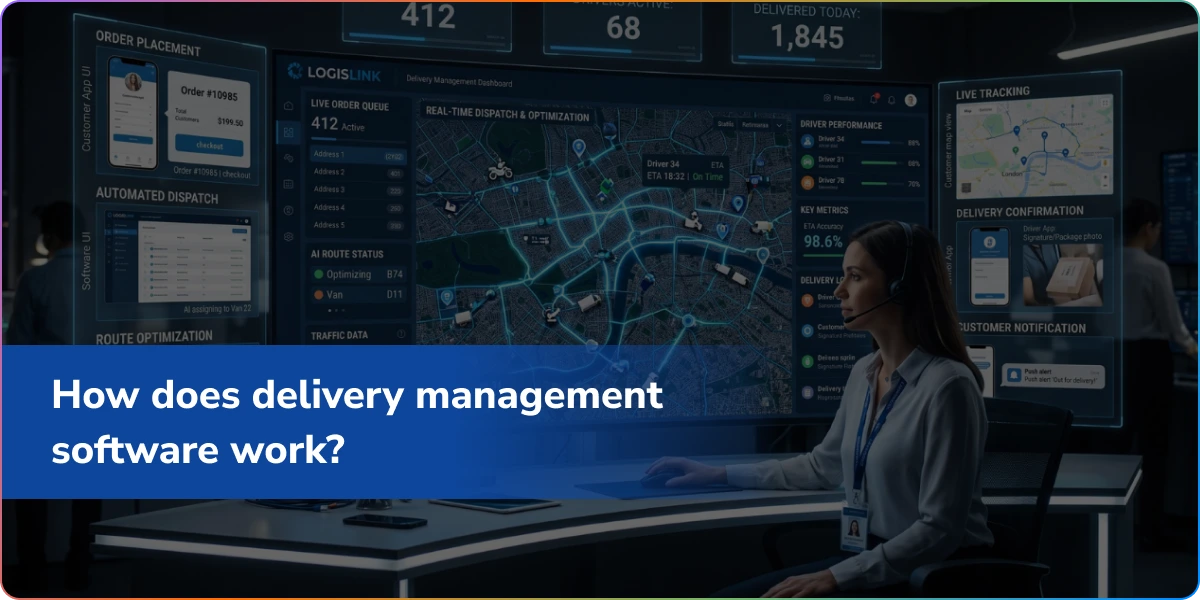
How Does Delivery Management Software Work?
Order Creation & Assignment
The process begins when an order is placed or imported into the delivery management system. Using the delivery dispatch software, orders are automatically assigned to available drivers based on predefined rules.
Smart Delivery Allocation
The system uses delivery driver management software to assign tasks intelligently by considering driver location, availability, workload, and type of vehicle.
Route Planning & Optimization
With the help of route optimization software – a core capability shared with a transportation management system – the system calculates the fastest and most efficient routes, reducing fuel costs and delivery time.
Real-Time Tracking
Using fleet tracking software and delivery tracking software, businesses can monitor driver location, order status, and route progress in real time.
Delivery Execution
Drivers receive delivery details through mobile apps, including navigation and customer information, ensuring smooth and accurate deliveries.
Proof of Delivery
Once the order is delivered, proof of delivery software captures signatures, photos, or OTP confirmations as evidence of successful delivery.
Notifications & Updates
Customers receive real-time alerts via email, WhatsApp, or SMS through an integrated order tracking system, keeping them informed at every stage. This level of personalized communication is typically powered by CRM development connected to the delivery platform.
Analytics & Reporting
The system collects data on delivery performance, delays, and efficiency, helping businesses make data-driven decisions and continuously improve operations.
That’s a Lot of Moving Parts to Build
Order assignment, route optimization, real-time tracking, proof of delivery – building all of this in-house takes time. Talk to our team about the fastest way to get it running.
Types of Delivery Management Software
| Type | Best For | Key Feature |
| Courier Delivery Software | Logistics & courier companies | Bulk shipments & delivery tracking software |
| eCommerce Delivery Management System | Online businesses | Order automation & delivery dispatch software |
| Food Delivery Software | Restaurants & cloud kitchens | Fast delivery & real-time tracking |
| Fleet-Based Software | Businesses with vehicles | Fleet tracking software & driver management |
| Transportation Management Software | All delivery businesses | Efficient routing & delivery routing software |
| Enterprise Delivery System | Large companies | Advanced analytics & automation |
Future Trends in Delivery Management Software
AI-Powered Route Optimization & Automation
Artificial Intelligence is transforming how deliveries are planned and performed. Through AI integration services, route optimization software can dynamically adjust routes, reduce fuel costs, and improve delivery accuracy. Studies show that AI can significantly improve last-mile efficiency, which accounts for nearly 41% of total logistics costs.
Rapid Market Growth & Adoption
The global delivery management system market is growing rapidly due to eCommerce expansion and rising customer expectations. It is projected to grow from $11.6 billion in 2025 to $25.5 billion by 2035, at a CAGR of 8.2%, highlighting strong future demand.
Cloud-Based & SaaS Delivery Platforms
Modern delivery management systems are moving to cloud-based models, making them more scalable and affordable. This allows even small businesses to use advanced tools like delivery dispatch software and order tracking systems without heavy infrastructure costs.
Rise of Autonomous & Drone Deliveries
Emerging technologies such as autonomous vehicles and drones are shaping the future of logistics. Early research shows these technologies can reduce delivery times and improve accuracy, especially in last-mile delivery.
Focus on Sustainability & Green Logistics
Companies are increasingly using delivery routing software to reduce fuel consumption and carbon emissions. Sustainable delivery practices are becoming a key competitive advantage in the transportation and logistics industry.
Conclusion
A modern delivery management system is essential for businesses that want to deliver faster, reduce costs, and meet rising customer expectations. By combining tools like fleet tracking software, route optimization software, delivery dispatch software, and an order tracking system, businesses can streamline operations from order creation to final delivery.
As technology continues to evolve, adopting the right delivery management software will give businesses a clear competitive edge in speed, efficiency, and customer satisfaction.
Looking to simplify and scale your delivery operations? Get started with LogixBuilt Solutions and transform the way you manage deliveries today.
Frequently Asked Questions
How does fleet tracking software help?
It provides real-time location updates of vehicles, helping businesses monitor and manage deliveries better.
What is route optimization software?
It finds the fastest and most efficient routes to reduce delays and fuel costs.
What is proof of delivery software?
It captures delivery confirmation through signatures, photos, or OTPs.
Is delivery management software only for courier companies using courier delivery software?
No, it’s used by eCommerce, food delivery, logistics, and many other industries.

Chirag Patel is the Chief Technology Officer at Logix Built Solutions Limited with 11+ years of experience in engineering scalable digital platforms. He specializes in CRM development, eCommerce solutions, and customer experience technologies designed to improve engagement, retention, and conversion. Chirag leads end-to-end product engineering with a strong focus on performance, automation, and architecture design, enabling businesses to deliver seamless digital experiences and achieve sustainable growth in competitive markets.