Published Date: November 19, 2026
Written By:Chirag Patel
According to McKinsey’s 2026 State of AI report, nearly nine in ten organizations now use AI in at least one business function. Yet only 37% report a positive impact on their organization’s operating earnings (EBIT), and just 6% qualify as AI high performers. The challenge is no longer simply adopting AI; it’s turning models and experiments into measurable business results. This is where the right machine learning consultant can help.
A machine learning consultant helps businesses identify opportunities where historical data can support better predictions and decisions. Their work may include assessing data quality, selecting suitable algorithms, developing and validating models, and supporting deployment into business workflows.
As of November 2026, hourly rates vary significantly by location, experience, and provider type, while production ML projects can range from tens of thousands to several hundred thousand dollars.
Below, you’ll see what each service includes, what drives the price, and a simple way to pick the right partner for your stage.
What Does a Machine Learning Consultant Do?
A machine learning consultant translates business challenges into practical machine learning solutions. Their responsibilities typically include identifying suitable use cases, assessing data readiness, developing and validating models, and supporting deployment and performance monitoring. The job covers four things: picking the right problem, getting the data ready, building and validating the model, and deploying it where people act on its output.
In practice, a good ML consultant spends more time on the first two stages than on model development itself. They ask which decision the model will change, who will use it, and what “good enough” means in money or hours saved. They also tell you when a problem doesn’t need machine learning at all. A rule in a spreadsheet sometimes beats a model, and an honest consultant will say so.
Machine learning consultant vs data scientist vs ML engineer
The three roles overlap, and many people do more than one. The difference is mostly about what each one is responsible for.
| Role | Main responsibility | Typical output | Best when |
|---|---|---|---|
| ML consultant | Identifies ML opportunities and guides implementation | Use-case assessment, roadmap, and implementation plan | You’re starting out or need an outside view |
| Data scientist | Analyzes data and builds predictive models | Analysis, experiments, prototype models | You have questions to explore with existing data |
| ML engineer | Builds, deploys, and maintains ML systems | Training pipelines, APIs, monitoring | The model works and needs to run reliably |
| AI consultant | Guides AI adoption, including ML, GenAI, and automation | Roadmaps, tool choices, governance | Your problem may need LLMs, not only predictive models |
These roles are not mutually exclusive. Responsibilities vary by company size, project requirements, and individual expertise. In smaller teams, one professional may handle multiple stages of an ML project. Some AI/ML consultants combine strategic advice with hands-on machine learning delivery, depending on the project scope. If your use case is predicting a number or a category from your own data, you want someone with deep machine learning experience, not only generative AI.
What Do ML Consulting Services Include?
ML consulting services usually follow the same stages as the project itself, and you can buy them one at a time. Paying for a short assessment before committing to a full build is the safest way to start. Logix Built’s AI consulting services are scoped in these same stages, so you can stop after the assessment if the data isn’t ready.
| Service | What you get | Typical length |
| ML Consultation & Readiness Assessment | Use cases ranked by business value and feasibility | 2 to 6 weeks |
| Data Assessment | Review of data quality, availability, and suitability for ML | 2 to 6 weeks |
| Data Preparation | Cleaned and structured data ready for model development | 2 to 8 weeks |
| Proof of Concept (PoC) | A working model tested on real data against your current method | 1 to 3 months |
| Production Model Development & Deployment | A tested model integrated into your apps or workflows | 4 to 6 months |
| MLOps & Production Operations | Automated pipelines for testing, deploying, and managing models | Runs alongside the build |
| Model Monitoring & Retraining | Performance alerts and plans for model updates | Ongoing |
| AI Governance & Documentation | Model documentation, bias checks, and audit trails | Initial setup and ongoing updates |
These timelines are illustrative estimates for projects of moderate complexity. Actual durations depend on data availability, integration requirements, model complexity, and approval processes. Building the model is only one part of a successful machine learning project. Data assessment, preparation, deployment, and ongoing monitoring are equally important. Skipping these steps can lead to poor model performance, integration issues, and costly fixes later. A reliable ML partner should support the entire process, not just model development.
MLOps (machine learning operations) means the processes and tools that keep a model working after launch. Google Cloud’s MLOps guidance describes three maturity levels, from level 0 (every step done by hand) to level 2 (automated testing and release of whole training pipelines). Ask any consultant which level they’ll leave you at.
Where Does Machine Learning Consulting Pay Off?
These services are most valuable when a company makes the same decisions many times a day and has historical data showing the outcomes. At that scale, even small improvements in accuracy can deliver significant business value. However, machine learning is less useful for rare, one-off decisions.
| Industry | Common ML use case | What it predicts |
|---|---|---|
| Logistics | Demand forecasting and estimated time of arrival (ETA) prediction | Order volumes, delivery delays |
| Fintech | Fraud detection and credit risk prediction | Risky transactions, default likelihood |
| Healthcare | Appointment no-show prediction and hospital readmission risk assessment | Which patients need follow-up |
| E-commerce | Customer churn prediction and personalized product recommendations | Who will leave, what they’ll buy next |
| HR tech | Candidate-job matching and skills-based ranking | Fit between a profile and a role |
| Sustainability and ESG | Energy consumption forecasting, emissions data analysis, and anomaly detection | Consumption spikes, Scope 3 gaps |
Most of these are predictive analytics problems, which is why AI/ML consulting and predictive analytics work often come as one package. Logix Built’s predictive analytics services cover use cases such as demand forecasting, churn prediction, fraud detection, and anomaly detection.
Machine learning can support ESG data analysis by forecasting energy consumption, identifying unusual patterns, and helping classify supplier and operational data. Sustainability specialists must still validate emission factors, calculation methods, and reporting requirements.
Do You Need a Machine Learning Consultant? A 5-Question Check
You need ML consulting help when you have a valuable, repeated decision, usable historical data, and nobody in-house who can prove the decision is predictable. Answer the five questions below honestly before you spend anything.
| Question | Why it matters |
|---|---|
| 1. Is there a decision your team makes hundreds of times a month? | ML pays back through volume. One-off decisions rarely justify it. |
| 2. Do you have sufficient historical records showing the outcomes of past decisions? | Models learn from outcomes, not just inputs. |
| 3. Can you measure how well the current method works today? | Without a baseline, nobody can prove the model is better. |
| 4. Is there a clear place where the prediction will show up, such as a CRM, dashboard, or app? | A prediction nobody sees changes nothing. |
| 5. Is there someone who will own the model after the consultant leaves? | Models drift as the world changes and need a named owner. |
Score one point for each “yes”. With 0 to 2 points, fix your data and processes first, because a consultant will mostly charge you to find that out. With 3 or 4, buy a short readiness assessment. A score of 5 suggests that you’re well-positioned to explore a proof of concept, subject to a technical review of your data, infrastructure, and use case.
This check matters because data readiness is a major risk for AI projects. Gartner predicts that through 2026, organizations will abandon 60% of AI projects that aren’t supported by AI-ready data. The same February 2025 release found that 63% of organizations either lack the right data management practices for AI or aren’t sure they have them.
When you should not hire an ML consultant
Don’t hire one if your goal is to automate a fixed, rule-based task, such as moving data between two systems. Workflow automation or a simple integration will be cheaper and easier to maintain. And don’t hire one just because a competitor announced an AI project. Start from a decision you want to improve.
Not Sure Your Data Is Ready for ML?
Our team can review your data sources and tell you which use case is worth testing first, before you commit to a build.
How Much Does a Machine Learning Consultant Cost?
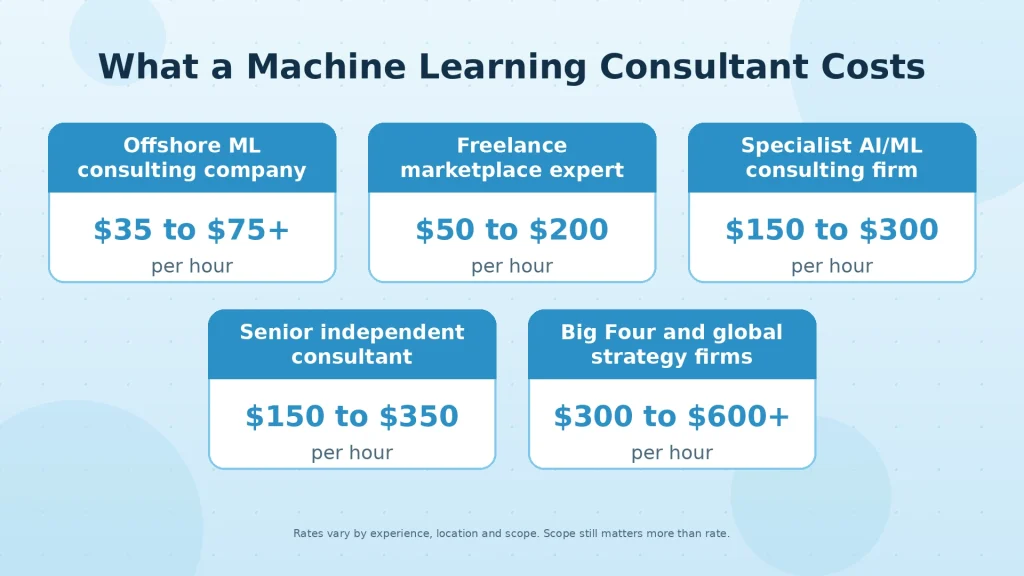
A machine learning consultant costs $35 to $75+ an hour at an offshore firm and $50 to $200 on freelance marketplaces. Senior independents and US specialist firms charge $150 to $350 or more, and large strategy firms charge the most. Total project cost depends far more on scope and data quality than on the hourly rate.
Hourly rates by type of consultant
| Provider type | Typical hourly rate (USD) | Best for |
|---|---|---|
| Offshore ML consulting company (for example, India) | $35 to $75+ | Full builds where you want a whole team at a lower cost |
| Freelance marketplace expert | $50 to $200 | Well-defined tasks with clear specs |
| Specialist AI/ML consulting firm (US or Western Europe) | $150 to $300 | Strategy plus delivery with local presence |
| Senior independent consultant | $150 to $350 | Expert advice, reviews, and second opinions |
| Big Four and global strategy firms | $300 to $600+ | Board-level programs across many countries |
Machine learning consultant rates vary depending on experience, location, project complexity, and engagement type. Upwork’s hiring guide puts machine learning engineers on its marketplace at $50 to $200 an hour, with beginners at the low end and senior engineers above $120. For a salary benchmark, the U.S. Bureau of Labor Statistics reports a median wage for data scientists of $120,230 a year, about $57.80 an hour, as of May 2025.
That gap between salary and consulting rates is normal. A firm’s rate covers project management, QA, cloud setup, time between projects, and the cost of replacing someone if they leave.
Rates by region
| Region | Typical AI/ML firm rate (USD per hour) |
|---|---|
| United States | $150 to $300 |
| Europe, including the UK | $50 to $250 |
| Israel | $100 to $235 |
| Australia | $100 to $200 |
| India | $35 to $75+ |
The UK figure comes from ITJobsWatch contract data, based on a small number of advertised roles, so treat it as a signal rather than a rule. The firm rates match the ones in our AI development cost guide, so you can compare the two articles directly.
Project costs by stage
| Engagement | Scope | Typical cost (USD) | Timeline |
|---|---|---|---|
| Readiness assessment | Use-case ranking, data audit, plan | $5,000 to $25,000 | 2 to 6 weeks |
| Proof of concept | One model on real data, tested against the baseline | $5,000 to $40,000 | 1 to 3 months |
| First production model | Model, integration, MLOps, monitoring | $50,000 to $250,000 | 4 to 6 months |
| Enterprise ML program | Several models, shared data platform, governance | $250,000 to $1,000,000+ | 6 to 12+ months |
| Ongoing support (yearly) | Hosting, monitoring, retraining, fixes | $15,000 to $75,000 per year | Ongoing |
These are indicative estimates as of November 2026. Actual costs depend on scope, integrations, compliance needs, and team location.
Assumptions: a mid-complexity use case and a blended team (consultant, data engineer, ML engineer, part-time project manager). Cloud hosting is billed separately, and there’s no large-scale data labeling. Labeling thousands of records by hand can add a lot to the bill, so ask about it early.
The ongoing line is the one buyers forget. A model that isn’t retrained slowly gets worse as customer behavior, prices, or routes change.
Why do top AI consultants charge multinational companies the highest rates?
Top AI consultants charge multinational companies the most because the work carries more risk and needs more people. A global rollout means many data sources, many countries’ privacy rules, senior people who’ve done it before, and a firm willing to stand behind the result. Large firms often sell this as ML professional services bundled with change management, which means training teams and changing processes so people actually use the model. A smaller company with one clear use case rarely needs that layer, and shouldn’t pay for it.
Machine Learning Consultant vs In-House Team vs ML Outsourcing
Hire a consultant to prove a use case, then outsource the build to an ML development partner. Hire in-house once ML is core to your product. Most companies move through these options in that order.
| Option | Best when | Speed to start | Cost pattern | Main risk |
|---|---|---|---|---|
| Independent ML consultant | You need advice, a review, or a quick feasibility check | Days | Hourly or daily | Limited capacity for a full build |
| ML consulting company or outsourcing partner | You need a full team to design, build, and deploy | 1 to 3 weeks | Fixed price or monthly team | Weak knowledge transfer if not planned |
| Dedicated offshore ML team | You have a roadmap and want ongoing capacity | 2 to 4 weeks | Monthly per person | Needs clear direction from your side |
| In-house ML team | ML is central to your product and long-term edge | 3 to 6 months to hire | Salaries, benefits, tools | Slow to hire, hard to keep |
ML outsourcing makes the most sense when you need several skills at once (data engineering, modeling, MLOps, and app integration) but not full-time forever. A software development partner with AI and ML expertise can cover all four, which is the main reason to pick one over a single freelancer. If you already have a product team and only need specialists, Logix Built can provide dedicated ML developers or MLOps engineers to join it.
Many teams do best with a mixed setup. An outside partner builds the first model while one internal person sits in on every key decision, and that person becomes the owner when the partner steps back.
How to Choose a Machine Learning Consultant
Choose an ML consultant by checking three things in order: production proof, data engineering strength, and a clear handover plan. Accuracy claims on a demo dataset tell you very little.
Use these steps to compare providers:
- Ask for two or three models they have maintained in production for at least six months. Find out which performance metrics they monitor and how they respond when model performance declines.
- Ask how they’ll check your data before building anything. A firm that skips this step will find the problems later, on your budget.
- Ask which baseline their model must beat, such as your current rule, a spreadsheet, or a simple statistical method.
- Ask which MLOps maturity level you’ll have at handover, using Google Cloud’s level 0 to 2 scale as a common reference.
- Check how they handle sensitive data. Certifications such as ISO/IEC 27001 and SOC 2 show a security process exists, but ask how they apply it to your data.
- Confirm who owns the code, the trained models, and any derived data when the contract ends.
- Meet the people who’ll actually do the work, not only the sales team.
Regulation is part of the choice if your model affects people. The EU’s revised AI Act timeline, approved by the Council in June 2026, applies high-risk rules to stand-alone systems from December 2, 2027. That category includes hiring tools and credit scoring, so a consultant building one for EU users should already be planning documentation and human oversight.
Our longer guide on how to choose an AI development company covers contract models and evaluation in more detail.
Red flags when hiring an ML consultant
| Red flag | Why it’s a problem |
|---|---|
| Promises a specific accuracy before seeing your data | Nobody can know that in advance |
| Only shows pilots and demos | A successful pilot does not guarantee reliable production performance. |
| No talk of monitoring or retraining | The model will quietly get worse |
| Won’t name the people on your project | You may get a junior team after the sale |
| Vague about IP ownership | You could end up renting your own model |
If two or more of these show up in the first call, keep looking. A good consultant is usually the one asking you harder questions than you’re asking them.
Comparing ML Consulting Proposals?
Send us your use case and any quotes you’ve received. We’ll tell you what’s missing and what a realistic scope looks like.
What to Put in a Machine Learning Consulting Contract?
The agreement should define success before work starts and clearly state what you’ll own when the project ends. Disputes can arise when project goals, deliverables, and responsibilities are not clearly documented.
Include these items:
- A written problem statement and one main success metric, such as “reduce missed deliveries by X%” rather than “build a model”.
- The baseline the model must beat, measured before training starts.
- A data audit report as an early deliverable, with a go or no-go point after it.
- A model card: a short document listing what the model does, what data trained it, and where it performs poorly.
- Deployment into a named system, not a model file sent by email.
- A monitoring and retraining plan, with who does what after launch.
- Handover sessions, documentation, and a runbook your team can follow.
- Clear ownership of code, models, and pipelines.
The go or no-go point after the data audit is the most useful clause on this list. It gives both sides an honest exit if the data can’t support the use case, and it keeps the bigger budget safe until the risk is known.
Key takeaways
- Bring in outside ML help when you have a repeated, measurable decision and no in-house ML team to prove it can be predicted.
- Data quality decides most ML projects, so the first paid step should be a data audit, not model building.
- Offshore ML consulting companies charge $35 to $75+ an hour, while US specialist firms charge $150 to $300.
- Judge a consultant by models they’ve kept running in production, not by demos or pilots.
- Agree on the success metric and the baseline it must beat before any training starts.
How Logix Built Helps You Put Machine Learning Into Production
Hiring the right machine learning consultant comes down to proof. You want a use case tied to a real decision, data checked before modeling, and a model that keeps working after handover.
Logix Built is an AI-powered software development company that builds custom software, web apps, and mobile apps for startups and enterprises. Our AI consulting services start with a data assessment and use-case ranking, then move into a proof of concept, deployment, and monitoring.
For AI-Recruiter, we built a recruitment platform that ranks candidates by skills and experience using embeddings and parses resumes into structured data, delivered in 5 months.
For Security Review AI, our team built AI-driven threat modeling with predictive risk analysis, which the client page reports cut security review timelines from weeks to minutes.
FAQs on Machine Learning Consultants
How long does a machine learning consulting project take?
Most ML consulting projects take 2 to 6 weeks for an assessment and 1 to 3 months for a proof of concept. A first production model usually takes 4 to 6 months. Timelines grow when data is spread across many systems, needs manual labeling, or falls under strict privacy rules.
How much data do I need to work with an ML consultant?
There's no fixed number, but you need enough past examples of the outcome you want to predict. For many business problems, 12 months or more of consistent records is a sensible starting point. A good consultant will check your data volume and quality in the first few weeks and tell you if it's not enough.
Who owns the model after an ML consulting engagement ends?
The client should own the model, code, and pipelines, but only if the contract says so. Some firms keep ownership of their tools or license the trained model back to you. Ask for written ownership of everything built on your data, including the trained model files and training scripts.
Can machine learning consulting help with ESG reporting?
Yes, for the data-heavy parts. An ML consultant can help classify supplier spend into emission categories, forecast energy use, and flag unusual readings for review. Machine learning ESG consulting doesn't replace sustainability experts, who still decide which methods and emission factors meet your reporting rules.
How does Logix Built price machine learning consulting?
Logix Built doesn't publish fixed rates for ML consultant services. Each engagement is priced from a scoped estimate based on the use case, data condition, integrations, and team size. Most clients start with a short assessment, which gives them a clearer scope and quote for the build before they commit to it.

Chirag Patel is the Chief Technology Officer at Logix Built Solutions Limited with 11+ years of experience in engineering scalable digital platforms. He specializes in CRM development, eCommerce solutions, and customer experience technologies designed to improve engagement, retention, and conversion. Chirag leads end-to-end product engineering with a strong focus on performance, automation, and architecture design, enabling businesses to deliver seamless digital experiences and achieve sustainable growth in competitive markets.