Published Date: November 19, 2025
Written By:Chirag Patel
In the current age of digitalization, companies of every size and caliber depend on cloud computing to house data, run applications, and expand their IT infrastructure economically. As a beginner or when moving your business to the cloud, it is important to know about cloud deployment models.
In this blog article, we will discuss what is cloud deployment model, the types of cloud deployment models, and provide real cloud deployment models examples so that it could be made simple to understand.
What is Cloud Deployment Model?
A cloud deployment model dictates how cloud services are made available to customers, who accesses them, and where the resources are located. It essentially determines the architecture, accessibility, and management of cloud computing resources.
When you begin encountering cloud computing deployment models, treat them as the map used to provide cloud services. Choosing the right cloud deployment model for cloud computing renders your data secure, applications scalable, and cost-effective. Businesses can also hire cloud developers to help implement and manage their chosen cloud environment.
In simple terms, when asked to explain cloud deployment models,it is the method that decides how, where, and by whom cloud services are provided and utilized.
Types of Cloud Deployment Models
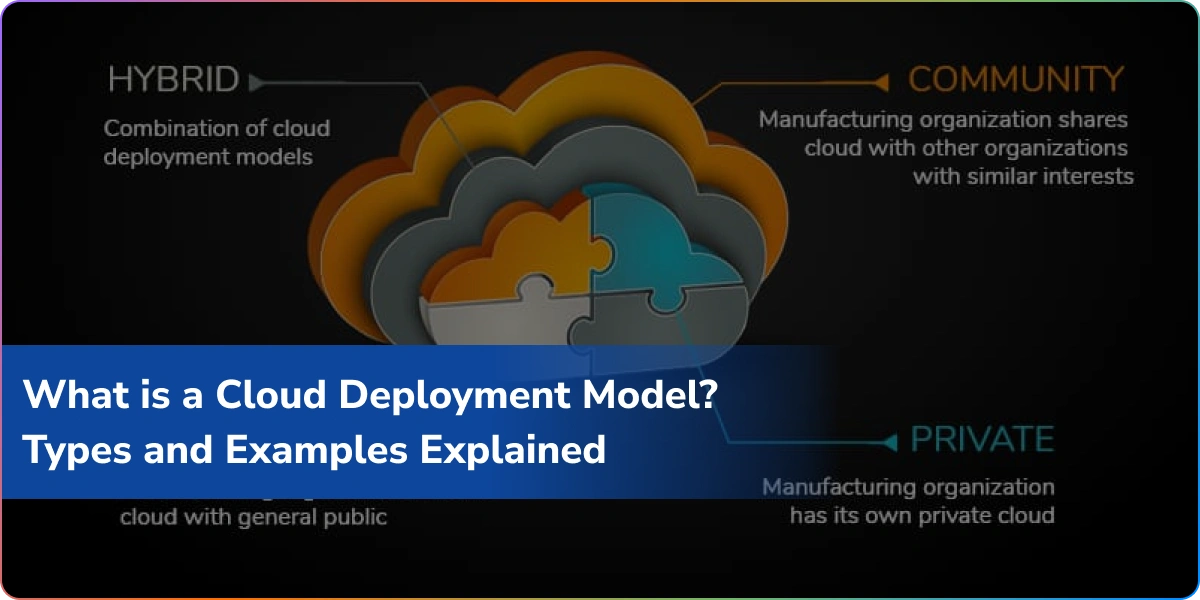
There are broadly four types of cloud deployment models that companies use today:
- Public Cloud Deployment Model
- Private Cloud Deployment Model
- Hybrid Cloud Deployment Model
- Community Cloud Deployment Model
Let us explain cloud deployment models in detail.
1. Public Cloud Deployment Model
The public cloud deployment model is a cloud infrastructure provided by third-party vendors including Amazon Web Services (AWS), Microsoft Azure, and Google Cloud Platform. Organizations using Azure can hire Azure developers to build, deploy, and manage their cloud applications. Businesses that need specialized AWS expertise can hire AWS developers to build and manage cloud-based solutions. In the cloud environment, the infrastructure is shared among numerous organizations, thus cost-saving and scalable.
Key Features:
- Shared multiple-tenant resources
- Pay-as-you-go pricing model
- Flexible and scalable for any size business
Use Cases / Cloud Deployment Models Examples:
- Hosting websites and online stores
- Development and test environments
- Big data analytics and AI workloads
Advantages:
- Lower cost through shared infrastructure
- Simple to scale up or down on demand
- Handled by the cloud provider, releasing IT maintenance
Disadvantages:
- Less control over security and data privacy
- Slightly fewer customization options
The public cloud deployment model is ideal for startups, small businesses, and projects that require rapid scalability.
2. Private Cloud Deployment Model
Unlike the public cloud, the private cloud deployment model provides exclusive resources for a single organization. Either the infrastructure is hosted internally or by a third-party vendor, with greater security, control, and customization.
Key Features:
- Exclusive infrastructure for a single organization
- Greater security and privacy
- May be hosted internally or by a third-party vendor
Use Cases / Cloud Deployment Models Examples:
- Financial institutions that store sensitive customer data
- Governmental agencies with confidential data
- Big businesses with stringent compliance requirements
Benefits:
- Complete control over infrastructure and data
- Ensure security and regulatory compliance
- Scalable to meet the exact business needs
Disadvantages:
- More expensive than public clouds
- Requires technical expertise for administration
The private cloud deployment model is suitable for businesses that handle sensitive information, such as healthcare organizations and banks.
3. Hybrid Cloud Deployment Model
A hybrid cloud deployment model is a combination of private and public clouds. It gives companies the choice of using the private cloud for sensitive workloads and the public cloud for non-sensitive workloads.
Key Features:
- Merges public and private cloud benefits
- Workloads are transferable between private and public clouds
- Coaxes flexibility and cost-optimized
Use Cases / Cloud Computing Deployment Models Examples:
- e-commerce companies using public cloud for traffic spikes and private cloud for payments
- Companies running analytics on the public cloud but storing sensitive information privately
- Backup and disaster recovery solutions
Advantages:
- Flexibility to deploy resources wherever needed
- Cost reduction by deploying public cloud for less sensitive workloads
- Ensures business continuity and disaster recovery
Disadvantages:
- May be complex to handle and integrate
- It is important to handle security and compliance with care
The hybrid cloud deployment model is ideal for organizations that want a balance between scalability, cost, and control.
4. Community Cloud Deployment Model
The community cloud deployment model is a shared infrastructure among organizations with common needs or compliance requirements. It is generally governed and administered by the community or a third-party provider jointly.
Key Features:
- Shared among organizations with common problems
- Shared cost and resources among participants
- Maintains compliance requirements
Use Cases / Cloud Deployment Models Examples:
- Research institutions collaborating on projects
- Healthcare institutions regulated under HIPAA
- Government institutions sharing resources
Advantages:
- Allows for regulatory and compliance needs
- Supports collaboration and shared competency
- Economical for similar organizations
Disadvantages:
- Limited to community organizations
- Less control over infrastructure compared to private clouds
The community cloud deployment model is suitable for groups of organizations in need of sharing resources, but also for particular compliance needs.
Key Points for Choosing a Cloud Deployment Model
The choice of a suitable cloud computing deployment models depends on the following points:
- Security Requirements: Sensitive data may need to be in private or hybrid cloud setups
- Cost Factors: Public cloud models are cost-effective, and private clouds might be more expensive.
- Compliance Factors: Health care and financial sectors may require private or community clouds.
- Scalability Requirements: Public and hybrid clouds offer high scalability for changing workloads.
- Management Control: Specify the level of control your organization desires over infrastructure management.
Cloud Deployment Models Examples in Real Life
The following are some real-life examples of cloud computing deployment models to understand how businesses make use of these models:
- Netflix: Employs a public cloud deployment model (AWS) to broadcast films globally.
- Banking Institutions: Typically employ a private cloud deployment model to secure sensitive financial data.
- Large Enterprises: Employ hybrid cloud deployment models to host both mission-critical applications and elastic operations.
- Healthcare Networks: Use community cloud computing deployment models to satisfy the HIPAA mandates, taking advantage of shared resources.
Explaining Cloud Deployment Models: Public vs Private vs Hybrid
Understanding cloud deployment models becomes simpler when you compare them:
| Deployment Model | Control | Cost | Security | Scalability | Example |
| Public Cloud | Low | Low | Moderate | High | AWS, Google Cloud |
| Private Cloud | High | High | High | Moderate | Internal enterprise cloud |
| Hybrid Cloud | Medium | Medium | High | High | Large enterprise with mixed workloads |
| Community Cloud | Medium | Medium | High | Medium | Healthcare consortium |
Advantages of Cloud Deployment Models: Knowledge
Cloud deployment model knowledge is advantageous to organizations in the following manner:
- Save Costs: Choose a model that fits budget needs and avoids unnecessary spending.
- Boost Security: Determine the model that most effectively protects sensitive information.
- Compliance Enhancement: Opt for deployment models that meet industry compliance.
- Scales Better: Ensure the infrastructure scales to accommodate traffic peaks and growth.
- Gain Efficiency: Streamline IT operations and reduce management overhead.
With the understanding of cloud deployment models in cloud computing, businesses can strategically plan their cloud journey and maximize ROI.
Misunderstandings in Cloud Deployment Models
- “Public cloud is insecure” – New public clouds have robust security capabilities.
- “Private cloud is always better” – Private clouds give control but are more costly.
- “Hybrid cloud is complicated” – Despite the need for careful integration, the flexibility outweighs the complication.
- “All cloud services are the same” – All models cater to varying business requirements, so choice is paramount.
How to Choose the Best Cloud Deployment Model
Follow these steps to choose the best cloud deployment model for your company:
- Assess Your Workloads: Decide which apps require the highest security, scalability, or cost efficiency.
- Evaluate Compliance Requirements: Determine industry requirements affecting data storage and processing.
- Set Budget & Resources: Decide how much you’re willing to invest in cloud infrastructure and management.
- Consider Long-Term Goals: Make sure the selected model supports future expansion, growth, and trends in technology.
- Test & Experiment: Begin small and build up gradually to prevent disruption and ensure optimal performance.
Conclusion
Cloud deployment models must be realized by business companies that are in need of flexible, secure, and scalable IT solutions. Be it a public cloud deployment model for small firms, a private cloud deployment model for confidential data, a hybrid cloud deployment model for balance, or a community cloud deployment model for collaboration, each deployment model addresses certain business needs.
By learning about cloud deployment models examples and defining cloud deployment models in cloud computing, businesses are able to make informed decisions that cut expenses, enhance security, and enhance operational efficiency.
Ready to choose the perfect cloud deployment model for your business? Contact our cloud experts at Logixbuilt Solutions today to get a tailored cloud strategy and implement the right deployment model with our cloud development services to meet your needs. To meet your needs. Optimize the advantages of cloud computing and drive your business towards efficiency and expansion!
FAQ's
What are the types of cloud deployment models?
Public Cloud: Shared, scalable, cost-effective Private Cloud: Secure, controlled, dedicated Hybrid Cloud: Mixture of public & private Community Cloud: Shared within similar organizations
How to choose the correct cloud deployment model?
To choose the correct model, one should consider security, budget, compliance, and scalability needs.
Can a company employ more than one model?
Yes, a hybrid model has the benefits of public as well as private clouds.
What are the examples of cloud deployment models?
Netflix: Public cloud Banks: Private cloud Enterprises: Hybrid cloud Healthcare networks: Community cloud

Chirag Patel is the Chief Technology Officer at Logix Built Solutions Limited with 11+ years of experience in engineering scalable digital platforms. He specializes in CRM development, eCommerce solutions, and customer experience technologies designed to improve engagement, retention, and conversion. Chirag leads end-to-end product engineering with a strong focus on performance, automation, and architecture design, enabling businesses to deliver seamless digital experiences and achieve sustainable growth in competitive markets.