Published Date: October 29, 2026
Written By:Chirag Patel
A 50-person sales team on Salesforce’s Core edition pays $117,000 a year in list-price licenses before any customization. That bill is why many companies start pricing their own CRM.
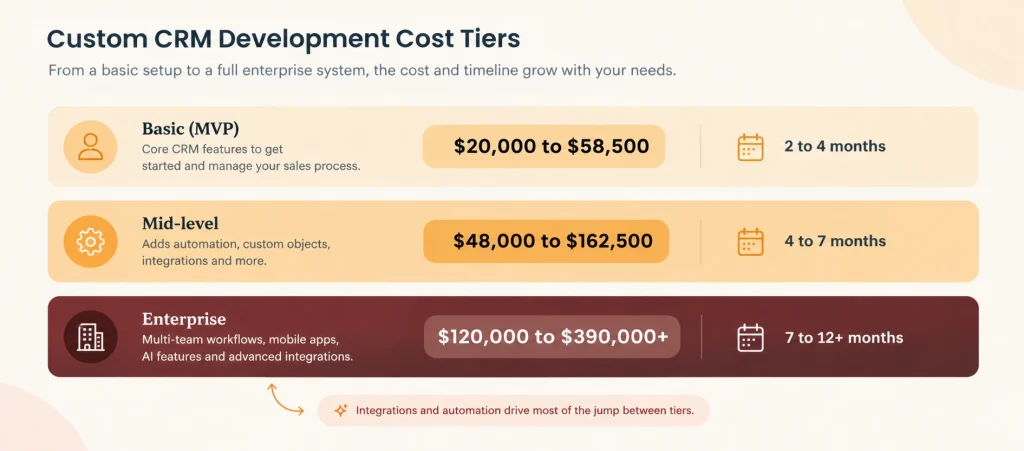
Custom CRM development costs in 2026 typically range from $20,000 to $58,500 for a basic CRM and $48,000 to $162,500 for a mid-level system with automation and integrations. Enterprise builds run $120,000 to $390,000+ or more. Most projects take 2 to 12 months, and yearly upkeep adds about 15% to 20% of the build cost.
You’ll see what each feature and stage costs, how location changes the price, what you’ll pay after launch, and when building beats a subscription.
Key takeaways
- Scope drives CRM development cost more than technology does. A CRM with contacts, a pipeline, and reports costs a fraction of one with custom objects, five integrations, and a mobile app.
- Every price tier in this guide is hours multiplied by a blended rate, so you can check any quote with the same formula.
- Integrations, email sync, and data migration are where CRM budgets usually slip, not screens.
- At Salesforce’s September 2026 list prices, a mid-level custom CRM usually costs less over three years once you pass about 30 to 35 users on Core seats.
- Under about 20 users with a standard sales process, buying or customizing an existing CRM is usually the smarter spend.
How Much Does Custom CRM Development Cost in 2026?
A custom CRM costs $20,000 to $390,000 or more in 2026, depending on workflows, integrations, and user roles. Most mid-sized businesses land between $48,000 and $162,500 for a first version their sales team will use every day.
The honest answer to “how much does it cost to develop a CRM?” is a range, because no two sales processes are the same. These three tiers cover most projects.
| CRM tier | Cost (USD) | What’s included | Typical effort | Timeline |
|---|---|---|---|---|
| Basic (MVP) | $20,000 to $58,500 | Contacts, accounts, leads, deal pipeline, tasks, email sync, simple reports, 2 to 3 user roles | 500 to 900 hours | 2 to 4 months |
| Mid-level | $48,000 to $162,500 | Everything in basic, plus workflow automation, custom objects, dashboards, 3 to 5 integrations, data migration | 1,200 to 2,500 hours | 4 to 7 months |
| Enterprise | $120,000 to $390,000+ | Multi-team workflows, ERP and legacy integrations, mobile apps, AI features, single sign-on, audit logs, compliance controls | 3,000 to 6,000+ hours | 7 to 12+ months |
The jump from basic to mid-level comes mostly from integrations and automation, not from extra screens.
Assumptions: a blended team rate of about $40 to $65 per hour, which is common for experienced offshore and mixed onshore-offshore teams. The team includes a project manager, a designer, 2 to 5 developers, and a QA tester. Hosting, licenses, and post-launch support are excluded. A US-only agency billing $100 to $200 per hour can push each range up by roughly 1.5 to 5 times.
These are indicative estimates as of October 2026. Actual costs depend on scope, integrations, compliance needs, and team location.
As a sanity check, Clutch’s 2026 software development pricing guide puts the average project reviewed on its platform at about $132,480, which sits inside the mid-level band. If you’re still deciding what a CRM should do for your business, our guide to customer relationship management covers the basics.
What Does Each CRM Feature Cost to Build?
CRM development cost per feature ranges from about $3,000 for basic contact records to $60,000 or more for native mobile apps.
| CRM feature | Indicative cost (USD) | What drives the price |
|---|---|---|
| Contacts and accounts | $3,000 to $8,000 | Custom fields, duplicate detection, import tools |
| Leads and lead routing | $3,000 to $10,000 | Scoring rules, assignment logic |
| Deal pipeline | $4,000 to $12,000 | Custom stages, approvals, forecasting |
| Activity timeline with email and calendar sync | $8,000 to $25,000 | Two-way Gmail and Outlook sync, threading, duplicates |
| Reports and dashboards | $5,000 to $20,000 | Number of views, real-time data, filters |
| Workflow automation | $8,000 to $30,000 | Simple triggers vs a visual builder with branches |
| Each third-party integration | $4,000 to $20,000 | API quality, one-way vs two-way sync |
| Customer or partner portal | $12,000 to $35,000 | Separate login, permissions, security testing |
| Native mobile apps (iOS and Android) | $20,000 to $60,000 | Offline mode, sync conflicts |
| AI features (lead scoring, summaries, assistants) | $10,000 to $50,000+ | Data quality, model API costs, human review steps |
Don’t add these numbers up to get a total. Features share the same database, login system, and API layer, so a full build usually costs less than the sum of its parts.
Email sync is the feature buyers most often underestimate. Gmail and Outlook can deliver events late, twice, or out of order, so the CRM has to sort and de-duplicate them before anything appears on a contact’s timeline. If reps can’t see their emails in the CRM, they stop using it, and the whole investment loses value.
Where Does the CRM Budget Go, Stage by Stage?
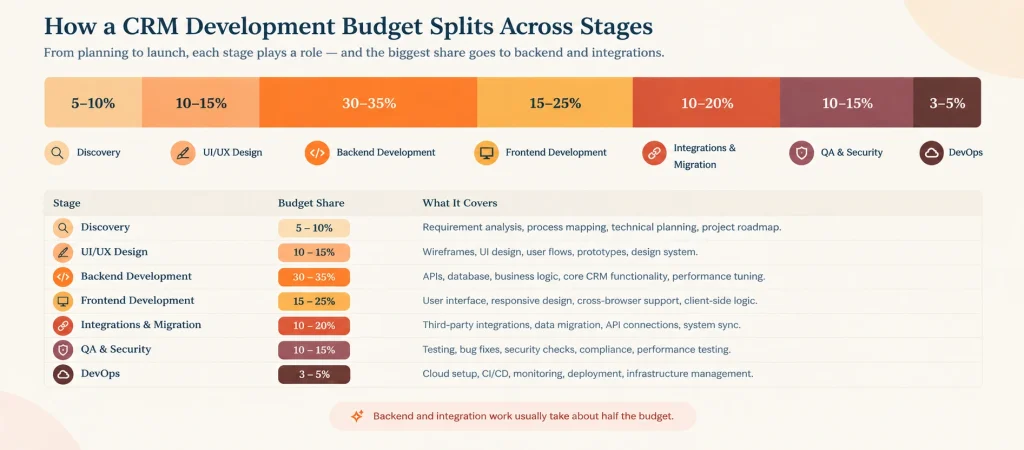
Backend work and integrations take the biggest share of a custom CRM budget, often 40% to 55% together. Discovery and design usually take 15% to 25%.
| Development stage | Share of budget | Example on a $100,000 build | What happens |
|---|---|---|---|
| Discovery and planning | 5% to 10% | $5,000 to $10,000 | Workflow mapping, data model, integration list, written scope |
| UI/UX design | 10% to 15% | $10,000 to $15,000 | User flows, wireframes, clickable prototype |
| Backend and data model | 30% to 35% | $30,000 to $35,000 | Database, business rules, permissions, APIs |
| Frontend | 15% to 25% | $15,000 to $25,000 | Screens, pipeline boards, dashboards |
| Integrations and data migration | 10% to 20% | $10,000 to $20,000 | Email, calendar, ERP, accounting, old CRM import |
| QA and security testing | 10% to 15% | $10,000 to $15,000 | Functional, regression, load, and access-control tests |
| Deployment and DevOps | 3% to 5% | $3,000 to $5,000 | Cloud setup, backups, monitoring, release pipeline |
Cutting discovery to save $5,000 is the most common false economy. A data model fixed in week two costs far less than one rebuilt in month five.
Ask every vendor for this stage split in writing, because it makes quotes easy to compare. On custom CRM development projects, Logix Built prices each stage separately so buyers can see where their money goes.
What Drives CRM Software Development Cost Up or Down?
Six factors decide most CRM software development cost: workflows, the data model, integrations, data migration, security, and the platforms you support. Each one can move a quote by tens of thousands of dollars.
Workflow complexity and automation
A CRM that follows one straight sales funnel is cheap to build. Costs rise with branching approvals, territory rules, commission logic, or a different pipeline for each product line. Simple trigger-and-action automation (“when a deal reaches Proposal, alert the manager”) covers most needs. A drag-and-drop workflow builder with branches can cost two to three times as much.
Custom objects and the data model
Standard CRMs think in contacts, companies, and deals. A freight broker needs loads and lanes. A clinic needs patients and referrals. Each custom object adds its own tables, screens, permissions, and reports, and the cost climbs quickly once you pass two or three. A distributor, for example, often needs price lists, credit limits, and order history inside the CRM. That’s why CRM software for distributors is scoped differently from a sales-only CRM.
Integrations
Each integration costs $4,000 to $20,000. A one-way calendar sync sits at the low end. A two-way ERP sync that must handle conflicts, retries, and partial failures sits at the high end. Old systems with no API cost the most, because the team has to build a workaround first. If you’re still deciding which system should own orders and invoices, our CRM vs ERP comparison helps you draw that line before you pay for two-way sync.
Data migration
Moving years of records from spreadsheets or an old CRM is rarely a copy-and-paste job. Duplicates, missing fields, and conflicting customer IDs must be cleaned and mapped first. Budget $3,000 to $25,000, and more if the old data is messy.
Security, user roles, and compliance
Basic role-based access is cheap. Field-level permissions, audit logs, single sign-on (SSO), and encryption key management add design, code, and testing time. Rules such as the Health Insurance Portability and Accountability Act (HIPAA) or the EU General Data Protection Regulation (GDPR) add more. Plan these in discovery, because adding them after launch often means reworking the database.
Platforms and AI features
A responsive web app works on phones and suits most office-based teams. Native iOS and Android apps with offline mode add $20,000 to $60,000. AI features such as lead scoring only work well when the CRM holds enough clean history, so many teams add them in a second release. AI also brings monthly model usage fees on top of the build cost.
Not Sure Which Tier Your CRM Falls Into?
Share your workflows and the tools you use today, and our team will map them to a scoped, stage-by-stage estimate.
How Team Location Changes the Cost to Develop a CRM System
The same CRM can cost $45,000 or $360,000 depending on where the team sits, because hourly rates differ by up to eight times between regions. This table prices one mid-level CRM of 1,800 hours in each region.
| Region | Cost of a 1,800-hour mid-level CRM | Typical agency rate (USD per hour) |
|---|---|---|
| US and Canada | $180,000 to $360,000 | $100 to $200 |
| UK and Western Europe | $126,000 to $270,000 | $70 to $150 |
| Eastern Europe | $72,000 to $144,000 | $40 to $80 |
| Latin America | $63,000 to $135,000 | $35 to $75 |
| India | $45,000 to $90,000 | $25 to $50 |
Location changes the price far more than the tech stack does. But the cheapest rate only saves money if the team ships with little rework.
Clutch’s 2026 pricing data shows most development companies listed on its platform charge roughly $25 to $49 per hour. Building in-house in the US is a different calculation. The U.S. Bureau of Labor Statistics puts the median software developer wage at $135,980 a year as of May 2025, about $65 an hour before benefits, taxes, tools, and management. Three developers and one QA tester at median pay already cost about $544,000 a year in wages.
If you consider an offshore team, judge process maturity as well as price. Logix Built, for example, holds CMMI Level 5 certification, a model that rates how measured and repeatable a company’s delivery process is.
Weighing a Build Against Your Current Seats?
Bring your user count and current CRM bill, and we’ll compare a custom build with your subscription over three years.
What Does a Custom CRM Cost After Launch?
After launch, a custom CRM usually costs 15% to 20% of the original build each year for maintenance, plus hosting and third-party fees.
| Cost item | Typical range (USD) | One-time or ongoing |
|---|---|---|
| Data migration | $3,000 to $25,000 | One-time |
| Training and rollout | $2,000 to $15,000 | One-time |
| Maintenance and support (bug fixes, security patches, updates) | 15% to 20% of build cost per year | Ongoing |
| Cloud hosting, backups, monitoring | $200 to $3,000 per month | Ongoing |
| Third-party services (email sending, SMS, telephony, maps) | $50 to $1,500 per month | Ongoing |
| AI model API usage | $100 to $5,000 per month, based on usage | Ongoing |
| Security testing and compliance audits (regulated industries) | $5,000 to $30,000 per year | Ongoing |
Over three years, these running costs can add 50% or more to the original build price. Compare quotes on total cost, not build cost alone.
The upside is that none of these costs grow per user the way subscription seats do. That difference is what makes the build-versus-buy math work at scale.
Custom CRM vs Salesforce: When Does Building Pay Off?
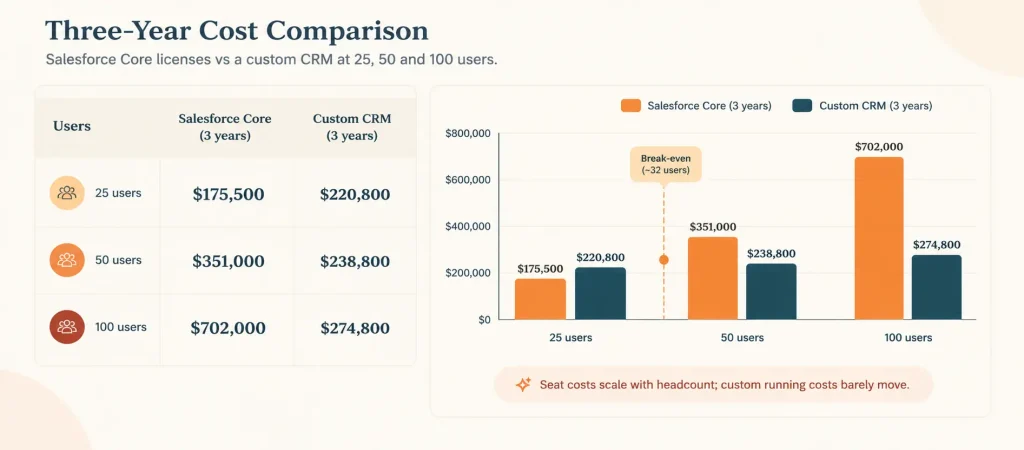
A custom CRM usually beats Salesforce on three-year cost once you pass about 30 to 35 users on Core-level seats. Below that, buying is usually cheaper.
Salesforce’s official Sales Cloud pricing, updated in September 2026, lists five paid editions. Starter Suite costs $25, Pro Suite $100, Core $195, Advanced $395, and Max $550 per user per month. Agentforce for Sales costs extra, from $125 per user per month.
For the custom side, we assume a $120,000 mid-level build and 18% yearly maintenance ($21,600). Hosting and services are set at $12,000, $18,000, and $30,000 a year for 25, 50, and 100 users.
| Users | Salesforce Core licenses, 3 years | Custom CRM, 3 years | Difference |
|---|---|---|---|
| 25 | $175,500 | $220,800 | Salesforce cheaper by $45,300 |
| 50 | $351,000 | $238,800 | Custom cheaper by $112,200 |
| 100 | $702,000 | $274,800 | Custom cheaper by $427,200 |
License fees grow with every hire, while custom CRM running costs grow slowly, so the gap widens fast after the break-even point.
This comparison leaves out Salesforce implementation partners, add-ons, and negotiated discounts, which can move the line either way. It also ignores what a mature platform gives you on day one: a large app marketplace, tested AI features, and a vendor that handles upgrades.
When buying or customizing is the better call
Choose a custom CRM when your sales process doesn’t fit standard pipelines or your seat costs pass about $75,000 a year. It also fits when the CRM is part of a product you sell. Buy Salesforce, HubSpot, or Zoho when your team has fewer than about 20 users and your process looks like a standard funnel. Customize an existing platform when it already covers about 80% of what you need.
Logix Built also provides Salesforce developers for teams that decide extending their current CRM is smarter than replacing it.
Whichever route you pick, adoption matters more than the platform. Nucleus Research found in 2024 that CRM returns an average of $3.10 for every dollar spent, and that productivity and process gains make up 51% of that return.
What Does a CRM for Distributors and Wholesalers Cost?
A CRM for a trading or distribution business needs more than a sales pipeline. It has to know what each dealer can buy at what price, how much credit they have left, what they ordered last time, and where the goods are. Distributor CRMs follow the same tiers as the main price table, $20,000 to $390,000+ depending on scope.
The costs below assume a blended rate of $40 to $65 per hour, the same basis as the main price tiers. At India’s rates of $25 to $50 per hour, the same hours produce lower totals. Teams billing at India’s rates will see costs about 23% to 37% lower for the same hours. A basic trading CRM of 500 to 900 hours would cost about $12,500 to $45,000 instead of $20,000 to $58,500.
Price lists and credit limits are where these projects get complicated. Each dealer may have its own rates, and the CRM must flag or block an order that breaches a credit limit before it reaches the warehouse. Automated credit-limit approvals add rules and testing time, which is why they appear in the higher tiers.
Order history and dealer self-service matter because distributors expect to see past invoices, reorder their usual items, and track shipments without calling the sales office. A dealer portal is a separate build from the internal CRM and adds both frontend and backend scope.
ERP and Tally sync lets the CRM pull live stock, ledger balances, and credit limits instead of relying on re-keyed data. Connecting to Tally, SAP, or Zoho Books requires custom API development and testing, and this is often the largest single cost in a trading CRM.
Route and delivery tracking covers field check-ins, order booking on the go, and dispatch status. Native or hybrid mobile apps with geo-tracking add development overhead, but a basic dispatch tracking module is often enough for the first release.
| CRM type | What it Includes | Build cost (USD) | Timeline |
| Basic trading CRM | Leads, contacts, simple order logs, basic reports | $20,000 to $58,500 | 2 to 4 months |
| Mid-market distributor CRM | Dealer pricing tiers, WhatsApp and SMS alerts, follow-up automation, field sales app, basic dispatch tracking | $48,000 to $162,500 | 4 to 7 months |
| Enterprise ERP-linked CRM | Tally, SAP, or ERP sync, automatic credit-limit checks, multi-branch territories, dealer and supplier portals | $120,000 to $390,000+ | 7 to 12+ months |
Messaging modules such as the WhatsApp Business API, transactional SMS gateways, and automated payment reminders add setup and recurring licensing fees, so quotes should list them as separate line items.
Annual maintenance for these systems typically runs 15% to 20% of the build cost, covering bug fixes, security patches, and updates. Builds with live ERP and messaging integrations sit at the upper end of that range, because those connections need more frequent fixes when the other systems change. Hosting and server costs are billed separately.
| CRM type | Annual maintenance (USD) | Monthly equivalent (USD) |
| Basic trading CRM | $3,000 to $11,700 | $250 to $975 |
| Mid-market distributor CRM | $7,200 to $32,500 | $600 to $2,700 |
| Enterprise ERP-linked CRM | $18,000 to $78,000+ | $1,500 to $6,500+ |
How to Get a Reliable Custom CRM Development Cost Estimate
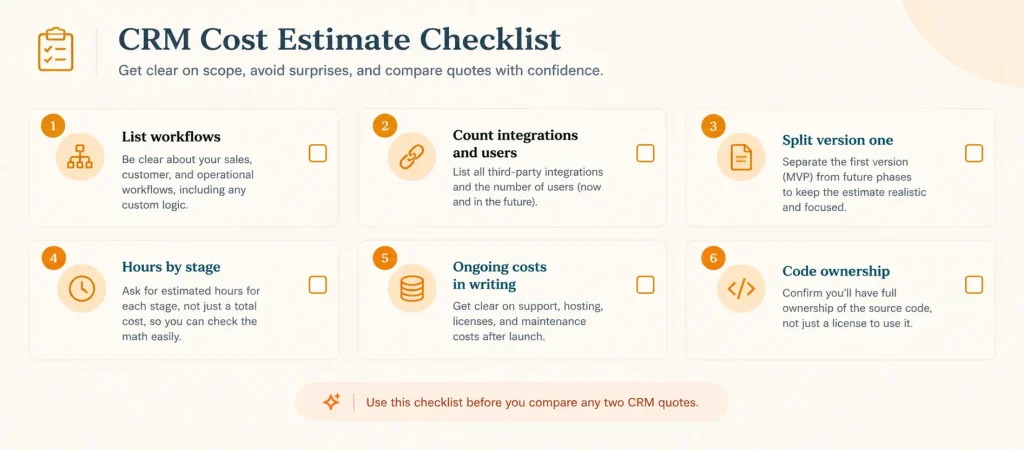
A reliable custom CRM development cost estimate comes from a written scope, not a feature list. Spend two to four weeks on discovery before you compare prices.
1. List your workflows, not features. Write down how a lead becomes a customer today, step by step, including every spreadsheet and workaround.
2. Count your integrations and users. Name every system the CRM must talk to and how many people will log in during year one.
3. Separate version one from later releases. Ship contacts, pipeline, timeline, email sync, reports, and roles first. Move AI, portals, and mobile apps to version two unless they’re essential.
4. Ask for hours by stage. A good quote shows hours and rates for each stage, plus what’s excluded.
5. Get ongoing costs in writing. Price maintenance, hosting, and support before you sign.
6. Confirm code and data ownership. Your contract should give you the source code, the database, and the deployment scripts.
Mistakes that push CRM budgets over
- Chasing feature parity with Salesforce in version one. Build what your team will use in the first 90 days and add the rest later.
- Leaving data migration until the end. Messy data found in the last month delays launch and adds cleanup costs.
- Testing with real users too late. Put 5 to 10 reps on the system before company-wide rollout, so problems surface while they’re cheap to fix.
- Picking the lowest hourly rate. A cheaper team that needs twice the hours or heavy rework costs more in the end.
- Having no owner for data quality. Without one person in charge of entry rules, reports stop being trusted within months.
How Logix Built Helps You Build a CRM Within Budget
A custom CRM pays off when it matches how your team sells and the costs are clear before the first sprint. The tiers, stage splits, and break-even math above give you a way to test any quote, including ours.
Founded in 2018, Logix Built is a CMMI Level 5 and ISO 9001:2015 certified software development company based in Surat, India. Its team of 110+ professionals has delivered 2,000+ projects for clients in 60+ countries, with a focus on AI, healthcare, fintech, logistics, CRM, and ERP. For CRM buyers, that means a measured delivery process and ISO/IEC 27001 certified handling of customer data.
Logix Built builds CRMs from scratch, extends platforms such as Salesforce, and connects CRMs to ERP and accounting systems. Our strongest CRM proof is TradeOne, a multi-tenant CRM we built and run at tradeonecrm.com. Explore Logix Built’s CRM development services, or contact our team for a scoped custom CRM development cost estimate for your workflows.
FAQs on Custom CRM Development Cost
Is a custom CRM worth it for a small business?
Usually not, unless your process is unusual. A team with fewer than about 20 users and a standard sales funnel will spend less on Salesforce Starter Suite or Pro Suite, HubSpot, or Zoho. A custom CRM makes sense for a small business when off-the-shelf tools force costly workarounds, or when the CRM is part of a product you sell.
How much does CRM maintenance cost per year?
Plan for 15% to 20% of the build cost each year. On a $100,000 CRM, that's $15,000 to $20,000 for bug fixes, security patches, framework updates, and small changes. Hosting, email and SMS services, and AI usage fees are billed separately. They depend on your user count and data volume.
Can I build on Salesforce or HubSpot instead of starting from scratch?
Yes. Customizing an existing platform is often the cheapest route when it covers most of your needs. You still pay per-user license fees, and heavy customization can make upgrades harder. Starting from scratch makes more sense when you need several custom objects, unusual workflows, or full ownership of the code.
Who owns the source code of a custom CRM?
You should own it. Your contract should transfer full ownership of the source code, database design, documentation, and deployment scripts to your company once you've paid. Check this before signing, because some vendors keep the rights to reusable modules or license the platform back to you.
How much does it cost to add AI to a CRM?
Most AI features cost $10,000 to $50,000 each to build, plus monthly model usage fees. Lead scoring, call and email summaries, and next-step suggestions are the most common. They work best once the CRM holds enough clean historical data, so many teams add AI in a second release.
How does Logix Built estimate CRM development cost?
Logix Built estimates a CRM from your workflows, integrations, user count, and compliance needs, then breaks the price down by development stage. Ongoing costs such as maintenance and hosting are listed separately, so you can compare the total with your current subscription.

Chirag Patel is the Chief Technology Officer at Logix Built Solutions Limited with 11+ years of experience in engineering scalable digital platforms. He specializes in CRM development, eCommerce solutions, and customer experience technologies designed to improve engagement, retention, and conversion. Chirag leads end-to-end product engineering with a strong focus on performance, automation, and architecture design, enabling businesses to deliver seamless digital experiences and achieve sustainable growth in competitive markets.