Published Date: September 4, 2026
Written By:Chirag Patel
For all growing businesses, whether big or small, keeping the books organized is an essential task. Many organizations adopt the practice of structuring the financial operations since beginning with ERP or accounting softwares. Both are capable of generating reports, recording transactions and handling finance.
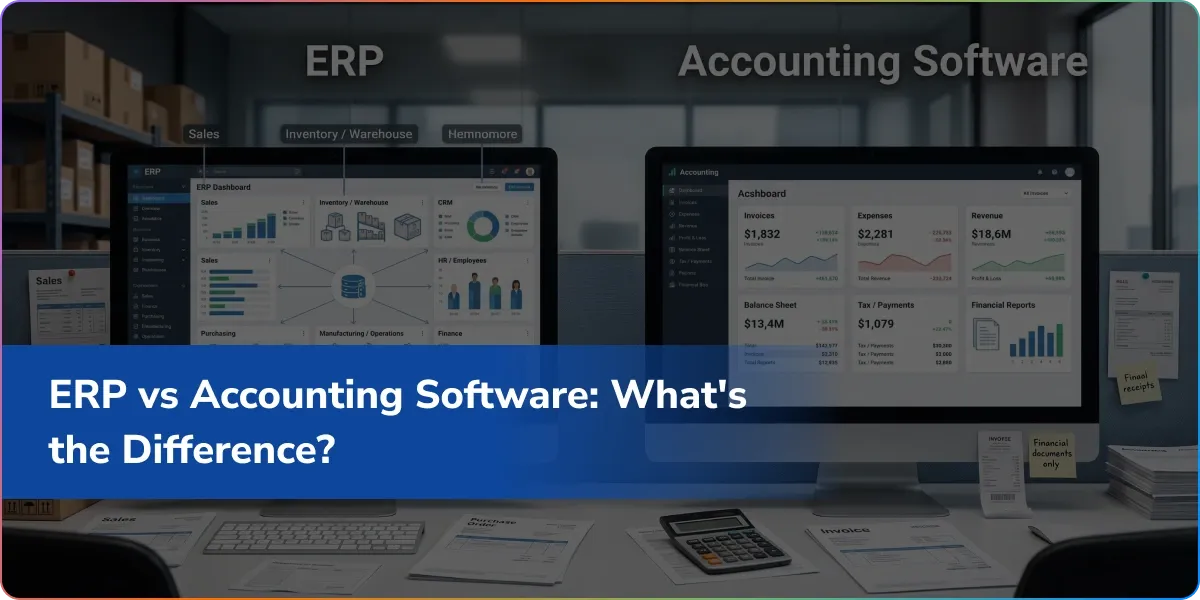
But then the real confusion of ERP vs Accounting software comes up. In general, Accounting software takes care of financial accounts, ledgers and reports. While ERP adjoins finance with other departments like procurement, operations, stock and HR all in one single platform.
In this blog, we will comprehend ERP vs Accounting Software differences and how to balance both in running a business.
What Is An ERP System?
Enterprise Resource Planning, i.e., ERP is a broader term as its name suggests. It is an extensive system that manages all the core operations of the company and incorporates them into one single platform. Apart from accounting, ERP handles the following areas too:
– Human Resources
– Supply Chain Management
– Stock Purchases
– Project Handling
– Warehouse and Stock Management
– Customer Relationship Management (CRM)
– Manufacturing and Production
It gives real-time updates across all departments on a unified dashboard. No segregation of departments is there.
What Is Accounting Software?
The accounting application tool is particularly built to handle financial accounts and transactions of the company. It mainly manages key financial aspects such as:
– Accounts Payables
– Accounts Receivables
– Invoicing & Billing
– Tax Reporting
– General Ledgers
– Bank Reconciliation Statements
– All the Financial Statements
– Payrolls Handling
– Financial Reporting
– Cost Monitoring
It reduces human errors in tax filing and calculations. With automation of record-keeping, you can get real-time insights of business profits and cash flows.
Key ERP vs Accounting Software Differences
Not Sure Which One Fits?
Cost, scalability, and how fast you’re growing all change the answer. Get help figuring out whether accounting software or ERP is the right move for you right now.
Both ERP and accounting software are designed to solve different purposes. If you’re comparing CRM vs ERP, it’s important to understand how each tool works and how it can help you achieve your business goals before investing in either solution.
Learn the quick differences of ERP vs Accounting software from the following table:
| CRUCIAL POINTS | ACCOUNTING SOFTWARE | ERP SYSTEM |
| Scope | Expenses, reporting, invoicing, taxes | Sales, purchase, finance, operations, inventory |
| Business View | Historical, Finance-only | End-to-end, Real-time |
| Analyze | Depict what the numbers are | Reasoning to why the numbers change |
| Automation Degree | Task-driven, foundational | Process-driven, peak |
| Scalability | Not for expanding operations | Created for complexity and growth |
| Integration | External or Limited | Fully across departments |
| Data Flow | Semi-manual & Manual logs | Full automated for business transactions |
| Key Purpose | For financial records only | For the entire business |
1. Inter-departmental Incorporation
- ERP provides in-built segments for each division, guaranteeing smooth flow of inputs from one branch to another.
- Accounting solutions can only work in solitude or would need third-party intervention.
2. Transparency Of Data
- ERP enables consolidated data access permits to concerned parties by providing updated and accurate reports for making better strategic decisions.
- Usually with accounting software, data is concealed and restricted only department-wise access. Thus, even managers don’t get real-time insightful updates.
3. Execution & Cost
- ERP comparatively needs more investment in time, effort and money. Also shifting from accounting to ERP system takes time but gives long-term results to the company.
- Accounting software generally takes less time for implementation and is cheaper than ERP.
4. Productivity & Automation
- ERP completely automates all operations from payrolls, end-to-end procedures to order handling. It decreases both manual errors as well as efforts.
- Accounting Software is limited to automation. It only automates certain financial tasks as of now.
5. Expandability
- ERP programs are curated for the purpose of growth capacity, flexibility to new locations, assisting expanding teams and handling complicated operations.
- Accounting solutions are basically adopted by small to medium size companies and hence lack adaptability to business expansion.
6. Features & Extent
- ERP software is far beyond just the accounting section. It takes care of overall departments and manages a comprehensive range of operations across the company.
- Whereas Accounting software is only limited to handle financial statements and book keeping only. Nothing more apart from that.
How Logix Built Helps You Between ERP vs Accounting Software?
Choosing between Accounting software vs ERP is a point of dilemma for many companies. For growing and thriving companies, shifting from Accounting software to ERP systems is a necessity call. We at Logix Built help you provide a customized ERP system as per your business needs at an appreciable cost.
Our advanced ERP tool simplifies your daily operations, while our ERP development solutions help businesses better manage sales, operations, accounting, and inventory under one platform. With a scalable ERP system, you can focus more on crucial tasks while everything is handled smoothly in the back end.
Get the demo of our robust ERP system now to attain company goals.
FAQs
What are ERP Accounting vs Standalone Accounting software differences?
Standalone accounting software handles core financial data, fiscal reports, bank transactions and taxes idle for small teams. ERP accounting incorporates finance with customer relationships, purchases, stock tracking and productions in big companies.
Which is a better option: Construction ERP vs Regular accounting software?
Regular accounting software deals in the back-office with generic financial statements, expenses and invoices. Whereas, Construction ERP copes with job-site realities, real-time labor & material cost, budget updates, inventory, scheduling and field operations.
Which is ideal for a small business among Accounting software vs ERP?
Due to convenient execution and lower expenditure, accounting software is a better option for small scale businesses. ERP programs are good for large scale companies needing inter-department connections, complex workflows and automated procedures.
When should the company shift from Accounting to ERP software?
Generally, when the organization is expanding and struggling to manage finances like high transaction amount, analytics & reporting, inter-divisions networking, etc. then it must adopt ERP systems to sophisticatedly handle all such scenarios.

Chirag Patel is the Chief Technology Officer at Logix Built Solutions Limited with 11+ years of experience in engineering scalable digital platforms. He specializes in CRM development, eCommerce solutions, and customer experience technologies designed to improve engagement, retention, and conversion. Chirag leads end-to-end product engineering with a strong focus on performance, automation, and architecture design, enabling businesses to deliver seamless digital experiences and achieve sustainable growth in competitive markets.