Published Date: October 23, 2026
Written By:Pushpak Pandya
Case managers rarely lose a patient because of a bad decision. They lose track because the information is scattered: a discharge note in one system, a payer approval in a fax queue, a follow-up call on a sticky note.
Healthcare case management software is a secure system that helps case managers assess patients, build care plans, coordinate services, and track every task and outcome in one place. Good systems connect to the electronic health record (EHR), payers, and care partners, keep an audit trail of every action, and flag patients at risk of readmission or missed care.
This guide shows the features that matter, the compliance rules for 2026, real cost ranges, and how to choose between buying and building.
Key takeaways
- Healthcare case management software moves one patient through assessment, care planning, coordination, and follow-up without losing a task between teams or systems.
- Readmissions are the clearest cost driver: the Agency for Healthcare Research and Quality (AHRQ) counted 3.8 million 30-day adult readmissions in 2018, at an average cost of $15,200 each.
- EHR integration and audit-ready security matter more than feature count, because a case tool that can’t share data creates double entry.
- Buy an established platform when your workflow matches it, and build or extend when your programs, payers, or regions force your team into workarounds.
- As of October 2026, a focused custom system typically starts at $40,000 to $90,000, while multi-facility platforms with several integrations often pass $200,000.
What Is Healthcare Case Management Software?
Healthcare case management software runs the case management process for each patient, from intake and assessment through care planning, coordination, and closure.
The Case Management Society of America (CMSA) defines case management as “a collaborative process of assessment, planning, facilitation, care coordination, evaluation, and advocacy” for a person’s health needs. The software turns those activities into structured assessments, task queues, care plans, alerts, and reports. A case manager can see what’s done, what’s late, and who owns the next step.
The users vary by setting. Hospital case management teams use it for utilization review and discharge planning. Health plans use it for complex cases and member outreach. Clinics use it for chronic care programs. Home health, residential care, behavioral health, and community programs use it to coordinate services that sit outside the hospital.
What does “medical case management” mean?
“Medical case management” has more than one meaning, so define yours before you shop for a medical case management system. In US public health programs, especially HIV care, it’s a defined service with required activities such as an individualized care plan and regular re-evaluation. In workers’ compensation and personal injury, it means coordinating treatment for an injured person and reporting progress to insurers or lawyers. In hospitals, the term often covers utilization management and discharge planning.
A system built for one meaning can be a poor fit for another. That’s why Logix Built’s custom healthcare software development services start by mapping the case workflow a team already runs, instead of fitting the team into a template.
How Does a Case Management System Work in Healthcare?
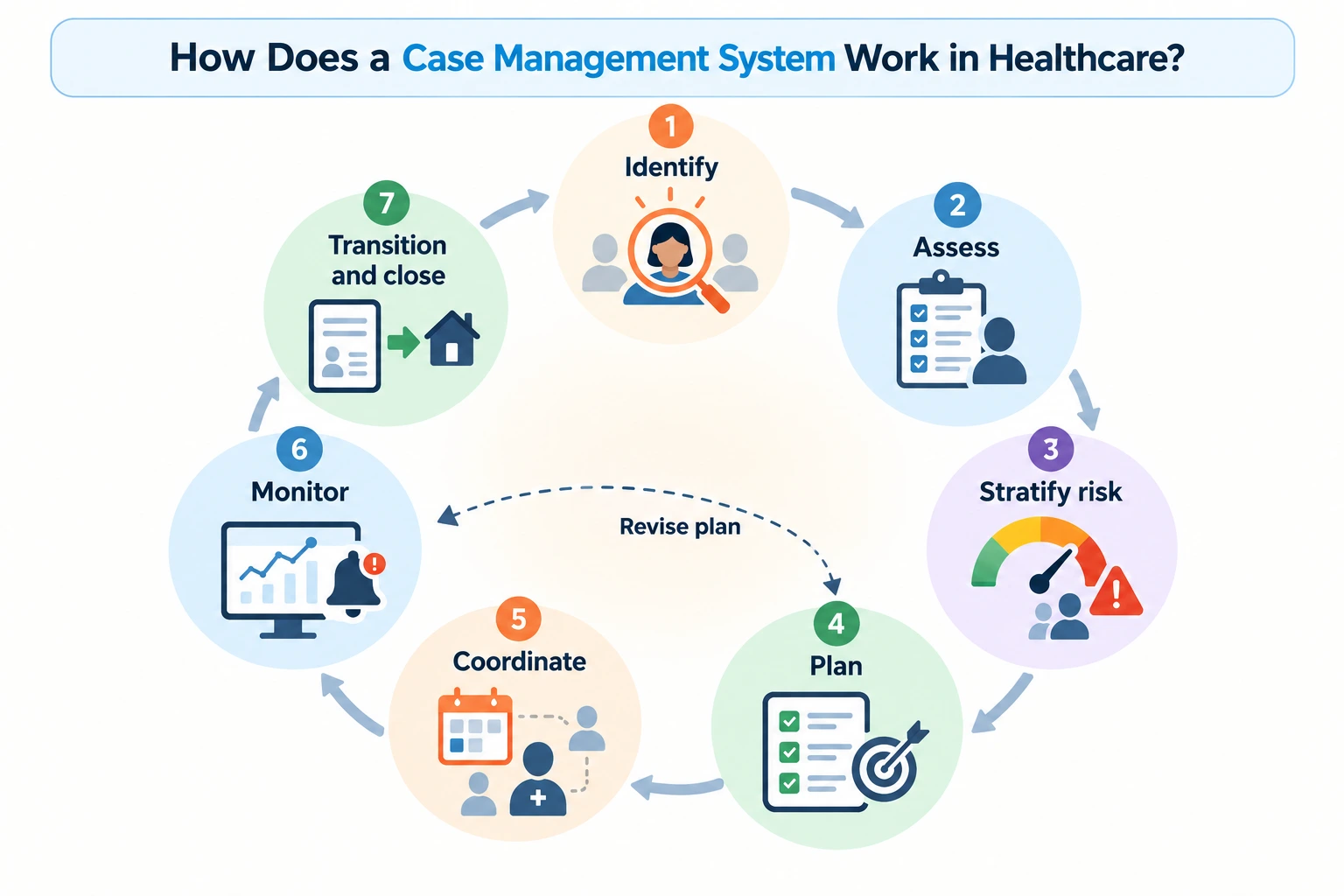
A case management system in healthcare works as a loop: it finds the patients who need help, plans their care, coordinates the work, and checks whether it worked. Most systems follow seven stages.
- Identify: Pull admissions, referrals, claims, or risk scores to find patients who need a case manager.
- Assess: Capture clinical, functional, social, caregiver, and benefit needs in structured forms.
- Stratify risk: Rank patients with rules or predictive models so the highest-risk cases get attention first.
- Plan: Build a care plan with goals, interventions, owners, and due dates.
- Coordinate: Send referrals, request prior authorizations, book appointments, and route tasks to the right person.
- Monitor: Alert the case manager to missed appointments, medication changes, abnormal results, or overdue tasks.
- Transition and close: Hand off to the next care setting, record outcomes, and close or reopen the case.
If your current tool only handles planning and coordination, your team is running the other five stages in spreadsheets, inboxes, and memory. That’s where most missed follow-ups start.
Case Management vs Care Management vs EHR: What’s the Difference?
Case management software coordinates one patient’s episode of need, an EHR records clinical care, and care management platforms track whole populations. The lines blur because many vendors sell more than one of these, but the core job of each is different.
| System | Main job | Main users | Time frame | Best for |
|---|---|---|---|---|
| Case management software | Coordinate one patient’s services, payers, and handoffs | Case managers, utilization review (UR) nurses, social workers | One episode, days to months | Discharges, complex cases, injury cases, program enrollment |
| Care management or population health platform | Find and manage at-risk groups of patients | Care teams, accountable care organization (ACO) staff | Ongoing | Value-based contracts, chronic disease programs |
| EHR | Document clinical care and orders | Physicians, nurses | Every encounter | The legal clinical record |
| Healthcare customer relationship management (CRM) software | Engage and follow up with patients | Access centers, navigators, marketing teams | The whole patient relationship | Referrals, outreach, retention |
The practical test is ownership: if a task belongs to a case manager and crosses systems or organizations, it belongs in case management software, even when the clinical record stays in the EHR. If outreach and engagement is your bigger need, read how a healthcare CRM differs in scope.
Types of Medical Case Management Software
Medical case management software comes in six common types, and each one is shaped by the care setting it serves. Buyers comparing health care case management software often look at products from different types without noticing, which is why demos can look alike while the fit is very different.
| Type | Typical users | Workflows it must support |
|---|---|---|
| Hospital and health system | UR nurses, discharge planners, social workers | Utilization review, discharge planning, avoidable-day tracking, readmission flags |
| Payer and health plan | Plan nurse case managers | Complex case management, prior authorization, member outreach, benefit checks |
| Ambulatory and chronic care | Primary care and specialty clinics | Care plans, remote monitoring, time tracking for care management billing |
| Post-acute, residential, and aged care | Facility and home care staff | Resident records, medications, incidents, shift handover, regulator reports |
| Behavioral, community, and social care | Community health and HIV programs, human services agencies | Intake, eligibility, referrals, social needs, funder reports |
| Workers’ comp and personal injury | Nurse case managers, insurers, legal teams | Injury case files, treatment plans, secure document exchange |
The type matters more than the brand name, because a hospital discharge tool and a residential care tool share very few daily workflows.
Here’s what the residential type looks like in practice. Logix Built built SRSPro, a CRM-style care management platform for a Supported Residential Services operator in Australia. The client’s facilities ran on paper files and spreadsheets, and shift handovers often missed updates. The web platform brings resident profiles, medication schedules with alerts, incident reporting, shift messaging, billing, and a compliance dashboard into one system for every facility in the network.
Must-Have Features to Look For in Case Management Software
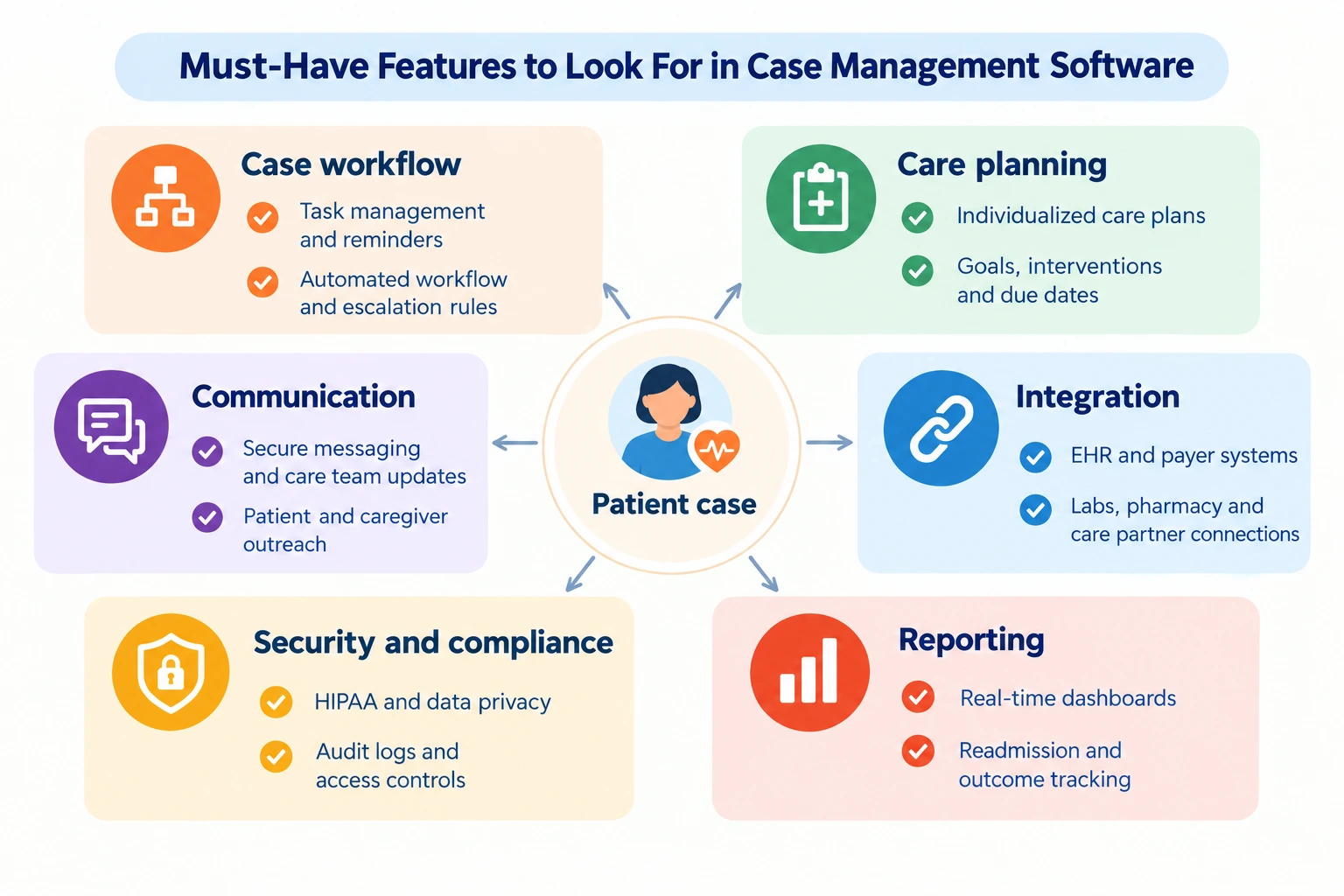
The must-have features fall into six groups: case workflow, care planning, communication, integration, security, and reporting. Use this table as a scoring sheet during vendor demos.
| Feature group | What to look for | Why it matters |
|---|---|---|
| Case workflow | Intake forms, assessments, case queues, task assignment, due dates, escalation rules | Keeps every case moving and visible to supervisors |
| Care planning | Goals, interventions, barriers, owners, version history | Shows what was planned, changed, and achieved |
| Communication | Secure messaging, shift handover notes, SMS and call logs, referral letters | Cuts missed handoffs between staff and partners |
| Integration | Health Level Seven (HL7) v2 feeds such as admission and discharge alerts, Fast Healthcare Interoperability Resources (FHIR) application programming interfaces (APIs), payer and lab connections, single sign-on | Removes double entry and gives real-time triggers |
| Security and compliance | Role-based access, multifactor authentication, encryption, audit trail, consent tracking | Protects patient data and passes audits |
| Reporting | Caseload, outcomes, readmissions, time on task, regulator and funder reports | Proves value and supports billing |
If a vendor is weak on integration or security, strength elsewhere won’t make up for it, because those two groups decide whether case managers trust the data. Integration is also where most custom effort goes, which is why we scope healthcare integration work as its own stage.
Which AI features are worth paying for?
AI earns its place in case management when it prepares work for a person, not when it makes the clinical call. Useful features today include:
- Risk scores that rank patients by likelihood of readmission or missed care, built on predictive analytics for patient risk.
- Summaries of long discharge notes, referral packets, and faxed records.
- Draft care plan updates and visit notes that a case manager reviews and signs.
- Task ranking that moves overdue or high-risk items to the top of the queue.
- Data extraction from scanned forms and faxes into structured fields.
Be careful with any AI that writes into the record or changes a care plan without human review. It adds clinical and legal risk that a simple review step removes at little cost.
Why Are Healthcare Organizations Investing in Case Management Software Now?
Organizations are investing now because readmission penalties, faster prior authorization rules, and billable care management all reward teams that can prove coordination with data.
– Readmissions are still expensive
AHRQ counted 3.8 million 30-day all-cause adult readmissions in 2018, a rate of 14 per 100 admissions, with an average cost of $15,200 per readmission. Medicare stays had the highest rate, at 16.9%. Under the Centers for Medicare & Medicaid Services (CMS) Hospital Readmissions Reduction Program, hospitals with excess readmissions lose up to 3% of base Medicare payments. Case management software helps by flagging high-risk discharges and tracking follow-up calls and visits after the patient goes home.
– Prior authorization deadlines tightened in 2026
The CMS Interoperability and Prior Authorization Final Rule (CMS-0057-F) sets new deadlines for impacted payers, such as Medicare Advantage plans and state Medicaid and Children’s Health Insurance Program (CHIP) programs. Since January 1, 2026, they must send prior authorization decisions within 72 hours for urgent requests and 7 calendar days for standard requests. By January 1, 2027, those payers must also offer FHIR-based APIs, including a Prior Authorization API. Case management systems that can send and read prior authorization data through these APIs will spend far less staff time on portals and phone calls.
– Care management time is billable, if you document it
Medicare pays for Chronic Care Management (CCM) for patients with two or more chronic conditions expected to last at least 12 months. Current Procedural Terminology (CPT) code 99490 requires at least 20 minutes of clinical staff time in a calendar month, according to the CMS Chronic Care Management Services booklet (June 2025). A tool that logs time per patient and keeps the care plan current turns that work into claims a billing team can defend.
All three pressures need the same thing: a dated, auditable record of who did what for which patient. Most teams still build that record by hand, so automating repetitive healthcare workflows is often the fastest early win.
Still Tracking Cases in Spreadsheets?
We can map your current case workflow and show which steps to automate first, with a stage-by-stage estimate.
HIPAA Compliance and Security Requirements by Market
Any case management system that handles patient data for a US healthcare provider or health plan must meet the Health Insurance Portability and Accountability Act (HIPAA) Privacy and Security Rules. The software vendor must also sign a business associate agreement (BAA). Other markets add their own health data laws.
In practice, HIPAA-ready software needs role-based access, unique logins, automatic logoff, audit logs, encryption in transit and at rest, backup and recovery, and a breach response process. The US Department of Health and Human Services (HHS) Office for Civil Rights proposed a major Security Rule update in January 2025 that would make encryption and multifactor authentication required, with few exceptions. As of October 2026 that rule still isn’t final, and the latest federal regulatory agenda moves final action to July 2027 at the earliest. Build to the proposed standard anyway: it’s what auditors already look for, and retrofitting later costs more. Our guide to HIPAA compliance for software development covers the controls in detail.
The cost of getting security wrong is high. IBM’s 2026 Cost of a Data Breach Report put the average healthcare breach at $6.64 million, the highest of any industry (Becker’s Hospital Review).
Logix Built applied these controls on InjuriaTrack, a HIPAA-compliant platform for a UK legal technology firm that manages personal injury cases full of medical records. The team used AWS key management for encryption, detailed audit logs, and a permission framework with more than 50 access controls to keep each law firm’s data separate.
| Market | Main health data rules | What the software needs |
|---|---|---|
| US | HIPAA Privacy and Security Rules, Health Information Technology for Economic and Clinical Health (HITECH) Act breach notification, 21st Century Cures Act information blocking rules, 42 CFR Part 2 for substance use records | BAAs, audit logs, patient data access, consent flags for Part 2 records |
| UK | UK General Data Protection Regulation (UK GDPR), Data Protection Act 2018, NHS Data Security and Protection Toolkit (DSPT) for NHS data | Data protection impact assessment, approved hosting, DSPT evidence |
| EU | GDPR, European Health Data Space regulation | Lawful basis records, data subject rights, EU hosting options |
| Australia | Privacy Act 1988 and the Australian Privacy Principles, My Health Records Act 2012 | Consent and access controls, breach notification process |
| UAE and Saudi Arabia | UAE Federal Law No. 2 of 2019 on health data, Saudi Personal Data Protection Law (PDPL) | In-country hosting for health data in many cases |
| India | Digital Personal Data Protection (DPDP) Act 2023 and its rules, Ayushman Bharat Digital Mission (ABDM) standards | Consent notices, user data rights, ABDM-ready records |
Plan your hosting region and consent design before development starts, because both are hard to change once patient data is live.
This article is for general information only and isn’t legal, financial, or medical advice. Confirm requirements with a qualified advisor for your market.
Should You Buy or Build Your Case Management Platform?
Buy an established platform when your workflow is standard, and build or extend when your programs, integrations, or regional rules force your team into workarounds.
| Your situation | Better choice | Why |
|---|---|---|
| One program with a standard utilization management or discharge workflow, on Epic or Oracle Health | Use the EHR’s case management module, or buy | Lowest risk, data already in place |
| Already on Salesforce, with an admin team | Configure Salesforce Health Cloud | Reuses your platform and skills |
| Fewer than about 15 users and a tight budget | Buy a software as a service (SaaS) product | Fastest start, no maintenance team needed |
| Several programs or settings (residential, injury, community plus clinical) | Build custom | Products force workarounds across mixed workflows |
| You plan to sell case management as a product | Build custom | You need to own the code and roadmap |
| Several systems the vendor can’t connect to | Build, or add a custom integration layer | Integration gaps cause most double entry |
The pattern is simple: the further your workflow sits from a product’s defaults, the more a custom build pays back.
A 3-year cost example
Picture a 50-person case management team in a regional health system. Capterra listed Salesforce Health Cloud Enterprise at $350 per user per month in March 2026. That’s $210,000 a year in licenses, or about $630,000 over three years, before implementation partners and add-ons. A mid-complexity custom build at $150,000, plus about $30,000 a year in maintenance, comes to roughly $210,000 to $240,000 over the same period before hosting.
Neither figure is a quote, and the custom route means you own security updates, hosting, and support. But the math shows why per-user licensing gets expensive as teams grow and why small teams usually do better buying.
How Much Does Healthcare Case Management Software Cost?
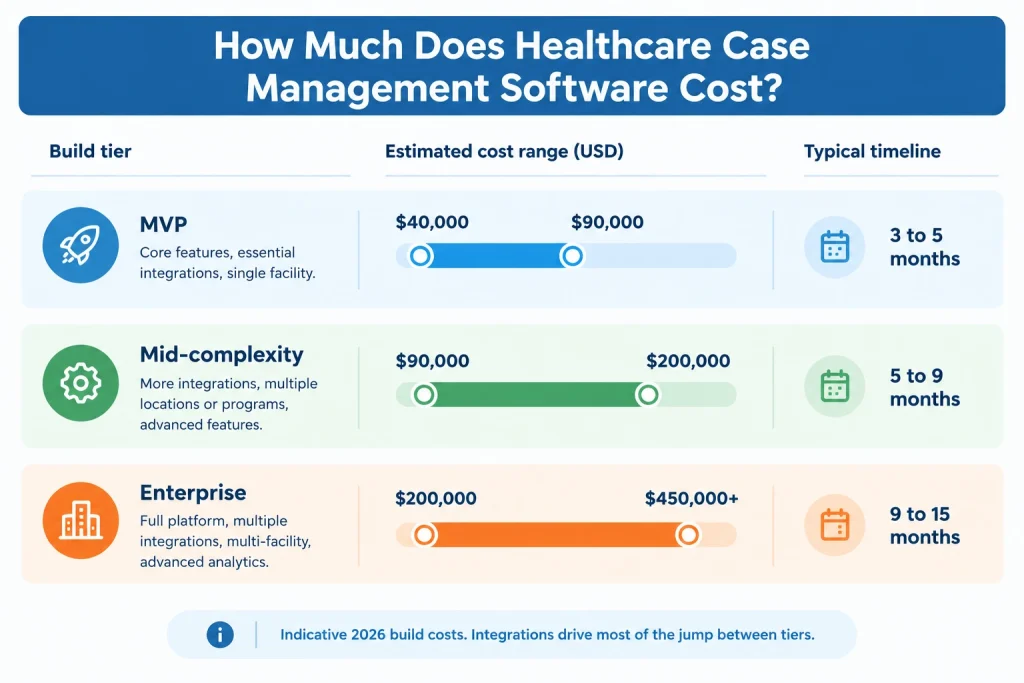
A custom healthcare case management software build usually costs $40,000 to $90,000 for a focused first version and $200,000 or more for a multi-facility platform.
| Tier | Typical scope | Cost (USD) | Timeline |
|---|---|---|---|
| Focused minimum viable product (MVP) | One program, intake and assessments, care plans, tasks and alerts, basic reports, one integration | $40,000 to $90,000 | 3 to 5 months |
| Mid-complexity platform | Several programs, two-way EHR integration through HL7 or FHIR, caregiver or patient app, role-based dashboards, care management time tracking | $90,000 to $200,000 | 5 to 9 months |
| Enterprise platform | Multi-facility or multi-tenant, payer and prior authorization connections, AI risk scoring and summaries, data migration, advanced analytics | $200,000 to $450,000+ | 9 to 15 months |
These are indicative estimates as of October 2026. Actual costs depend on scope, integrations, compliance needs, and team location.
Assumptions: a blended team of 4 to 8 people (business analyst, designer, developers, testers, part-time security and DevOps), mixed onshore and offshore rates, a web app first, HIPAA-eligible cloud hosting, and no features regulated as a medical device. The ranges reflect several published 2026 pricing guides and Logix Built’s own healthcare project ranges.
The jump between tiers comes mostly from integrations and data migration, not from the number of screens.
What pushes the cost up?
- Integrations: each EHR, payer, lab, or pharmacy connection adds design, testing, and vendor approval time. It’s usually the biggest single line item.
- Compliance scope: HIPAA engineering, plus SOC 2 or HITRUST preparation, adds controls, documents, and testing.
- Data migration: moving years of paper files or spreadsheets into structured records takes longer than most teams expect.
- Roles and permissions: every extra user type (nurse, social worker, supervisor, partner, family member) multiplies test cases.
- AI features: risk models and document summaries need clean data, review screens, and ongoing monitoring.
- Regions: hosting in more than one country, or meeting more than one privacy law, adds infrastructure and legal review.
What does it cost to run each year?
Budget 15% to 25% of the build cost each year for maintenance, security patches, and regulatory updates. On top of that, plan for HIPAA-eligible cloud hosting, any EHR or clearinghouse interface fees, an annual penetration test, and usage fees if you use AI services.
Want a Scoped Estimate for Your Case Workflow?
Share your programs, user count, and the systems you need to connect, and we’ll return a stage-by-stage cost and timeline.
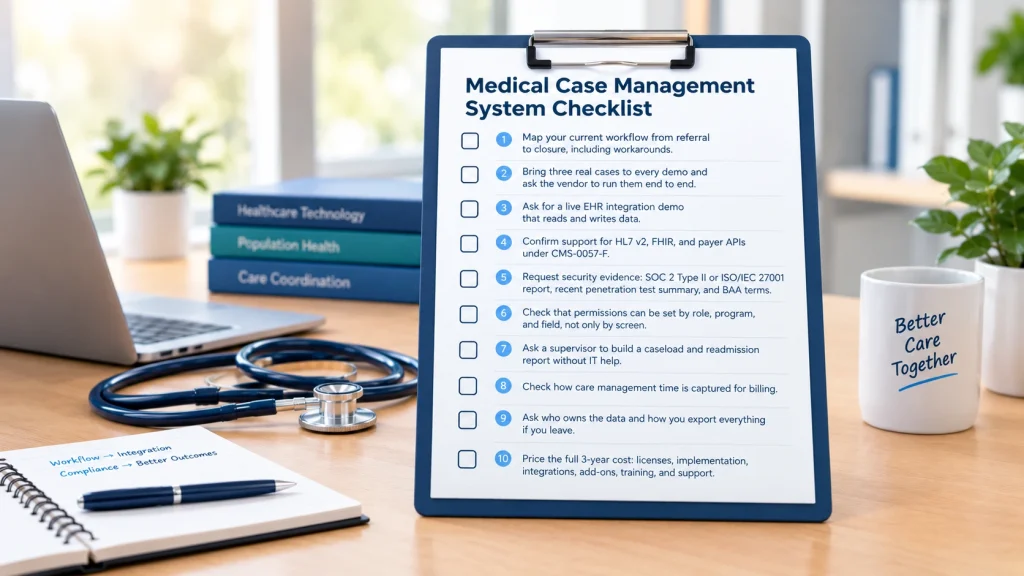
How to Choose a Medical Case Management System: 10-Point Checklist
Choose a medical case management system by testing it against your real cases, integrations, and compliance rules, not against the vendor’s demo script.
- Map your current workflow from referral to closure, including the workarounds staff use today.
- Bring three real, de-identified cases to every demo and ask the vendor to run them end to end.
- Ask for a live EHR integration demo that reads and writes data, not a slide of logos.
- Confirm support for HL7 v2, FHIR, and the payer APIs required under CMS-0057-F.
- Request security evidence: a SOC 2 Type II or ISO/IEC 27001 report, a recent penetration test summary, and BAA terms.
- Check that permissions can be set by role, program, and field, not only by screen.
- Ask a supervisor to build a caseload and readmission report without IT help.
- Check how care management time is captured for billing.
- Ask who owns the data and how you export everything if you leave.
- Price the full 3-year cost: licenses, implementation, integrations, add-ons, training, and support.
Mistakes we see buyers make
The most common mistake is buying for the feature list instead of the workflow. Close behind are treating integration as “phase two”, underestimating the effort to move paper and spreadsheet records, and designing screens without case managers in the room.
Teams that expand into a new country also tend to find hosting and consent rules late, when changes cost the most. Check those rules during vendor selection, not after launch.
How Logix Built Helps You Build Case Management Software That Fits Your Workflow
The best healthcare case management software is the one your case managers trust: it shows every open task, shares data with the systems around it, and stands up to an audit. Whether you buy, extend, or build, hold it to that bar.
Founded in 2018, Logix Built is a CMMI Level 5 and ISO 9001:2015 certified software development company based in Surat, India. Its team of 110+ professionals has delivered 2,000+ projects for clients in 60+ countries, with a focus on AI, healthcare, fintech, logistics, CRM, and ERP. The company is also ISO/IEC 27001 certified, which matters when patient data is involved.
For case management, we start with your workflow and integrations, then build in phases so case managers use the first version within months, not years. You can see that approach in SRSPro (residential care, Australia) and InjuriaTrack (HIPAA-compliant injury case management, UK).
To scope your system, explore our healthcare software development services or contact our team for a free estimate.
FAQs on Healthcare Case Management Software
Can case management software integrate with Epic or Oracle Health?
Yes, most modern case management software can connect to Epic and Oracle Health, but the depth varies a lot. Look for HL7 v2 feeds for admission and discharge alerts, and FHIR APIs for reading and writing patient data. Ask the vendor to show a live two-way connection, and expect EHR vendor review steps to add several weeks to a project.
How long does it take to implement healthcare case management software?
A small team can start on a SaaS product within weeks, but larger rollouts with EHR integration often take 6 to 12 months of configuration. A custom build usually takes 3 to 5 months for a focused first version and 9 to 15 months for an enterprise platform. Rolling out one program at a time lowers risk either way.
Does healthcare case management software have to be HIPAA compliant?
Yes, if it stores, processes, or sends protected health information for a US healthcare provider or health plan. The software vendor counts as a business associate and must sign a BAA. Compliance also depends on how you set up and use the system, so access rules, audit reviews, and staff training stay your responsibility.
Can AI replace case managers?
No. AI can rank patients by risk, summarize long records, draft care plan updates, and push overdue tasks to the top of the queue. Clinical judgment, patient trust, and decisions about care still belong to trained case managers. The best results come from AI that prepares the work and a person who approves it.
What does medical case management mean in workers' compensation?
In workers' compensation, medical case management means coordinating treatment for an injured employee so they recover and return to work safely. A nurse case manager assesses the injury, works with doctors on a treatment plan, and reports progress to the insurer or employer. Software for this setting needs injury case files, secure document sharing, and claim-linked reports.
Does Logix Built build case management software outside the US?
Yes. Logix Built built SRSPro, a care management platform for residential care facilities in Australia, and InjuriaTrack, a HIPAA-compliant injury case management platform for a UK firm. We design hosting, consent, and audit features around the privacy laws of each market, including HIPAA, UK GDPR, and Australia's Privacy Act 1988.

Written by the author
Pushpak Pandya
Pushpak Pandya is the Chairperson and Full-time Director at Logix Built Solutions Limited, with over 12 years of experience in enterprise software and digital transformation. She has led the delivery of custom healthcare software, telemedicine platforms, patient portals, doctor appointment systems, pharmacy management solutions, ERP, and CRM applications. Her expertise includes building secure, scalable, and compliant software that modernizes legacy systems, streamlines business processes, and improves operational efficiency. Pushpak regularly shares insights on healthcare technology, digital health innovation, healthcare software trends, and business process automation.