Published Date: November 17, 2026
Written By:Siddharth Pandya
Fast, on-time deliveries and real-time tracking have become standard customer expectations. If your company relies on spreadsheets, phone calls, and WhatsApp to organise deliveries, it can lead to missed updates, scheduling errors, and delays. Understanding the key features of delivery management software helps businesses choose a solution that addresses their operational challenges without paying for unnecessary features.
What Is Delivery Management?
Delivery management involves planning, scheduling, tracking, and completing deliveries, from the moment an order is received until it reaches the customer. A delivery management system helps businesses coordinate these activities through a central platform, connecting dispatchers, drivers, and customers with relevant delivery information. For a step-by-step look at how delivery management software works, read our detailed guide.
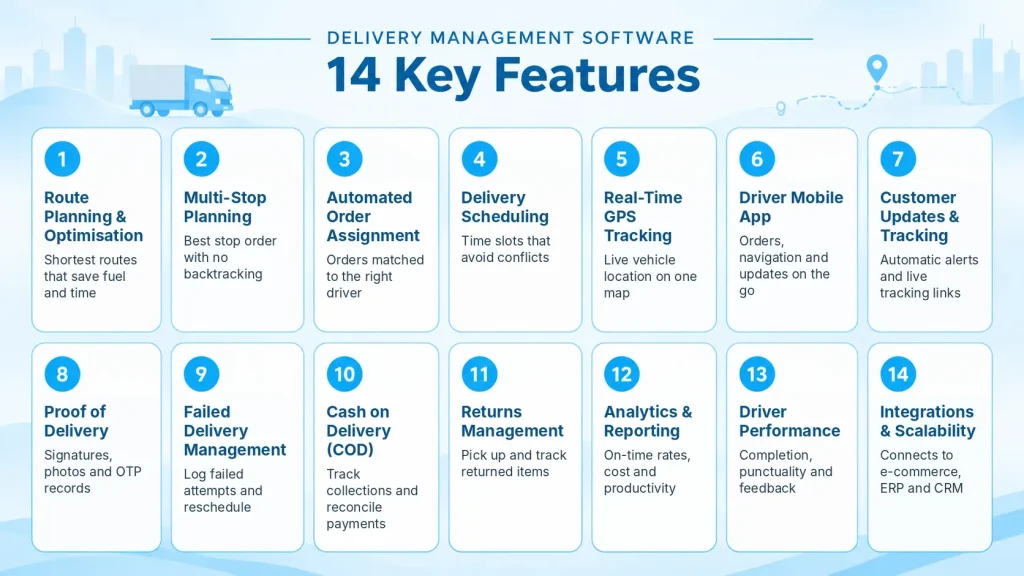
14 Key Features of Delivery Management Software
The right delivery management software features help businesses manage daily operations, reduce manual work, improve delivery accuracy, and keep customers informed throughout the delivery process.
1. Route Planning and Optimisation
Delivery route management software analyses the most efficient routes for drivers by considering distance, traffic conditions, delivery time windows, and vehicle capacity. Rather than planning the stops manually, dispatchers can generate optimised routes more efficiently. This reduces fuel expenses, minimises delays and increases the number of stops per day.
2. Multi-Stop Delivery Planning
When drivers have multiple orders to deliver, planning the right sequence of stops can save time and fuel. Multi-stop delivery planning helps dispatchers arrange several delivery locations in the most practical sequence. It considers delivery priorities, time windows, and vehicle capacity so drivers can complete multiple orders without unnecessary backtracking.
3. Automated Order Assignment
Manual order dispatching is time-consuming and prone to errors. Effective software automatically assigns orders to drivers based on their location, workload, vehicle type, delivery area, and availability. Dispatchers can also override automated assignments when manual adjustments are required.
4. Delivery Scheduling
Delivery scheduling allows businesses to assign specific delivery dates and time slots to customer orders. Dispatchers can plan deliveries based on driver availability, order priority, and customer preferences. It also helps businesses manage workloads, avoid scheduling conflicts, and ensure orders reach customers within the expected time.
5. Real-Time GPS Tracking
Real-time GPS tracking, the foundation of real-time order tracking, allows managers to monitor vehicle locations, check completed stops, and identify delayed deliveries. Dispatchers can respond to unexpected delays or route changes without repeatedly calling drivers.
6. Driver Mobile App
A dedicated delivery management app gives drivers access to assigned orders, turn-by-turn navigation, customer details, delivery status updates, and communication tools. The app should work smoothly on both Android and iOS devices and, where supported, offer offline functionality so drivers can access assigned orders and delivery details in areas with poor network connectivity.
7. Customer Updates and Live Tracking Link
Lack of delivery updates can frustrate customers and increase support enquiries. Automated SMS, email, or app notifications keep customers informed about dispatch, estimated arrival times, and delivery status. Live tracking links also allow customers to view their package location on a map.
Not Sure Which Features Your Team Needs?
Route planning, live tracking, driver apps, and customer updates do not suit every fleet in the same way. Tell us how you deliver today and we will help you pick the right ones.
8. Proof of Delivery
Digital proof of delivery (POD), including customer signatures, photographs, OTP verification, and timestamps, provides a delivery record that helps businesses resolve disputes and reduce fraudulent claims. These records also give businesses a reliable reference for checking delivery completion, updating order statuses, and maintaining accurate transaction records.
9. Failed Delivery Management
Not every delivery goes as planned. Customers may be unavailable, addresses may be incorrect, or drivers may face unexpected issues. Failed delivery management helps businesses record unsuccessful delivery attempts, identify the reasons, and schedule another attempt when required. This makes it easier to manage pending orders and reduce repeated delivery problems.
10. Cash on Delivery (COD) Management
For businesses that accept cash on delivery, keeping track of collected payments is an important part of delivery operations. COD management helps drivers record cash collections, update payment statuses, and share collection details with the dispatch team. It also makes payment reconciliation easier and helps businesses keep their delivery and payment records organised.
11. Returns Management
Managing product returns can become difficult when businesses handle multiple deliveries every day. Returns management helps coordinate product pickups, assign return requests to drivers, and track returned items until they reach the warehouse or seller. This gives businesses better supply chain visibility into reverse logistics and makes the return process easier to manage.
12. Analytics & Reporting
Analytics and reporting dashboards, supported by predictive analytics, help businesses evaluate delivery performance and identify operational bottlenecks. Businesses can monitor important metrics such as on-time delivery rates, average delivery times, failed delivery attempts, cost per delivery, and driver productivity.
13. Driver Performance Management
Driver performance management helps businesses evaluate individual driver efficiency and identify areas that need improvement. Managers can review delivery completion rates, punctuality, adherence to assigned routes, and customer feedback. These insights help businesses identify training needs, recognise consistent performance, and improve workforce management.
14. Integrations and Scalability
A modern delivery management platform connects with e-commerce stores, accounting tools, and payment gateways through custom API development and integration. It can also sync order data with ERP systems and CRM platforms. These integrations reduce duplicate data entry and keep order information consistent across systems. A scalable delivery management platform can also support business growth as the number of drivers, vehicles, warehouses, and delivery locations increases.
Delivery Management Software Features According to Business Type
Different industries have different delivery requirements. The following features are particularly important for each business type:
- Last-mile logistics: Last mile delivery management software, often used alongside a transportation management system, helps businesses manage the final stage of delivery through real-time tracking, route optimisation, delivery scheduling, and customer notifications.
- Courier services: Courier delivery management software makes it easier to manage bulk shipments, parcel tracking, driver assignments, multiple delivery stops, and shipment status updates.
- Restaurants and food establishments: Delivery management software for restaurants helps coordinate food preparation, manage delivery assignments, track orders, and keep customers updated about estimated arrival times.
- Small businesses: Delivery management software for small business owners should be affordable, easy to implement, and simple to operate, with features that support daily orders and a limited number of drivers.
Benefits of Delivery Management Software for Courier Fleets
Implementing the right delivery management software can improve fleet efficiency, reduce operational costs, and increase delivery reliability. Key benefits for courier fleets include lower fuel expenses through optimised routes, more deliveries per driver, fewer failed delivery attempts, and better visibility into daily fleet operations.
With features such as route optimisation, automated order assignment, real-time GPS tracking, and performance analytics, courier businesses can manage daily operations more efficiently. Digital delivery records also help managers monitor driver performance, track completed orders, and identify areas that need improvement.
Ready to Cut Fuel Costs and Failed Deliveries?
Better routes and clear fleet tracking can help your drivers complete more orders each day. Talk to us about what this could look like for your fleet.
How to Choose the Right Delivery Management Software
Start by identifying your main operational challenges, such as delayed deliveries, limited fleet visibility, or high fuel costs. Then, compare available solutions against the key features of delivery management software discussed above:
- Ask for a demo: Try the driver application and the dispatcher panel using your test orders.
- Evaluate usability: If drivers find it difficult to use the application, its adoption will not be successful regardless of the number of its features.
- Consider support and price: Clear pricing, responsive customer support, and regular software updates are important factors when evaluating a delivery management solution.
- Compare Available Solutions: Compare multiple solutions based on their features, pricing, integration capabilities, and scalability to find the right fit for your business. If your current software no longer meets your requirements, explore alternative delivery management platforms.
Free delivery management software may be suitable for testing or managing a small number of deliveries, but it often comes with limitations on order volumes, driver accounts, and reporting. Paid plans may offer additional capabilities that support business growth and operational efficiency.
Why Choose Logix Built for Delivery Management Software Development?
Logix Built provides custom software development for delivery management software tailored to business workflows and operational requirements. From route optimisation and automated order assignment to real-time GPS tracking, driver applications, and delivery analytics, we help businesses build solutions that improve delivery coordination and fleet visibility.
Looking to streamline your delivery operations? Logix Built develops custom delivery management software with route optimisation, real-time tracking, automated dispatch, and fleet management capabilities. Contact our team to discuss your software requirements.
Frequently Asked Questions
Is delivery management software suitable for small businesses?
Yes. Delivery management software for small businesses can simplify order assignment, route planning, and delivery tracking without requiring a large operations team.
Is free delivery management software available?
Yes. Some providers offer free delivery management software with limited orders, drivers, or reporting capabilities. Businesses should compare these limitations before choosing a plan.
Can delivery management software integrate with existing business systems?
Yes. Many delivery management platforms support API integrations with e-commerce platforms, ERP systems, CRMs, and accounting software. Check integration compatibility before implementation.
How long does it take to implement delivery management software?
Implementation time depends on the software's complexity, integrations, customisation requirements, and number of users. Basic solutions may take less time, while customised platforms require additional development and testing.

Siddharth Pandya is the Founder, CEO, and Managing Director of Logix Built Solutions Limited, an AI-powered development company specializing in custom software, web, mobile app, and AI-driven solutions for enterprises and startups. With 15+ years of experience in digital innovation and enterprise technology, he leads the company's vision of building intelligent, scalable software solutions across web, mobile, AI/ML, and data science applications. Under his leadership, Logix Built has helped businesses in healthcare, fintech, logistics, e-commerce, real estate, and other sectors improve operational efficiency, adopt AI-powered automation, and gain a competitive edge in their markets.