Published Date: November 15, 2026
Written By:Chirag Patel
Building a logistics app sounds straightforward until you start defining what it needs to do. A local delivery business may need driver dispatch, GPS tracking, and proof of delivery. A third-party logistics (3PL) provider, on the other hand, may require multi-client shipment management, carrier integrations, automated billing, and warehouse coordination. Both businesses need logistics software, but their development costs can vary significantly.
So, how much does logistics app development cost in 2026? According to ITD GrowthLabs’ 2026 pricing guide, a growth-tier logistics app in India, including a driver app, dispatch dashboard, and customer tracking, may cost approximately ₹18–35 lakh ($21K–$42K). This is a vendor-specific estimate, and actual costs vary depending on project requirements.
The final cost depends on operational complexity, integrations, transaction volumes, scalability, and deployment requirements, instead of just the number of screens. This guide sheds light on logistics app cost breakdown by application type, individual modules, development timelines, recurring expenses, and practical ways to control your budget without compromising essential operations.
How Much Does It Cost to Develop a Logistics App in 2026?
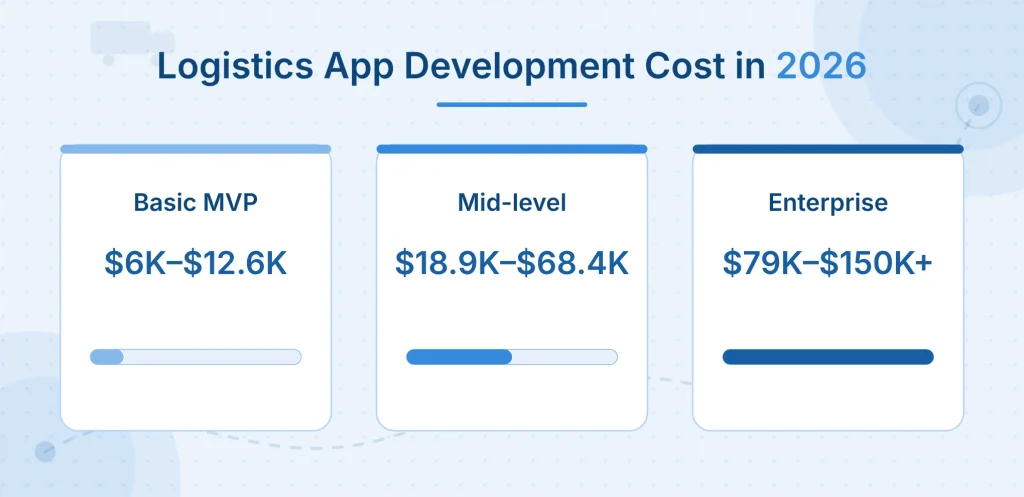
The logistics app development cost in 2026 can range from $6,000 for a basic MVP to $150K USD or more for an enterprise platform in India. The final price depends on the operational workflows, integrations, system complexity, and scale required. The following are indicative estimates for custom logistics software development, excluding ongoing operating expenses and hardware unless specified.
Logistics App Development Cost by Project Complexity
| Project Complexity | Estimated Cost | Timeline | Typical Scope |
| Basic logistics MVP | $6,000 – $12,600 | 6 – 10 weeks | Shipment records, dispatch, GPS tracking, admin dashboard |
| Mid-Level Logistics Platform | $18,900 – $68,400 | 3 – 5 months | Driver app, route planning, proof of delivery, reporting, integrations |
| Enterprise Logistics Ecosystem | $79,000 – $150,000 | 6 – 10+ months | Multi-location operations, ERP/TMS/WMS integrations, advanced routing, automation |
The difference is more than just the number of features. A basic app might display vehicle locations and record deliveries, while an enterprise platform may process thousands of location updates, coordinate warehouses, and synchronize billing across multiple systems. These requirements increase development, infrastructure, and testing effort.
Logistics App Development Cost by Country
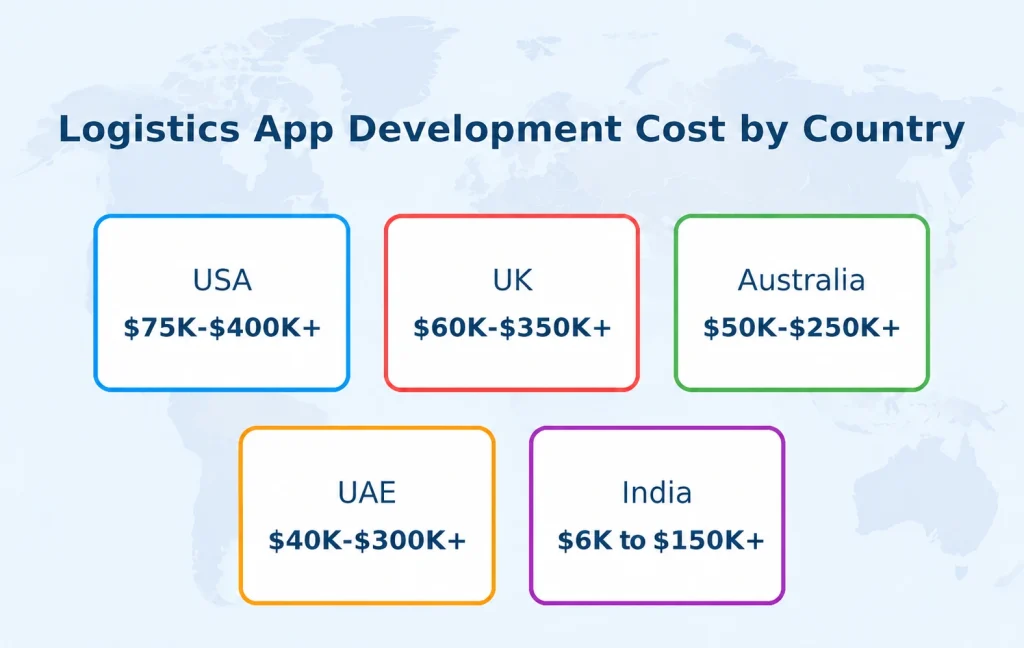
The logistics app development cost varies significantly across countries due to differences in developer rates, technical expertise, and operational expenses. The following estimates use USD as the base currency, with local currency equivalents calculated using exchange rates as of October 30, 2026.
| Country | Estimated Development Cost (USD) | Approx. Local Currency |
| USA | $75,000 – $400,000+ | – |
| UK | $60,000 – $350,000+ | £44,727 – £260,908+ |
| Australia | $50,000 – $250,000+ | A$71,160 – A$355,800+ |
| UAE | $40,000 – $300,000+ | AED 146,900 – AED 1,101,750+ |
| India | $6,000 – $150,000+ | ₹5.70 Lakh – ₹1.41 crore+ |
Exchange rates : 1 USD = ₹95.0709, £0.74545, A$1.4232, and AED 3.6725. Local currency amounts are rounded.
Logistics App Development Cost by Application Type
The cost of logistics app development also varies by software type.
| Application Type | Indicative Cost | Main Cost Drivers |
| Fleet Management App | $15,800 – $31,600 | GPS/telematics, fuel tracking, maintenance |
| Warehouse Management System (WMS) | $15,000 – $40,000 | Inventory tracking, barcode scanning, warehouse workflow |
| Transportation Management System (TMS) | $20,000 – $50,000 | Route planning, carrier management, freight rate calculation |
| Last-Mile Delivery App | $12,600 – $36,800 | Dispatch, route optimization, proof of delivery |
| Freight Booking App | $21,100 – $52,600 | Load matching, carrier onboarding, pricing, payments |
| Multi-module Logistics Platform | $36,800 – $150,000 | Shared data, integrations, scalability |
For example, fleet management app cost increases when basic GPS tracking expands to include telematics and predictive maintenance. Similarly, warehouse management system (WMS) development cost depends on whether the system handles simple stock records or complex picking, barcode scanning, and inventory synchronization.
The transportation management system (TMS) cost can rise with carrier integrations and freight reconciliation. Last-mile delivery app cost depends on dispatch automation, dynamic routing, and failed-delivery workflows. Freight booking platforms add complexity through load matching, payments, and document management.
A multi-module platform can cost more because its components must exchange data reliably, not simply because it contains more features. Estimate your logistics software development cost based on actual operational requirements rather than a single price for every logistics app.
Logistics App Cost Breakdown: Where Does the Budget Go?
The logistics app development cost is not limited to coding the application. A significant part of the budget goes into understanding operational workflows, designing interfaces, integrating existing systems, testing real-world scenarios, and preparing the software for production.
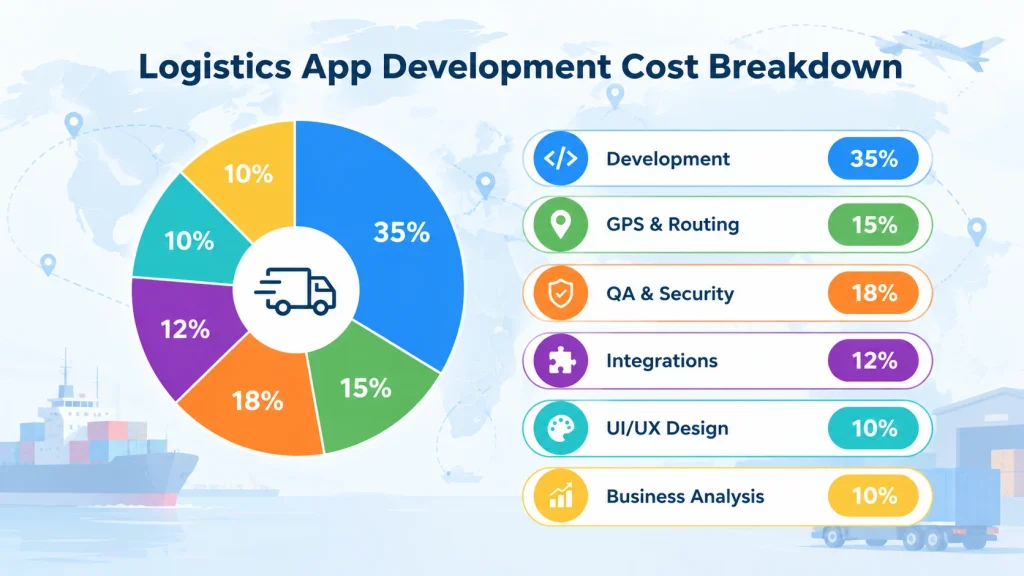
For a custom logistics platform development in India, the following table illustrates how a hypothetical $50,000 development budget might be allocated. These percentages are planning assumptions, not fixed industry averages.
| Development Activity | Estimated Allocation | Budget Examples |
| Business analysis and architecture | 10% | $5,000 |
| Frontend and backend development | 35% | $17,500 |
| GPS tracking and route optimization | 15% | $7,500 |
| UI/UX Design | 10% | $5,000 |
| Third-party integrations | 12% | $6,000 |
| QA, security, deployment, and training | 18% | $9,000 |
| Total | 100% | $50,000 |
The actual logistics app cost breakdown depends on the application type. A tracking-focused MVP may spend less on optimization and integrations, while an enterprise platform may require significantly more investment in architecture, data synchronization, and testing.
Business Analysis and Solution Architecture
Before development begins, the team must understand how shipments move through the business. This involves stakeholder interviews, workflow mapping, requirements documentation, data modeling, integration assessment, and architecture planning.
For example, dispatch rules may depend on vehicle capacity, driver availability, delivery deadlines, and service zones. If these rules emerge halfway through development, the team may need to redesign APIs, database structures, and assignment logic. Investing in discovery reduces this risk and makes the initial logistics software development cost estimate more reliable.
UI/UX Design and User Workflows
Logistics applications serve different users, including drivers, dispatchers, warehouse operators, customers, and administrators. Each group needs interfaces suited to its tasks.
Drivers may need large, accessible controls and offline data capture, while dispatchers need shipment queues, live maps, and exception alerts. Designing these workflows carefully reduces manual entry, user errors, and training requirements.
Frontend and Backend Development
This phase typically accounts for a substantial share of the budget. Frontend development covers driver applications, customer portals, dispatcher dashboards, and administrative interfaces. Backend development handles APIs, authentication, databases, shipment status transitions, permissions, and business rules.
A single tracking interface is considerably narrower in scope than a platform coordinating several user roles through a shared backend. This distinction directly affects custom logistics software development estimates.
GPS Tracking, Mapping, and Route Optimization
GPS tracking captures vehicle locations, while mapping displays them and ETA services estimate arrival times. Route optimization goes further by calculating efficient routes based on vehicle capacity, delivery windows, traffic, and driver constraints.
Background location permissions, tracking frequency, geospatial queries, and route recalculation all affect implementation and infrastructure costs. Advanced optimization can therefore increase logistics mobile app development cost beyond what basic map integration requires.
Third-Party Integrations
Connecting the application to ERP, accounting, WMS/TMS, carrier APIs, telematics, payment gateways, mapping services, and notification providers adds both development and testing work.
The estimate should include authentication, data mapping, webhook handling, retries, error recovery, and reconciliation. A successful API connection is only the beginning; the integration must also handle failures without losing shipment or billing data.
QA, Security, Deployment, and Training
Testing covers functional workflows, API integrations, multiple devices, network interruptions, and performance under peak loads. Security work includes access controls, audit logs, and protection of sensitive operational data. Deployment also requires monitoring, backup procedures, user acceptance testing, and staff training.
These activities help turn a working prototype into production-ready software. When estimating the cost of logistics app development, businesses should budget for them upfront rather than treating them as optional work after launch.
The Biggest Logistics App Cost Factors
The logistics app development cost depends on user roles, data processing, integrations, scalability, and automation requirements. Understanding these factors helps businesses prioritize the right features of a logistics app without overspending.
Number of User Roles and Operational Workflows
An app serving drivers, dispatchers, warehouse operators, shippers, carriers, and administrators needs different interfaces, permissions, and workflows. Each role adds development and testing requirements. When deciding what features should a logistics app have, prioritize essential workflows rather than building unnecessary dashboards.
Real-Time Tracking and Data Processing
Tracking costs depend on GPS update frequency, active vehicles, data retention, and alert processing. Frequent updates improve visibility but increase network traffic, database writes, infrastructure consumption, and battery usage. Tracking hundreds of vehicles every few minutes is less demanding than processing frequent updates across thousands of vehicles alongside live dashboards and geofencing alerts.
Route Optimization Complexity
Basic route planning follows predefined routes or sequences of stops. Advanced optimization considers vehicle capacity, driver hours, delivery windows, traffic, and dynamic reassignment. These requirements increase logistics mobile app development cost and may justify using specialist routing engines or third-party services instead of building optimization logic from scratch.
Legacy Systems and Integration Complexity
Connecting to ERP, accounting, warehouse, and carrier systems can be more difficult than developing new features. Legacy systems may lack modern APIs or use inconsistent data formats. Data mapping, migration, synchronization, and error recovery increase the cost of logistics app development, particularly when existing systems are poorly documented.
Scale, Reliability, and Security Requirements
Shipment volumes, peak traffic, uptime targets, multi-tenant access, and disaster recovery influence architecture and testing. Enterprise platforms may also require detailed audit logs and stricter access controls, increasing upfront engineering effort.
AI, Automation, and Advanced Analytics
Rules-based automation, such as assigning shipments using predefined conditions, is generally simpler than predictive ETAs, demand forecasting, or AI-assisted dispatch. Advanced capabilities require reliable historical data, model evaluation, and ongoing monitoring.
Businesses exploring AI-powered features of a logistics app should start with a measurable use case, such as predicting delivery delays, before investing in complex models. This approach helps connect development spending to operational improvements.
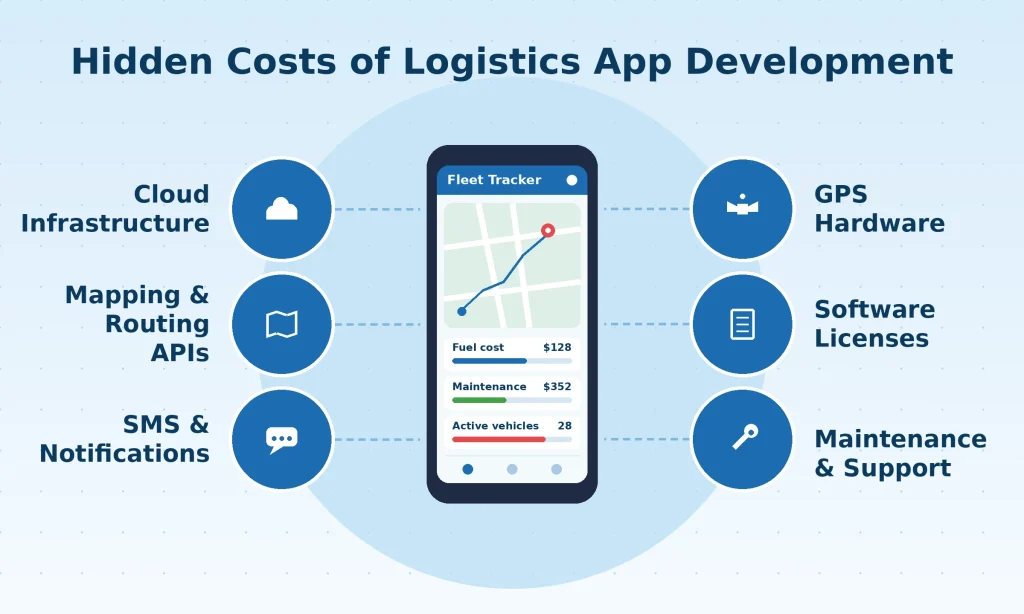
What are the Hidden Costs of Logistics App Development?
The initial logistics app development cost covers building and launching the software, but ongoing expenses can significantly increase the total investment. Businesses should account for the total cost of ownership (TCO), including infrastructure, maintenance, third-party services, and operational rollout.
Hidden Costs to Include in Your Budget
- Cloud Infrastructure and Databases: Hosting, storage, backups, and monitoring create recurring expenses that increase with shipment volumes and data-processing requirements.
- Mapping and Routing APIs: Map loads, geocoding, traffic data, and route calculations may incur usage-based charges, particularly when managing large fleets.
- Communication Services: SMS, WhatsApp messages, OTPs, and delivery notifications can involve per-message fees or subscription charges.
- GPS and Telematics Hardware: Tracking devices, installation, connectivity plans, and replacements add costs when dedicated hardware is required.
- Third-Party Software and Licenses: Routing engines, analytics platforms, and ERP connectors may require monthly subscriptions, annual renewals, or usage-based payments.
- Maintenance and Security: Bug fixes, security patches, operating system compatibility updates, and technical support require ongoing investment.
- Migration, Training, and Rollout: Transferring existing data, training employees, and deploying software across multiple locations can add one-time implementation expenses.
- Post-launch Enhancements: New features, carrier API changes, and evolving compliance requirements may require additional development.
The cost of logistics app development can rise as usage grows. For example, tracking thousands of vehicles at frequent intervals creates greater data-processing demands than occasional tracking across a small fleet.
How to Calculate Your First-Year Budget
Use this formula to estimate the total first-year investment:
First-year cost = Initial development + integration and rollout expenses + infrastructure and licenses + maintenance and support + planned enhancements.
Estimate each expense using projected shipment volumes, active vehicles, users, warehouse locations, and GPS tracking frequency. Include peak usage rather than relying only on average activity.
Avoid applying one fixed operating-cost percentage to every project. A tracking-heavy platform may spend more on mapping and infrastructure, while a system connected to multiple legacy applications may require greater integration and maintenance investment.
Accounting for these expenses upfront provides a more realistic estimate of logistics software development cost and reduces the risk of unexpected budget overruns after launch.
Want to Know Your Real First-Year Cost?
Hosting, maps, messages, and upkeep add up fast after launch. Share your fleet size and workflows, and we will help you plan the full budget.
How Long Does It Take to Build a Logistics App?
The logistics app development timeline ranges from 6-10 weeks for a basic MVP to 6-10 months or longer for an enterprise platform, depending on integrations, features, and operational complexity.
What Happens During Each Development Phase
The process includes discovery and architecture, UI/UX design, development, integrations, QA and user acceptance testing (UAT), and deployment. Design and development can overlap, but integration testing depends on API access, test data, and connected systems being ready.
What Can Delay a Logistics App Project?
Changing requirements, unclear dispatch rules, data migration, unavailable APIs, hardware procurement, and offline synchronization can extend timelines. Performance testing and multi-location rollouts also require additional time.
Adding developers does not always accelerate delivery when integration dependencies and sequential testing remain unchanged.
To estimate how long it takes to build a logistics app, finalize the initial scope, confirm integration access, and define acceptance criteria before development begins.
How to Reduce Logistics App Development Cost Without Compromising Operations
Reducing logistics app development cost requires prioritizing essential workflows, reusing existing systems, and choosing technology based on actual operational needs.
Start With One High-Value Operational Workflow
Build one complete workflow, such as order creation→dispatch→driver assignment→delivery confirmation→billing handoff. A connected process creates more value than multiple disconnected features.
Buy Commodity Capabilities and Build Differentiating Logic
Use third-party services for mapping, messaging, routing, and payments. Reserve custom development for business-specific dispatch rules and carrier allocation. Compare usage fees, service limits, and vendor lock-in against long-term development costs.
Reuse Existing Systems and Data
Integrate existing ERP, CRM, accounting, or warehouse systems instead of rebuilding their functionality. Keeping a single source of truth also reduces duplicate data and maintenance effort.
Choose an Architecture That Matches Actual Demand
Consider cross-platform mobile development, modular architecture, and managed infrastructure. Avoid microservices or custom AI models unless operational requirements justify their complexity.
Set Measurable MVP Acceptance Criteria
Track dispatch time, failed-delivery rates, ETA accuracy, and billing reconciliation time. Use these metrics to evaluate whether further investment is worthwhile.
Experienced providers of logistics software development services can help prioritize these decisions. When estimating how much does it cost to build a logistics app, measure the budget against operational improvements, not feature count alone.
Build vs Buy: Which Option Makes Financial Sense?
The right choice depends on operational complexity, shipment volume, customization needs, and long-term ownership costs. Compare three approaches before committing to a development budget.
| Factor | Off-the-shelf Software | Customized SaaS | Fully Custom Software |
| Initial Cost | Low | Moderate | High |
| Ongoing Costs | Subscription and usage fees | Subscription and customization fees | Maintenance and infrastructure |
| Customization | Limited | Moderate | Extensive |
| Integrations | Available connectors | APIs and custom integrations | Built around business systems |
| Ownership | Vendor-controlled | Vendor-dependent | Greater control over the product |
| Deployment | Fast | Moderate | Usually longer |
| Scaling Costs | May rise with usage | Depends on pricing tiers | Depends on architecture and usage |
For example, a standard freight platform may be sufficient for basic shipment management, while a specialized operation may require a tailored solution. The freight booking app cost depends on requirements such as carrier integrations, rate comparison, booking workflows, and shipment tracking.
Custom logistics software development is not automatically cheaper. Its financial value depends on workflow fit, expected usage, competitive differentiation, and ongoing maintenance.
To decide how can I reduce logistics app development cost, compare the three-year total cost of ownership, including subscriptions, transaction fees, integrations, upgrades, and internal support. Choose custom development when its operational benefits justify the additional investment.
How to Estimate Your Logistics App Budget Before Hiring a Development Company
A realistic budget starts with clear operational requirements, not just a feature list. Before approaching a logistics app development company, define the following:
- Business Model: Identify your logistics model and the primary operational problem to solve.
- Users and Platforms: Specify user roles, mobile platforms, and web dashboards.
- Core Workflows: Separate must-have features from future enhancements.
- Expected Scale: Estimate shipment volumes, vehicles, users, and operating locations.
- Integrations: List required ERP, CRM, payment, mapping, and other integrations, including data migration.
- Operational Complexity: Define tracking accuracy, offline functionality, and routing requirements.
- Technical Requirements: Specify security, uptime, reporting, and compliance needs.
- Delivery and Ownership: Set deployment deadlines, support expectations, and ownership requirements.
Reduce Operational Complexity with Custom Logistics Software with Logix Built
Managing shipments, coordinating fleets, tracking deliveries, and handling warehouse operations across disconnected systems can increase costs and slow down decision-making. Logix Built develops custom logistics software tailored to your business workflows, helping you streamline dispatch, improve shipment visibility, automate repetitive tasks, and connect essential operational systems through a unified platform.
Whether you need a fleet management application, a last-mile delivery solution, or a comprehensive logistics management platform, our team helps you identify the right features, integrations, and technical architecture for your requirements. By hiring logistics app developers from Logix Built, businesses can address their current operational challenges while building a scalable solution that supports future growth.
Logix Built developed Liftor, a delivery and transportation platform for a Surat-based client, connecting customers with nearby drivers through automated driver matching, live GPS tracking, and instant ride notifications. Developed over approximately one year, the platform operates across iOS, Android, and web, supporting efficient transportation and delivery coordination.
For a Malaysia-based logistics company, Logix Built developed Brang Chain, a parcel delivery platform that replaced manual phone coordination with digital order management. Built over approximately 1.5 years, the platform features automated driver assignment, real-time parcel tracking, and dedicated workflows for merchants, drivers, and administrators, simplifying daily logistics operations.
Planning a logistics app project? Partner with Logix Built to evaluate your requirements, prioritize development investments, and define a practical roadmap for your logistics software.
Frequently Asked Questions
How does the number of third-party integrations affect the budget?
Each integration requires development, authentication, data mapping, error handling, and testing. Connecting multiple ERP, payment, mapping, or carrier systems can increase both initial development costs and ongoing maintenance expenses.
Is it cheaper to develop a logistics app for Android than for Android and iOS?
Launching on one platform can reduce initial development and testing costs. However, cross-platform development may offer a more economical way to support both operating systems, depending on device-specific requirements and application complexity.
How do per-shipment fees affect the total cost of a logistics app?
Some services charge according to shipment volume, API requests, tracking frequency, or notifications. These usage-based expenses can grow as operations expand, so estimate costs using projected monthly volumes rather than launch-day usage alone.
What causes two logistics app development cost quotes to differ significantly?
Proposals may cover different feature scopes, integration depths, testing standards, infrastructure, and post-launch support. Compare deliverables, team composition, assumptions, and recurring charges to determine whether the lower quote represents genuine savings or excludes essential work.
How much does it cost to build a logistics app in India?
The cost of building a logistics app in India can range from approximately $6,000 for a basic MVP to $150,000 or more for an enterprise platform. The final cost depends on features, integrations, supported platforms, and operational complexity.
What are the essential features of a logistics app?
Essential logistics app features include real-time GPS tracking, driver management, order dispatch, route optimization, proof of delivery, shipment notifications, reporting, and administrative dashboards. The required features depend on the business model and operational requirements.

Chirag Patel is the Chief Technology Officer at Logix Built Solutions Limited with 11+ years of experience in engineering scalable digital platforms. He specializes in CRM development, eCommerce solutions, and customer experience technologies designed to improve engagement, retention, and conversion. Chirag leads end-to-end product engineering with a strong focus on performance, automation, and architecture design, enabling businesses to deliver seamless digital experiences and achieve sustainable growth in competitive markets.