
Published Date: November 16, 2026
Written By:Chirag Patel
Customers now demand that their bank knows who they are, reacts immediately, and delivers appropriate offerings without even asking for it. It would be impossible to fulfil such requirements using spreadsheets and disparate systems. This is why CRM in banking has evolved from an optional tool into an essential part of modern banking operations and customer relationship management.
In this guide, we are going to talk about how CRM helps banks, its main benefits, applications, and implementation.
What Is CRM in Banking?
If you ever wondered about what is the CRM meaning in banking: CRM means Customer Relationship Management. It is all about putting all customer information in one place, so all departments have the same view of the whole picture of the client.
As opposed to general tools, the bank CRM system is based on finance-related processes, such as opening an account, lending money, KYC (Know Your Customer), compliance, and relationship management. Modern CRM systems in the banking industry are no longer limited to storing customer contact information.
Why Banks Need a CRM?
Customer information is present in huge amounts in the bank’s databases for branches, mobile applications, call centres, and loan management. Without proper integration, customer information remains scattered across different systems, making it difficult for banks to maintain a unified customer view. Integrating CRM into banking operations helps consolidate customer information and provides banks with several advantages:
- Understanding customer requirements and life events
- Faster response time and consistency
- Compliance with regulatory standards with appropriate audit trails
- Keeping pace with fintechs that provide a seamless digital experience
CRM Key Benefits for the Banking Industry
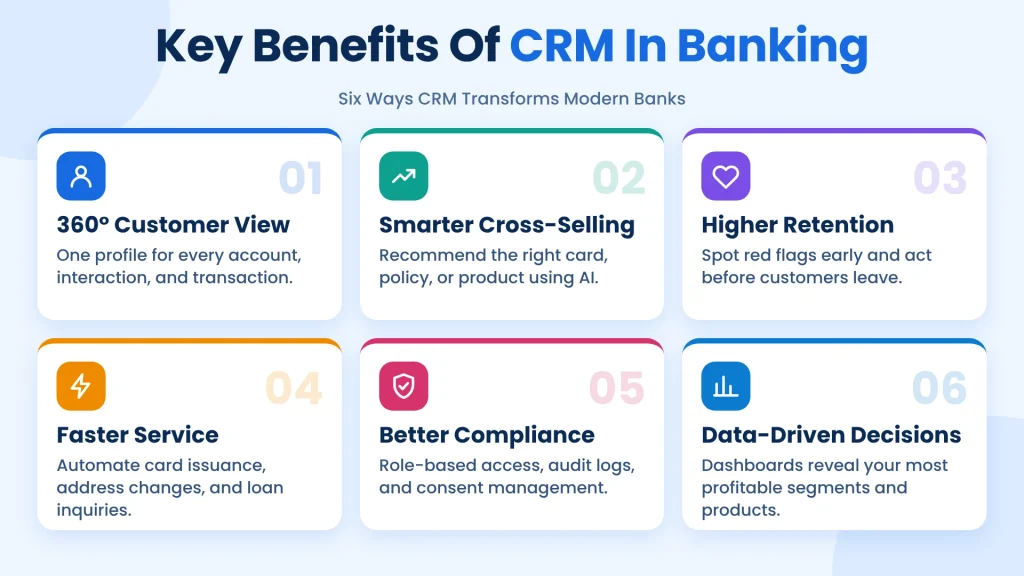
- Customer View in 360 degrees
A unified customer profile brings together account details, interaction history, and relevant transaction information from connected banking systems. Relationship managers need not ask their clients to repeat themselves. - Improved cross-selling and up-selling
By analysing customer spending patterns, preferences, and existing products, banks can use AI-powered insights to recommend relevant credit cards, insurance policies, and other financial products. - Higher customer retention
Red flags, like reduced activity and complaints, surfaced through predictive analytics, allow for early action before a customer leaves. The cost of retaining a customer is considerably lower compared to acquiring a new one. - Speedier and more efficient service
The automation of processes will shorten the processing time of requests such as changes of addresses, card issuance, and loan inquiries. - Enhanced compliance and security
Role-based access control, activity logs, and consent management help banks maintain stronger security controls and support regulatory compliance. This has been one of the primary reasons for the growth of CRM in the banking sector. - Decision-Making based on data
Using dashboards and reports to find the most profitable segments, branches, and products.
Traditional Banking vs. Banking CRM
Traditional banking processes often rely on disconnected systems and manual tasks. A CRM system helps banks centralise customer information, automate workflows, and improve communication.
| Traditional Banking Approach | Banking CRM Approach |
|---|---|
| Customer data stored across multiple systems | Unified customer information |
| Manual customer follow-ups | Automated follow-ups and reminders |
| Generic marketing campaigns | Personalised customer campaigns |
| Limited interaction tracking | Centralised customer interaction history |
| Manual report preparation | CRM dashboards and automated analytics |
| Disconnected customer service channels | Integrated omnichannel communication |
| Manual service request tracking | Automated request tracking and escalation |
A well-integrated CRM system helps banks move from fragmented customer management to a more connected and customer-focused approach.
Top Use Cases of CRM for the Banking Industry
A correctly implemented CRM for the banking industry must cater to the entire organization’s teams.
- Retail Banking: Handle onboarding processes, monitor the customer journey, and deliver personalised offers and service requests via branches, website and mobile app.
- Commercial Banking: Commercial banking CRM is useful for managing complicated corporate accounts, monitoring credit facilities, managing many stakeholders and deal pipeline tracking.
- Loan and mortgage management: Monitor loans from lead generation through disbursement of the loan, automate document collection, and provide customers with live status updates.
- Wealth management: Keep information on clients’ objectives, risk tolerance, and portfolio to offer customised recommendations and follow-ups.
- Customer support: Document all inquiries, establish SLAs, and automatically escalate to ensure nothing is missed.
- Marketing campaigns: Classify customers based on their behaviour, conduct targeted marketing campaigns, and track the conversion rate. This is how CRM banking software makes its mark in increasing revenues.
- Monitoring for fraud and risk: Integrate CRM with fraud detection and risk monitoring systems to display alerts, track suspicious customer activity, and route cases to the appropriate teams.
Real-World Examples of CRM in Banking
Banks use CRM platforms to improve customer service, manage leads, and create connected banking experiences. Here are three examples:
1. Kotak Mahindra Bank – Unified Customer Experience
Kotak Mahindra Bank partnered with Salesforce to connect customer service and engagement processes across its banking operations. The platform consolidated 12 systems into one omnichannel customer service platform, helping teams manage customer requests across different channels.
2. Canara Bank – CANARA RISHTEY CRM
Canara Bank introduced CANARA RISHTEY to improve customer service and business growth. Its FY 2024–25 annual report states that the bank launched 12 CRM modules to track customer data, analyse behaviour, manage complaints, and support personalised services.
3. AU Small Finance Bank – Digital Loan Onboarding
AU Small Finance Bank partnered with Salesforce to digitise vehicle loan onboarding. The solution integrated existing systems, reduced manual data entry, and introduced digital document verification and real-time dashboards.
These examples show how CRM in the banking industry can support customer relationship management, digital onboarding, complaint handling, and operational efficiency.
Features to Consider in Banking CRM
Whatever system you decide to use, the following features should be present:
- Single customer view with integration of customer data into core banking applications. Banks weighing which system to prioritise first may find our CRM vs ERP comparison useful.
- Workflow automation and approvals
- Omni-channel communication (email, SMS, WhatsApp, calling), including chatbots for banking that answer routine queries and pass context to your CRM
- Reporting and analytics
- Security and encryption
- Scalability and mobile compatibility
It is important for banks to determine whether the vendors have a clear understanding of the regulations for CRM in banking and financial services.
How to Implement a CRM in Banks: Step-by-Step
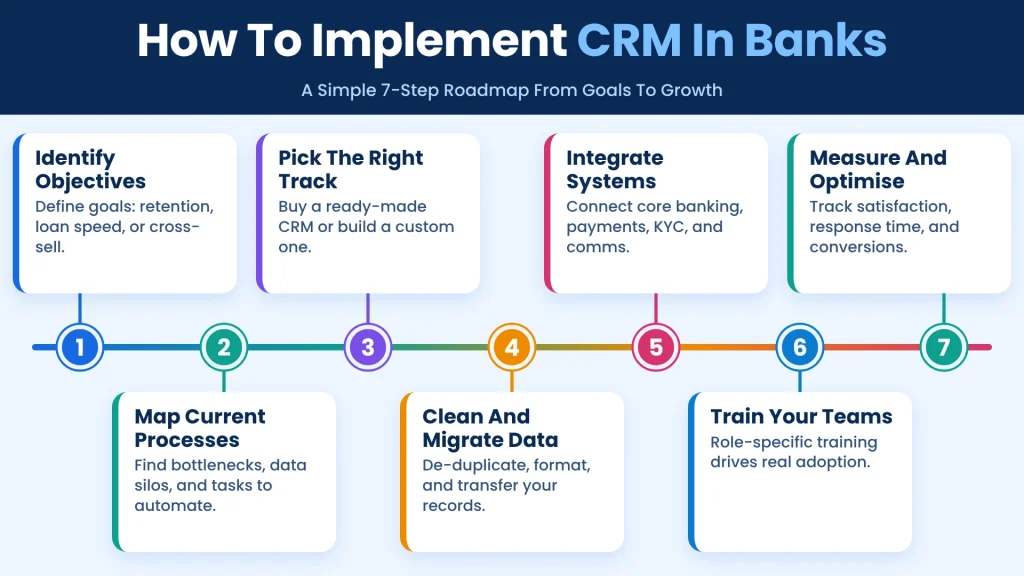
Step 1: Identify objectives. Determine what needs to be improved, whether it is retention, processing time of loans, or cross-sell income.
Step 2: Map current processes. Find the bottlenecks, data silos, and tasks that must be automated.
Step 3: Pick the right track. Banks may either buy CRM solutions for banks that work specifically or develop their own custom solutions. Banks can choose between implementing an existing CRM platform and developing a custom solution. Custom CRM development offers greater flexibility to match specific banking workflows, compliance requirements, and integration needs. The right approach depends on the bank’s size, technical requirements, and long-term goals.
Step 4: Data cleaning and migration. De-duplicate the data, format it correctly, and transfer it.
Step 5: System integration. Connect the CRM with banking systems, payment systems, KYC systems, and communications systems through custom API development and integration.
Step 6: Train your teams. The key to success is adoption. Offer role-specific training and support.
Step 7: Measure and optimise. Measure KPIs such as customer satisfaction, response time, and conversion rates, then optimise continuously.
Key Considerations Before Implementing Banking CRM Software
Successful CRM implementation requires more than selecting the right software. Banks should consider the following factors:
1. Core Banking System Integration
Connect the CRM with core banking systems, loan management platforms, payment gateways, and KYC systems. This allows authorised teams to access relevant customer information without switching between multiple applications.
2. Data Privacy and Regulatory Requirements
Banking CRM systems must follow applicable data protection, cybersecurity, and regulatory requirements. Implement encryption, access controls, audit logs, and secure data handling practices to protect customer information.
3. CRM Data Migration
Before migrating to a new system, clean existing customer records, remove duplicate entries, and validate data accuracy. Proper migration planning helps prevent information loss and operational disruptions.
4. Employee Training and Adoption
Train relationship managers, customer support teams, and other employees according to their roles. A simple interface and clear workflows can encourage employees to use the CRM effectively.
5. CRM Implementation Cost Factors
The cost of banking CRM development depends on system complexity, customisation, third-party integrations, security requirements, data migration, and ongoing maintenance. Banks should evaluate both initial development costs and long-term operating expenses before selecting a solution.
Best Practices in CRM Implementation for Banks
Adopting the CRM best practices for banks ensures that you don’t repeat any common mistakes:
- Have a solid strategy in place before picking technology
- Maintain data integrity through audits
- Get input from front-line employees early in the process
- Focus on security and consent management
- Implement incrementally rather than in one big project
- Use customer data and analytics to personalise interactions and support data-driven decisions
Clear objectives, proper implementation, and user adoption are essential for successful banking CRM projects.
Build Smarter Banking Relationships with Logix Built
Banks that understand their clients keep them loyal. Logix Built makes it possible through customised CRM in banking systems, delivered by our fintech software development team and built for your processes, requirements, and objectives.
Whether it’s onboarding, loan management, relationship management, or campaigns tailored specifically for your customers, we provide platforms which can securely and scalably help you see a 360-degree view of your customers. We connect with your core banking applications, so you can work faster and your customers know their worth.
Are you ready to turn your customer information into stronger connections? Work with Logix Built now and revolutionise your banking CRM.
FAQs
How does CRM help banks keep customers?
CRM helps banks retain customers through personalised communication, timely follow-ups, and faster complaint resolution. It also helps banks understand customer needs and recommend relevant financial products.
Is CRM a good fit for small banks and credit unions?
Yes, cloud-based CRM solutions are suitable for small banks and credit unions. They offer flexible pricing, lower infrastructure costs, easy maintenance, and the ability to scale features as the institution grows.
How much time does it take to implement CRM in a bank?
Banking CRM implementation can take around 3–12 months, depending on customisation, data migration, system integrations, security testing, and employee training. This is an indicative timeline, not a fixed standard.
Is the information about customers secure in a banking CRM?
Yes, banking CRM systems can protect customer data through encryption, role-based access, multi-factor authentication, and audit logs. Regular security audits and proper access management are also important.
Is the information about customers secure in a banking CRM?
Yes, a banking CRM can help protect customer information through encryption, role-based access controls, multi-factor authentication, and audit logs. However, security also depends on proper configuration, access management, and compliance with applicable regulations.
How much time does it take to implement CRM in a bank?
CRM implementation can take several months, depending on the bank's size, data migration requirements, system integrations, customisation, and testing. A simple deployment may take less time than a complex enterprise-wide implementation.

Chirag Patel is the Chief Technology Officer at Logix Built Solutions Limited with 11+ years of experience in engineering scalable digital platforms. He specializes in CRM development, eCommerce solutions, and customer experience technologies designed to improve engagement, retention, and conversion. Chirag leads end-to-end product engineering with a strong focus on performance, automation, and architecture design, enabling businesses to deliver seamless digital experiences and achieve sustainable growth in competitive markets.